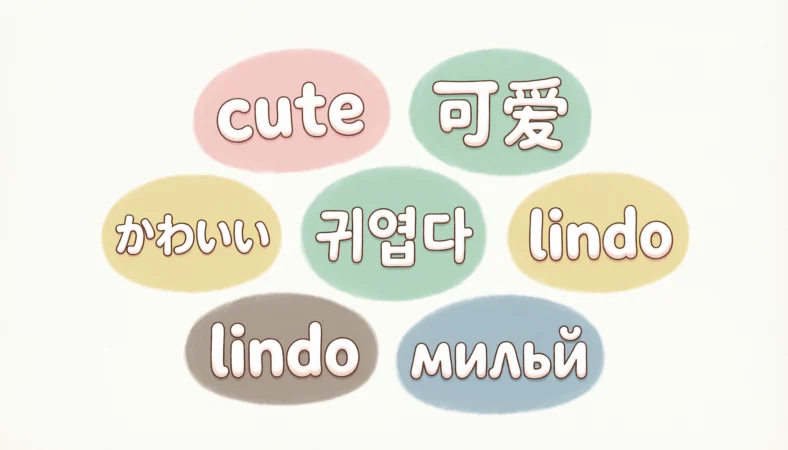
Want to know how to say cute in different languages? if you’re writing a caption, learning a new language, complimenting someone, or simply curious about how people around the world express affection, this guide gives you 70 useful translations of “cute.”
The word “cute” does not always have a perfect one-word equivalent. Depending on the language and context, it can describe a person, baby, animal, object, appearance, or something charming and adorable. The examples below use natural everyday expressions where possible.
If you’re searching for cute in all languages, how to say cute in different languages, or simply want to explore cute translations around the world, this list provides the phrase, an easy pronunciation guide, and a practical example sentence.
How to Say Cute in Different Languages
Here are 70 ways to express “cute” in different languages. Pronunciations are simplified for English speakers and are intended as practical guides rather than exact phonetic transcriptions.
| # | Language | Native phrase | Easy English pronunciation | Example sentence | English meaning |
|---|---|---|---|---|---|
| 1 | English | cute | kyoot | That puppy is so cute. | That puppy is very adorable. |
| 2 | Spanish | lindo / linda | LEEN-doh / LEEN-dah | Qué linda bebé. | What a cute baby. |
| 3 | French | mignon / mignonne | meen-YON / meen-YON | Ce chat est mignon. | This cat is cute. |
| 4 | German | süß | zooss | Das Kätzchen ist süß. | The kitten is cute. |
| 5 | Italian | carino / carina | kah-REE-no / kah-REE-na | Che carino questo cane! | How cute this dog is! |
| 6 | Portuguese | fofo / fofa | FOH-foh / FOH-fah | Que bebê fofo! | What a cute baby! |
| 7 | Dutch | schattig | SKHAH-tikh | Wat een schattig hondje! | What a cute little dog! |
| 8 | Swedish | söt | suhrt | Vilken söt katt! | What a cute cat! |
| 9 | Norwegian | søt | suht | For en søt valp! | What a cute puppy! |
| 10 | Danish | sød | suuth | Hvor er den sød! | How cute it is! |
| 11 | Finnish | söpö | SUR-pur | Mikä söpö koira! | What a cute dog! |
| 12 | Icelandic | sætur / sæt | SAI-tur / sait | Þetta er svo sætt. | This is so cute. |
| 13 | Irish | gleoite | GLEE-tuh | Tá sé gleoite. | It is cute. |
| 14 | Welsh | ciwt | kyoot | Mae’r gath yn giwt. | The cat is cute. |
| 15 | Scottish Gaelic | grinn | grin | Tha e grinn. | It is cute. |
| 16 | Polish | słodki / słodka | SWOHT-kee / SWOHT-kah | Jaki słodki pies! | What a cute dog! |
| 17 | Czech | roztomilý / roztomilá | ROH-toh-mee-lee | To je roztomilé. | That is cute. |
| 18 | Slovak | roztomilý / roztomilá | ROHT-toh-mee-lee | To je roztomilé. | That is cute. |
| 19 | Slovenian | srčkan / srčkana | SURCH-kan / SURCH-kah-nah | Kako srčkan kuža! | What a cute puppy! |
| 20 | Croatian | sladak / slatka | SLAH-dahk / SLAHT-kah | Kako slatka mačka! | What a cute cat! |
| 21 | Serbian | сладак / слатка | SLAH-dahk / SLAHT-kah | Како слатка мачка! | What a cute cat! |
| 22 | Bulgarian | сладък / сладка | SLAH-duhk / SLAH-dkah | Какво сладко куче! | What a cute dog! |
| 23 | Macedonian | сладок / слатка | SLAH-dok / SLAHT-kah | Какво слатко маче! | What a cute kitten! |
| 24 | Russian | милый / милая | MEE-lee / MEE-lah-yah | Какой милый котёнок! | What a cute kitten! |
| 25 | Ukrainian | милий / мила | MEE-lee / MEE-lah | Який милий песик! | What a cute doggy! |
| 26 | Belarusian | мілы / мілая | MEE-ly / MEE-lah-yah | Які мілы кот! | What a cute cat! |
| 27 | Lithuanian | mielas / miela | MYEH-las / MYEH-lah | Koks mielas šuniukas! | What a cute puppy! |
| 28 | Latvian | mīļš / mīļa | meelsh / MEE-lyah | Cik mīļš kaķis! | What a cute cat! |
| 29 | Estonian | armas | AHR-mas | Kui armas kutsikas! | What a cute puppy! |
| 30 | Hungarian | aranyos | AH-rah-nyosh | Milyen aranyos kutya! | What a cute dog! |
| 31 | Romanian | drăguț / drăguță | druh-GOOTS / druh-GOOTS-uh | Ce cățeluș drăguț! | What a cute puppy! |
| 32 | Albanian | i bukur / e bukur | ee BOO-koor / eh BOO-koor | Sa qen i bukur! | What a cute dog! |
| 33 | Greek | χαριτωμένος / χαριτωμένη | ha-ree-toh-MEH-nos / ha-ree-toh-MEH-nee | Τι χαριτωμένο γατάκι! | What a cute kitten! |
| 34 | Turkish | sevimli | seh-VEEM-lee | Ne kadar sevimli bir kedi! | What a cute cat! |
| 35 | Azerbaijani | şirin | shee-REEN | Nə şirin pişikdir! | What a cute cat! |
| 36 | Armenian | սիրուն | see-ROON | Ինչ սիրուն կատու է։ | What a cute cat! |
| 37 | Georgian | საყვარელი | sah-kvah-REH-lee | რა საყვარელი ლეკვია! | What a cute puppy! |
| 38 | Arabic | لطيف / لطيفة | la-TEEF / la-TEE-fah | يا له من قط لطيف! | What a cute cat! |
| 39 | Hebrew | חמוד / חמודה | kha-MOOD / kha-moo-DAH | איזה חתול חמוד! | What a cute cat! |
| 40 | Persian | بامزه | ba-MEH-zeh | چه گربه بامزهای! | What a cute cat! |
| 41 | Hindi | प्यारा / प्यारी | PYAAR-ah / PYAAR-ee | कितना प्यारा बच्चा है! | What a cute baby! |
| 42 | Urdu | پیارا / پیاری | PYAAR-ah / PYAAR-ee | کتنا پیارا بچہ ہے! | What a cute baby! |
| 43 | Bengali | মিষ্টি | MEESH-tee | কী মিষ্টি বাচ্চা! | What a cute baby! |
| 44 | Punjabi | ਪਿਆਰਾ / ਪਿਆਰੀ | PYAAR-ah / PYAAR-ee | ਕਿੰਨਾ ਪਿਆਰਾ ਬੱਚਾ ਹੈ! | What a cute baby! |
| 45 | Gujarati | ક્યૂટ | kyoot | આ કૂતરો કેટલો ક્યૂટ છે! | This dog is so cute! |
| 46 | Marathi | गोंडस | GON-dus | किती गोंडस मांजर आहे! | What a cute cat! |
| 47 | Nepali | प्यारो / प्यारी | PYAAR-oh / PYAAR-ee | कस्तो प्यारो कुकुर! | What a cute dog! |
| 48 | Sinhala | හුරතල් | hoo-rah-tal | මේ පූසා හරි හුරතල්. | This cat is very cute. |
| 49 | Tamil | அழகான | ah-la-GAA-nah | இந்த பூனை அழகாக இருக்கிறது. | This cat looks cute. |
| 50 | Telugu | ముద్దుగా | mood-doo-gah | ఈ పిల్లి చాలా ముద్దుగా ఉంది. | This cat is very cute. |
| 51 | Kannada | ಮುದ್ದಾಗಿದೆ | mood-dah-GEE-deh | ಈ ಬೆಕ್ಕು ಮುದ್ದಾಗಿದೆ. | This cat is cute. |
| 52 | Malayalam | സുന്ദരം | soon-dah-RAM | ഈ പൂച്ച സുന്ദരമാണ്. | This cat is cute. |
| 53 | Thai | น่ารัก | nah-RAHK | แมวตัวนี้น่ารักมาก | This cat is very cute. |
| 54 | Vietnamese | dễ thương | zay thuong | Em bé thật dễ thương. | The baby is very cute. |
| 55 | Indonesian | lucu | LOO-choo | Anak kucing itu lucu. | That kitten is cute. |
| 56 | Malay | comel | CHOH-mel | Anak kucing itu comel. | That kitten is cute. |
| 57 | Filipino | cute / kaibig-ibig | kyoot / kah-ee-big-EE-big | Ang cute ng batang ito! | This child is so cute! |
| 58 | Javanese | lucu | LOO-choo | Kucing iki lucu. | This cat is cute. |
| 59 | Chinese (Mandarin) | 可爱 | kě ài | 这只猫很可爱。 | This cat is very cute. |
| 60 | Cantonese | 可愛 | ho2 oi3 | 呢隻貓好可愛。 | This cat is very cute. |
| 61 | Japanese | かわいい | ka-wa-EE | この猫はかわいい。 | This cat is cute. |
| 62 | Korean | 귀여워 | gwi-yeo-wo | 이 강아지 정말 귀여워요. | This puppy is really cute. |
| 63 | Mongolian | хөөрхөн | KHOOR-khun | Энэ гөлөг хөөрхөн. | This puppy is cute. |
| 64 | Kazakh | сүйкімді | soo-yik-MDEE | Бұл күшік сүйкімді. | This puppy is cute. |
| 65 | Uzbek | yoqimli | yokh-LEE-mee | Bu mushuk juda yoqimli. | This cat is very cute. |
| 66 | Swahili | mrembo | mrem-boh | Mtoto huyu ni mrembo. | This child is cute. |
| 67 | Zulu | muhle | MOO-hleh | Le ngane yinhle. | This child is cute. |
| 68 | Afrikaans | oulik | OH-lik | Die hondjie is oulik. | The puppy is cute. |
| 69 | Malagasy | mahafatifaty | ma-ha-fa-tee-FAH-tee | Tena mahafatifaty ilay saka. | That cat is very cute. |
| 70 | Esperanto | ĉarma | CHAR-ma | La katido estas ĉarma. | The kitten is charming and cute. |
Cute Translations Are Not Always Literal
A useful thing to remember when exploring cute translations is that languages divide the idea of “cute” differently.
For example, some languages commonly use words that are closer to “adorable,” “lovely,” “sweet,” “charming,” or “pretty.” The most natural translation can also change according to the person or thing being described.
A word used for a cute baby may not be the expression a native speaker would normally use for an attractive adult. Likewise, a cute animal may be described with a different adjective from a cute outfit or object.
That is why the example sentences in this guide are important. They show how the expression can work in everyday context rather than presenting a dictionary equivalent alone.
Cute in Different Languages for Social Media
If you’re looking for a short expression for a caption, several translations are particularly recognizable and easy to use:
- Spanish: lindo / linda
- French: mignon / mignonne
- Italian: carino / carina
- German: süß
- Japanese: かわいい
- Korean: 귀여워
- Mandarin Chinese: 可爱
- Thai: น่ารัก
- Turkish: sevimli
- Indonesian: lucu
When using a translation as a caption, consider the subject and grammatical form. Some languages change the adjective according to gender, while others use a form that stays unchanged.
How to Say Cute Around the World
In some languages, the closest everyday expression emphasizes sweetness or affection. In others, it focuses more on charm, attractiveness, or something being lovable.
Similarly, Korean 귀여워 is a common informal expression used when reacting to something adorable. In Mandarin, 可爱 can describe people, animals, and things that are charming or adorable.
This makes learning cute in all languages more interesting than simply memorizing 70 vocabulary equivalents. The surrounding culture and context influence how the word is actually used.
Tips for Using Cute Translations Correctly
Before using one of these expressions with a native speaker, keep these practical points in mind:
- Check gender: Languages such as Spanish, French, Italian, Portuguese, Russian, and Arabic may require different forms depending on the noun.
- Consider formality: Some languages have informal forms that are best suited to friends, family, or casual conversation.
- Think about context: A word meaning “cute” may sound natural for a baby or animal but unusual when describing an adult.
- Use the example as a guide: The surrounding sentence often tells you more about natural usage than a single dictionary word.
- Remember pronunciation: English-style pronunciation guides are approximations. Native pronunciation can include sounds that English does not have.
Why Learn How to Say Cute in Different Languages?
Learning a simple word such as “cute” can be an easy way to begin exploring another language. It is useful for everyday conversations, travel, social media captions, compliments, language-learning exercises, and conversations about pets or children.
It can also help you understand how different languages express emotions and affection. A direct translation may capture the basic meaning, while the natural expression reveals how speakers actually communicate.
Frequently Asked Questions
1. What is the word for cute in different languages?
There are many equivalents. Examples include lindo in Spanish, mignon in French, süß in German, carino in Italian, かわいい in Japanese, 귀여워 in Korean, and 可爱 in Mandarin Chinese.
2. How do you say cute in all languages?
There is no single universal word for “cute.” Different languages use words meaning cute, adorable, sweet, charming, lovely, or lovable. The 70-language table above provides commonly used expressions and examples.
3. What is the cutest word for cute in another language?
“Cute” is subjective, so there is no objectively cutest translation. Words such as Japanese かわいい, Korean 귀여워, and French mignon are commonly associated with expressing affection or adorableness, but the best choice depends on context and personal preference.
4. How do you say “cute” in Japanese?
The common Japanese word is かわいい (kawaii). It can describe people, animals, clothes, food, characters, objects, and many other things considered adorable or charming.
5. How do you say “cute” in Spanish?
Common Spanish options include lindo and linda, with the form depending on grammatical gender. Bonito and bonita can also mean pretty or nice depending on the context.
Conclusion
Learning cute in different languages is a simple way to discover how people around the world express affection, charm, and admiration. From Japanese かわいい and Korean 귀여워 to Spanish lindo and French mignon, each expression has its own cultural and grammatical context.
Use the 70 translations above as a starting point, pay attention to the example sentences, and remember that natural usage is often more important than a literal word-for-word translation.

I am Johnny Thomas, a passionate language enthusiast and writer. I enjoy exploring different languages, cultures, words, and expressions. I create helpful, easy-to-understand content to help readers discover languages and communicate confidently.