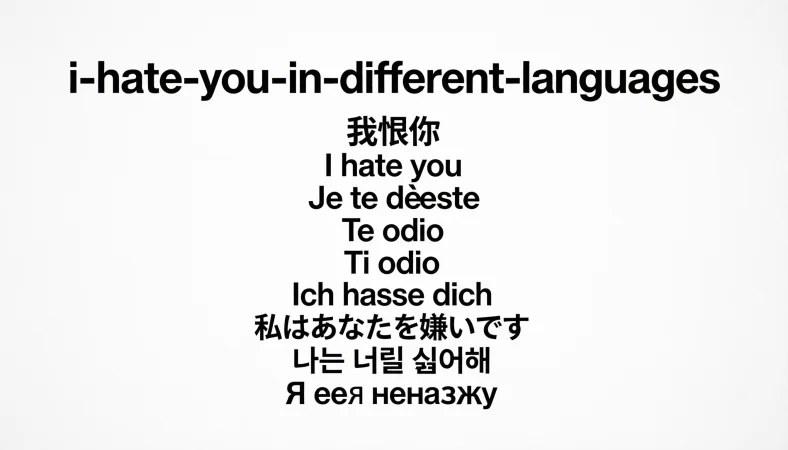
Looking for “I hate you in different languages”? if you are learning a language, writing dialogue, exploring international expressions, or simply curious about how strong emotions are expressed around the world, this guide gives you 70 translations in one easy-to-read list.
Below, you will find “I hate you” in all languages with the native phrase, an easy English pronunciation, a short example sentence, and the English meaning of that example.
Because expressions can vary by gender, formality, dialect, and context, the examples use common conversational forms where possible.
I Hate You in Different Languages
The table below covers 70 different languages and provides practical “I hate you” translations. Pronunciations are simplified for English speakers rather than being formal phonetic transcriptions.
| # | Language | Native phrase | Easy English pronunciation | Real-life example | English meaning |
|---|---|---|---|---|---|
| 1 | Spanish | Te odio. | tay OH-dee-oh | Te odio por mentirme. | I hate you for lying to me. |
| 2 | French | Je te déteste. | zhuh tuh day-TEST | Je te déteste quand tu mens. | I hate you when you lie. |
| 3 | German | Ich hasse dich. | ikh HAH-suh dikh | Ich hasse dich dafür. | I hate you for that. |
| 4 | Italian | Ti odio. | tee OH-dee-oh | Ti odio per questo. | I hate you for this. |
| 5 | Portuguese | Eu te odeio. | eh-oo tee oh-DAY-oh | Eu te odeio por isso. | I hate you for that. |
| 6 | Dutch | Ik haat je. | ik HAH-t yuh | Ik haat je daarvoor. | I hate you for that. |
| 7 | Swedish | Jag hatar dig. | yah HAH-tar day | Jag hatar dig för det. | I hate you for that. |
| 8 | Norwegian | Jeg hater deg. | yay HAH-ter die | Jeg hater deg for det. | I hate you for that. |
| 9 | Danish | Jeg hader dig. | yai HAY-ther die | Jeg hader dig for det. | I hate you for that. |
| 10 | Finnish | Minä vihaan sinua. | MEE-nah VEE-hahn SEE-noo-ah | Minä vihaan sinua nyt. | I hate you now. |
| 11 | Icelandic | Ég hata þig. | yeh HAH-ta thig | Ég hata þig fyrir þetta. | I hate you for this. |
| 12 | Irish | Is fuath liom thú. | iss foo-ah lim hoo | Is fuath liom thú anois. | I hate you now. |
| 13 | Welsh | Rwy’n dy gasáu di. | roin duh gah-SAI dee | Rwy’n dy gasáu di am hyn. | I hate you for this. |
| 14 | Polish | Nienawidzę cię. | nyeh-nah-VEE-dzeh chyeh | Nienawidzę cię za to. | I hate you for that. |
| 15 | Czech | Nenávidím tě. | neh-NAH-vee-deem tyeh | Nenávidím tě za to. | I hate you for that. |
| 16 | Slovak | Nenávidím ťa. | neh-NAH-vee-deem tya | Nenávidím ťa za to. | I hate you for that. |
| 17 | Slovenian | Sovražim te. | soh-VRAH-zhim teh | Sovražim te zaradi tega. | I hate you for that. |
| 18 | Croatian | Mrzim te. | MER-zim teh | Mrzim te zbog toga. | I hate you for that. |
| 19 | Serbian | Мрзим те. | MER-zim teh | Мрзим те због тога. | I hate you for that. |
| 20 | Bosnian | Mrzim te. | MER-zim teh | Mrzim te zbog toga. | I hate you for that. |
| 21 | Macedonian | Те мразам. | teh MRA-zam | Те мразам поради тоа. | I hate you for that. |
| 22 | Bulgarian | Мразя те. | MRAH-zya teh | Мразя те за това. | I hate you for that. |
| 23 | Russian | Я тебя ненавижу. | ya tee-BYAH nee-na-VEE-zhoo | Я тебя ненавижу за это. | I hate you for that. |
| 24 | Ukrainian | Я тебе ненавиджу. | ya teh-BEH neh-na-VY-dzhoo | Я тебе ненавиджу за це. | I hate you for this. |
| 25 | Belarusian | Я ненавіджу цябе. | ya neh-na-VEED-zhoo tsya-BYEH | Я ненавіджу цябе за гэта. | I hate you for that. |
| 26 | Lithuanian | Aš tavęs nekenčiu. | ash tah-VESS neh-KEN-choo | Aš tavęs nekenčiu už tai. | I hate you for that. |
| 27 | Latvian | Es tevi ienīstu. | ess TEH-vee yeh-NEES-too | Es tevi ienīstu par to. | I hate you for that. |
| 28 | Estonian | Ma vihkan sind. | mah VEEK-an sind | Ma vihkan sind selle pärast. | I hate you for that. |
| 29 | Hungarian | Gyűlöllek. | DYOO-lul-lek | Gyűlöllek ezért. | I hate you for this. |
| 30 | Romanian | Te urăsc. | teh oo-RESK | Te urăsc pentru asta. | I hate you for that. |
| 31 | Albanian | Të urrej. | tuh oo-RAY | Të urrej për këtë. | I hate you for this. |
| 32 | Greek | Σε μισώ. | seh mee-SOH | Σε μισώ γι’ αυτό. | I hate you for this. |
| 33 | Turkish | Senden nefret ediyorum. | SEN-den nef-RET eh-dee-YOR-um | Senden nefret ediyorum bunun için. | I hate you for this. |
| 34 | Arabic | أنا أكرهك | ana akrahuk | أنا أكرهك بسبب هذا. | I hate you because of this. |
| 35 | Hebrew | אני שונא אותך / אני שונאת אותך | ah-NEE soh-NAY ot-KHA / ah-NEE soh-NET ot-KHA | אני שונא אותך על זה. | I hate you for this. |
| 36 | Persian | ازت متنفرم | azat motanafferam | ازت متنفرم برای این کار. | I hate you for doing this. |
| 37 | Hindi | मैं तुमसे नफ़रत करता हूँ / करती हूँ | main tum-se nafrat karta hoon / karti hoon | मैं तुमसे नफ़रत करता हूँ। | I hate you. |
| 38 | Urdu | میں تم سے نفرت کرتا ہوں / کرتی ہوں | main tum se nafrat karta hoon / karti hoon | میں تم سے نفرت کرتا ہوں۔ | I hate you. |
| 39 | Bengali | আমি তোমাকে ঘৃণা করি। | ami tomake ghri-na kori | আমি তোমাকে ঘৃণা করি। | I hate you. |
| 40 | Punjabi | ਮੈਂ ਤੈਨੂੰ ਨਫ਼ਰਤ ਕਰਦਾ ਹਾਂ / ਕਰਦੀ ਹਾਂ। | main tainu nafrat karda haan / kardi haan | ਮੈਂ ਤੈਨੂੰ ਇਸ ਲਈ ਨਫ਼ਰਤ ਕਰਦਾ ਹਾਂ। | I hate you for this. |
| 41 | Gujarati | હું તને ધિક્કારું છું. | hoon tane dhik-karoon chhoon | હું તને આ માટે ધિક્કારું છું. | I hate you for this. |
| 42 | Marathi | मला तुझा तिरस्कार आहे. | mala tujha tiraskar aahe | मला तुझा यासाठी तिरस्कार आहे. | I hate you for this. |
| 43 | Nepali | म तिमीलाई घृणा गर्छु। | ma timilai ghrina garchhu | म तिमीलाई त्यसका लागि घृणा गर्छु। | I hate you for that. |
| 44 | Sinhala | මම ඔයාට වෛර කරනවා. | mama oyata vairakaranawa | මම ඔයාට ඒකට වෛර කරනවා. | I hate you for that. |
| 45 | Tamil | நான் உன்னை வெறுக்கிறேன். | naan unnai veruk-kiren | நான் உன்னை இதற்காக வெறுக்கிறேன். | I hate you for this. |
| 46 | Telugu | నేను నిన్ను ద్వేషిస్తున్నాను. | nenu ninnu dveshistunnanu | నేను నిన్ను అందుకు ద్వేషిస్తున్నాను. | I hate you for that. |
| 47 | Kannada | ನಾನು ನಿನ್ನನ್ನು ದ್ವೇಷಿಸುತ್ತೇನೆ. | naanu ninnannu dveshisuttene | ನಾನು ನಿನ್ನನ್ನು ಅದಕ್ಕಾಗಿ ದ್ವೇಷಿಸುತ್ತೇನೆ. | I hate you for that. |
| 48 | Malayalam | ഞാൻ നിന്നെ വെറുക്കുന്നു. | njan ninne verukkunnu | ഞാൻ നിന്നെ അതിന് വെറുക്കുന്നു. | I hate you for that. |
| 49 | Thai | ฉันเกลียดคุณ | chan gliat khun | ฉันเกลียดคุณมาก | I hate you very much. |
| 50 | Vietnamese | Tôi ghét bạn. | toy get ban | Tôi ghét bạn vì điều đó. | I hate you for that. |
| 51 | Indonesian | Aku membencimu. | AH-koo mem-BEN-chee-moo | Aku membencimu karena itu. | I hate you for that. |
| 52 | Malay | Saya benci awak. | SAH-yah BEN-chee AH-wak | Saya benci awak kerana itu. | I hate you for that. |
| 53 | Tagalog | Galit ako sa iyo. | gah-LEET ah-koh sah EE-yoh | Galit ako sa iyo dahil dito. | I am angry at you because of this. |
| 54 | Chinese (Mandarin) | 我恨你。 | wǒ hèn nǐ | 我恨你这么做。 | I hate you for doing this. |
| 55 | Cantonese | 我憎你。 | ngo zang nei | 我憎你咁做。 | I hate you for doing this. |
| 56 | Japanese | あなたが嫌いです。 | anata ga kirai desu | あなたが嫌いです。 | I hate you / I dislike you. |
| 57 | Korean | 나는 너를 싫어해. | na-neun neo-reul shi-reo-hae | 나는 너를 정말 싫어해. | I really hate you. |
| 58 | Mongolian | Би чамайг үзэн яддаг. | bee cha-maig oo-ZEN yad-dag | Би чамайг үүний төлөө үзэн яддаг. | I hate you for this. |
| 59 | Georgian | მე შენ მძულხარ. | meh shen mdzool-khar | მე შენ ამის გამო მძულხარ. | I hate you for this. |
| 60 | Armenian | Ես ատում եմ քեզ։ | yes ah-toom em kez | Ես ատում եմ քեզ դրա համար։ | I hate you for that. |
| 61 | Azerbaijani | Mən səndən nifrət edirəm. | men sen-DEN nif-RET eh-dee-REM | Mən səndən buna görə nifrət edirəm. | I hate you for this. |
| 62 | Kazakh | Мен сені жек көремін. | men seh-nee zhek kuh-reh-MIN | Мен сені сол үшін жек көремін. | I hate you for that. |
| 63 | Uzbek | Men sendan nafratlanaman. | men sen-DAN naf-rat-la-na-MAN | Men sendan buning uchun nafratlanaman. | I hate you for this. |
| 64 | Swahili | Ninakuchukia. | nee-na-koo-CHOO-lee-ah | Ninakuchukia kwa sababu hiyo. | I hate you because of that. |
| 65 | Afrikaans | Ek haat jou. | ek HAH-t yow | Ek haat jou daarvoor. | I hate you for that. |
| 66 | Zulu | Ngiyakuzonda. | ng-ya-koo-ZON-da | Ngiyakuzonda ngalokho. | I hate you for that. |
| 67 | Xhosa | Ndiyakucaphukela. | n-dee-ya-koo-ka-poo-KEH-la | Ndiyakucaphukela ngenxa yaloo nto. | I hate you because of that. |
| 68 | Haitian Creole | Mwen rayi ou. | mwen RYE-ee oo | Mwen rayi ou pou sa. | I hate you for that. |
| 69 | Latin | Te odi. | teh OH-dee | Te odi propter hoc. | I hate you because of this. |
| 70 | Esperanto | Mi malamas vin. | mee mah-LAH-mas vin | Mi malamas vin pro tio. | I hate you for that. |
How to Say “I Hate You” in Different Languages
The phrase “I hate you” is not expressed identically in every language. Some languages have different forms depending on the speaker or listener, while others use grammatical structures that do not map word-for-word onto English.
For example, Hindi and Urdu commonly require the speaker’s gender to be reflected in the verb form. Hebrew also distinguishes masculine and forms in this expression.
Japanese, meanwhile, often uses a softer expression equivalent to “I dislike you” rather than a direct, highly emotional equivalent of English “I hate you.”
“I Hate You” Translations and Cultural Context
Strong emotional phrases can sound much harsher in one language than another. Context matters, especially when a phrase is used between friends, romantic partners, family members, or fictional characters
If you are using one of these translations in a message, conversation, story, or piece of dialogue, check the social context before using it.
I Hate You Around the World
Searching for “I hate you around the world” reveals an interesting feature of language: people may express the same emotion using very different grammatical structures.
European languages such as Spanish, French, German, Italian, and Portuguese have relatively direct equivalents.
South Asian languages often incorporate grammatical features such as gender or politeness. East Asian languages may use different levels of directness depending on the relationship between speakers.
These differences make multilingual expressions more than simple word-for-word translations. They also provide a useful glimpse into how languages communicate emotion.
Important Tips Before Using These Translations
- Check the context: A literal translation may sound stronger or more unnatural than intended.
- Consider formality: Some languages distinguish formal and informal ways of addressing another person.
- Watch grammatical gender: Languages such as Hindi, Urdu, and Hebrew may change the wording based on the speaker or listener.
- Consider regional variation: A phrase can differ between countries where the same language is spoken.
- Do not rely only on pronunciation: English-friendly pronunciation is approximate and cannot reproduce every sound accurately.
- Use native-language context when possible: A phrase that is grammatically correct may still sound unusual in everyday conversation.
Frequently Asked Questions
1. How do you say “I hate you” in different languages?
“I hate you” has different translations depending on the language. Examples include Te odio in Spanish, Je te déteste in French, Ich hasse dich in German, Ti odio in Italian, and 我恨你 in Mandarin Chinese.
2. What is “I hate you” in all languages?
There is no practical list containing every language in the world, but this guide provides 70 translations of “I hate you” across European, Asian, African, Middle Eastern, and other languages.
3. What is the most common way to say “I hate you”?
There is no single universal expression. The natural wording depends on the language, dialect, relationship between speakers, and intended level of emotion.
4. Can “I hate you” have different meanings in different languages?
Yes. Some languages have direct equivalents, while others commonly use expressions closer to “I dislike you.” Tone and context can also change how strongly the phrase is understood.
5. Are these translations suitable for everyday conversation?
They can be used as general language references, but some expressions are very strong. Before using one with a native speaker, consider the local context, level of formality, relationship, and regional usage.
Conclusion
Learning “I hate you in different languages” is more than memorizing 70 translations. It shows how languages handle emotion, grammar, politeness, and cultural differently.
Use the table as a quick reference, but remember that natural communication depends on more than translating individual words.

I am Ashley Marie, a passionate language enthusiast who loves exploring different languages, cultures, words, and expressions. I enjoy sharing simple, useful language insights that help readers communicate confidently and discover the beauty of languages.