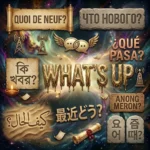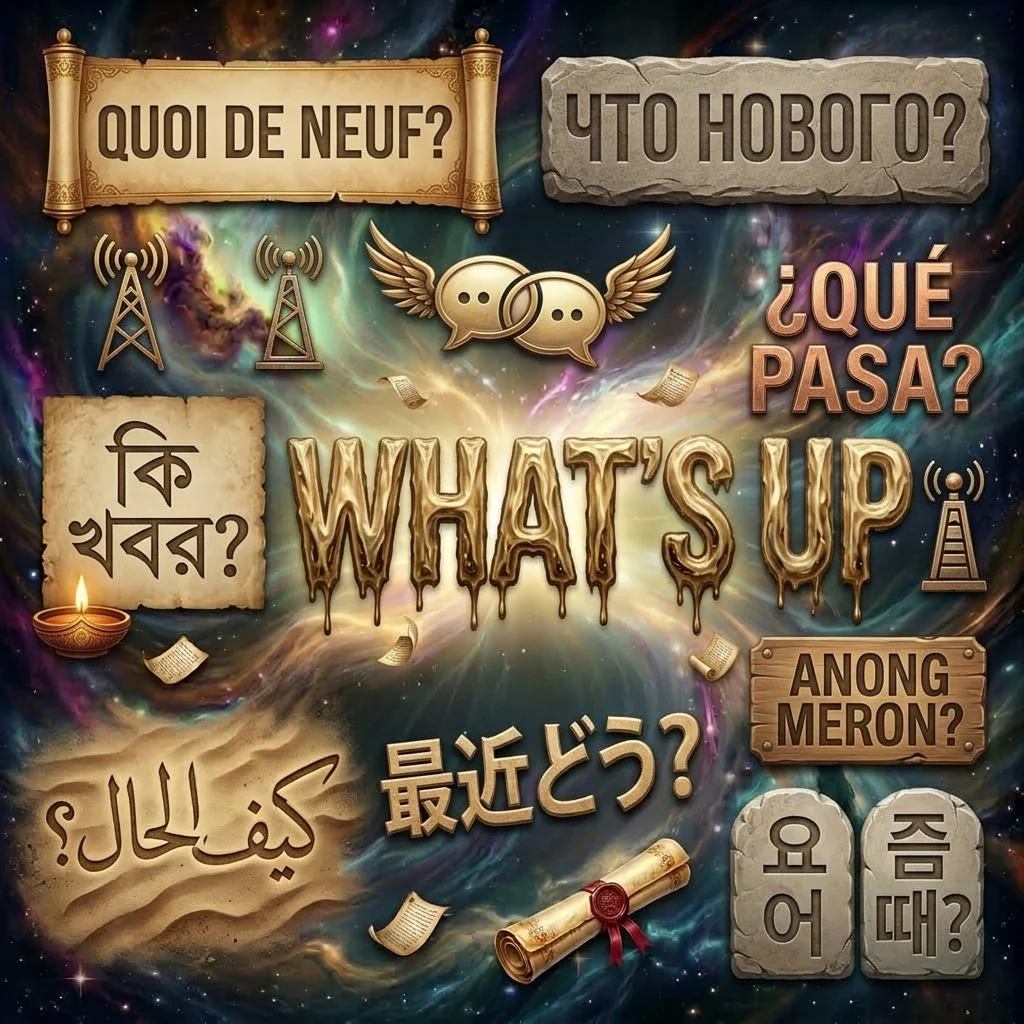
Want to learn how to say “what’s up” in different languages?
If you are chatting with international friends, traveling abroad, or learning a new language, knowing casual greetings can help you start conversations naturally and confidently.
“What’s up?” is an informal English expression used to greet someone, ask how they are doing, or find out what is happening.
Depending on the situation, it can mean “How are you?”, “What’s happening?”, or “What are you doing?”
However, not every language has an exact equivalent.
Some languages use a casual greeting, while others use a phrase that asks how someone is doing or what they are doing.
Understanding these differences helps you choose the right expression for everyday conversations.
In this guide, you will discover what’s up in 70 different languages, including native phrases, easy English pronunciations, example sentences, and their English meanings.
What’s Up in Different Languages: Quick Translations
Here are some popular ways to say “What’s up?” around the world.
| Language | Native Phrase | English Meaning |
|---|---|---|
| Spanish | ¿Qué pasa? | What’s up? |
| French | Quoi de neuf ? | What’s new? |
| German | Was geht? | What’s up? |
| Italian | Che si dice? | What’s happening? |
| Portuguese | E aí? | What’s up? |
| Dutch | Hoe gaat het? | How’s it going? |
| Arabic | شو الأخبار؟ | What’s the news? |
| Hindi | क्या हाल है? | How are things? |
| Urdu | کیا حال ہے؟ | How are things? |
| Chinese (Mandarin) | 最近怎么样? | How have you been lately? |
| Japanese | 元気? | How are you? |
| Korean | 잘 지내? | How are you doing? |
| Russian | Как дела? | How are things? |
| Turkish | Ne haber? | What’s up? |
| Indonesian | Ada apa? | What’s up? |
These phrases are useful starting points for informal conversations. Some are direct equivalents of “What’s up?”, while others are more naturally understood as “How are you?” or “What’s new?”
How to Say What’s Up in Different Languages: 70 Languages
The following table includes 70 languages from Europe, Asia, Africa, and other regions. Each entry provides a commonly used conversational phrase, an approximate pronunciation, and an example showing how it can be used.
The phrases are generally informal. Actual usage can vary by region, age, relationship, and context. In some languages, the most natural equivalent is a greeting rather than a literal translation.
| No. | Language | Native Phrase | Easy English Pronunciation | Example Sentence | English Meaning |
|---|---|---|---|---|---|
| 1 | English | What’s up? | Wuts up | Hey, what’s up? | Hey, what’s happening? |
| 2 | Spanish | ¿Qué pasa? | Keh PAH-sah | ¡Hola! ¿Qué pasa? | Hi! What’s up? |
| 3 | French | Quoi de neuf ? | Kwah duh NUF | Salut, quoi de neuf ? | Hi, what’s new? |
| 4 | German | Was geht? | Vahs gayt | Hey, was geht? | Hey, what’s up? |
| 5 | Italian | Che si dice? | Keh see DEE-cheh | Ciao, che si dice? | Hi, what’s happening? |
| 6 | Portuguese | E aí? | Ee ah-EE | E aí, tudo bem? | What’s up, everything good? |
| 7 | Dutch | Hoe gaat het? | Hoo khaht het | Hé, hoe gaat het? | Hey, how’s it going? |
| 8 | Afrikaans | Hoe gaan dit? | Hoo khahn dit | Haai, hoe gaan dit? | Hi, how’s it going? |
| 9 | Swedish | Hur är läget? | Hoor air LEH-get | Hej, hur är läget? | Hi, how are things? |
| 10 | Norwegian | Hva skjer? | Vah share | Hei, hva skjer? | Hey, what’s happening? |
| 11 | Danish | Hvad så? | Vath soh | Hej, hvad så? | Hey, what’s up? |
| 12 | Icelandic | Hvað segirðu gott? | Kvath SAY-eer-thoo goht | Hæ, hvað segirðu gott? | Hi, how are you? |
| 13 | Finnish | Mitä kuuluu? | MEE-tah KOO-loo | Hei, mitä kuuluu? | Hi, how are you? |
| 14 | Estonian | Mis toimub? | Miss TOI-moob | Tere, mis toimub? | Hi, what’s happening? |
| 15 | Latvian | Kā iet? | Kah yet | Sveiki, kā iet? | Hello, how’s it going? |
| 16 | Lithuanian | Kaip sekasi? | Kipe seh-KAH-see | Labas, kaip sekasi? | Hi, how are you doing? |
| 17 | Polish | Co słychać? | Tso SWIH-hatch | Cześć, co słychać? | Hi, what’s up? |
| 18 | Czech | Co je nového? | Tso yeh NO-veh-ho | Ahoj, co je nového? | Hey, what’s new? |
| 19 | Slovak | Čo nové? | Cho NO-veh | Ahoj, čo nové? | Hi, what’s new? |
| 20 | Slovenian | Kaj dogaja? | Kyeh doh-GAH-yah | Živjo, kaj dogaja? | Hey, what’s happening? |
| 21 | Croatian | Što ima? | Shtoh EE-mah | Bok, što ima? | Hi, what’s up? |
| 22 | Serbian | Шта има? | Shtah EE-mah | Ћао, шта има? | Hey, what’s up? |
| 23 | Bosnian | Šta ima? | Shtah EE-mah | Zdravo, šta ima? | Hi, what’s up? |
| 24 | Bulgarian | Какво става? | Kahk-VOH STAH-vah | Здрасти, какво става? | Hey, what’s happening? |
| 25 | Macedonian | Што има? | Shto EE-mah | Здраво, што има? | Hi, what’s up? |
| 26 | Russian | Как дела? | Kahk dee-LAH | Привет, как дела? | Hi, how are things? |
| 27 | Ukrainian | Як справи? | Yak SPRAH-vy | Привіт, як справи? | Hi, how are you? |
| 28 | Belarusian | Як справы? | Yak SPRAH-vy | Прывітанне, як справы? | Hello, how are things? |
| 29 | Greek | Τι λέει; | Tee LEH-ee | Γεια, τι λέει; | Hey, what’s up? |
| 30 | Romanian | Ce mai faci? | Cheh my fach | Salut, ce mai faci? | Hi, how are you? |
| 31 | Hungarian | Mi újság? | Mee OOY-shahg | Szia, mi újság? | Hi, what’s new? |
| 32 | Albanian | Ç’kemi? | Chkeh-mee | Përshëndetje, ç’kemi? | Hello, what’s up? |
| 33 | Turkish | Ne haber? | Neh hah-BEHR | Selam, ne haber? | Hey, what’s up? |
| 34 | Azerbaijani | Nə var, nə yox? | Nah vahr, nah yokh | Salam, nə var, nə yox? | Hi, what’s up? |
| 35 | Uzbek | Nima gap? | Nee-mah gahp | Salom, nima gap? | Hi, what’s up? |
| 36 | Kazakh | Не жаңалық? | Neh zha-nyh-LYK | Сәлем, не жаңалық? | Hi, what’s new? |
| 37 | Kyrgyz | Эмне жаңылык? | Em-neh zha-nyh-LYK | Салам, эмне жаңылык? | Hi, what’s new? |
| 38 | Tajik | Чӣ хабар? | Chee kha-BAR | Салом, чӣ хабар? | Hi, what’s up? |
| 39 | Persian | چه خبر؟ | Cheh kha-BAR | سلام، چه خبر؟ | Hi, what’s up? |
| 40 | Arabic | شو الأخبار؟ | Shoo il-akh-BAAR | مرحبا، شو الأخبار؟ | Hello, what’s the news? |
| 41 | Hebrew | מה נשמע? | Mah nish-MAH | היי, מה נשמע? | Hey, how are things? |
| 42 | Urdu | کیا حال ہے؟ | Kya haal hai | سلام، کیا حال ہے؟ | Hi, how are you? |
| 43 | Hindi | क्या हाल है? | Kya haal hai | अरे, क्या हाल है? | Hey, how are things? |
| 44 | Bengali | কী খবর? | Kee kho-BOR | আরে, কী খবর? | Hey, what’s up? |
| 45 | Punjabi | ਕੀ ਹਾਲ ਹੈ? | Kee haal hai | ਸਤ ਸ੍ਰੀ ਅਕਾਲ, ਕੀ ਹਾਲ ਹੈ? | Hello, how are you? |
| 46 | Gujarati | શું ચાલે છે? | Shun CHAA-le chhe | કેમ છો, શું ચાલે છે? | How are you, what’s going on? |
| 47 | Marathi | काय चाललंय? | Kai CHAAL-lay | अरे, काय चाललंय? | Hey, what’s going on? |
| 48 | Nepali | के छ? | Keh chha | नमस्ते, के छ? | Hello, what’s up? |
| 49 | Sinhala | කොහොමද? | Koh-hoh-mah-dah | ආයුබෝවන්, කොහොමද? | Hello, how are you? |
| 50 | Tamil | என்ன விஷயம்? | En-na vee-SHA-yam | வணக்கம், என்ன விஷயம்? | Hello, what’s the matter? |
| 51 | Telugu | ఏంటి సంగతి? | Ayn-tee sahn-GAH-tee | హాయ్, ఏంటి సంగతి? | Hi, what’s up? |
| 52 | Kannada | ಏನು ಸಮಾಚಾರ? | Eh-noo sah-MAA-chaara | ನಮಸ್ಕಾರ, ಏನು ಸಮಾಚಾರ? | Hello, what’s the news? |
| 53 | Malayalam | എന്തൊക്കെയുണ്ട്? | En-thok-ke-yoondu | ഹായ്, എന്തൊക്കെയുണ്ട്? | Hi, what’s going on? |
| 54 | Thai | เป็นไงบ้าง? | Pen ngai bahng | หวัดดี เป็นไงบ้าง? | Hi, how’s it going? |
| 55 | Lao | ເປັນແນວໃດ? | Pen naew dai | ສະບາຍດີ ເປັນແນວໃດ? | Hello, how are things? |
| 56 | Khmer | សុខសប្បាយទេ? | Sok sah-bai tei | សួស្តី សុខសប្បាយទេ? | Hello, are you well? |
| 57 | Vietnamese | Có gì mới không? | Kaw zee moy khom | Chào bạn, có gì mới không? | Hi, anything new? |
| 58 | Indonesian | Ada apa? | Ah-dah ah-pah | Hai, ada apa? | Hey, what’s up? |
| 59 | Malay | Apa khabar? | Ah-pah KHA-bar | Hai, apa khabar? | Hi, how are you? |
| 60 | Filipino (Tagalog) | Anong balita? | Ah-nong bah-LEE-tah | Uy, anong balita? | Hey, what’s the news? |
| 61 | Chinese (Mandarin) | 最近怎么样? | Zui-jin zen-yang | 嗨,最近怎么样? | Hi, how have you been lately? |
| 62 | Japanese | 元気? | Gen-kee | やあ、元気? | Hey, how are you? |
| 63 | Korean | 잘 지내? | Jal jee-nae | 안녕, 잘 지내? | Hey, how are you doing? |
| 64 | Mongolian | Юу байна? | Yoo bai-na | Сайн уу, юу байна? | Hi, what’s up? |
| 65 | Burmese | ဘာထူးလဲ။ | Bah too leh | ဟေး၊ ဘာထူးလဲ။ | Hey, what’s new? |
| 66 | Swahili | Mambo? | Mahm-boh | Hujambo, mambo? | Hello, what’s up? |
| 67 | Amharic | ምን አዲስ ነው? | Min ah-dees new | ሰላም፣ ምን አዲስ ነው? | Hi, what’s new? |
| 68 | Yoruba | Ṣé àlàáfíà ni? | Sheh ah-laa-fee-ah nee | Pẹlẹ o, ṣé àlàáfíà ni? | Hello, is everything well? |
| 69 | Hausa | Lafiya lau? | Lah-fee-yah lau | Sannu, lafiya lau? | Hello, are you well? |
| 70 | Zulu | Kunjani? | Koon-jah-nee | Sawubona, kunjani? | Hello, how are you? |
Note: The English pronunciations are simplified guides, not exact phonetic transcriptions. Arabic, Chinese, Japanese, Korean, and other languages may have sounds, tones, or regional expressions that are difficult to represent fully in English spelling.
What Does “What’s Up?” Really Mean?
“What’s up?” is a casual greeting that can serve several purposes. Its meaning depends on the conversation and the relationship between the speakers.
Here are three common uses:
- Asking how someone is doing: “Hey, what’s up?” can be another way of asking how a friend feels.
- Asking what is happening: You might use it when you notice something unusual or enter a busy room.
- Starting a conversation: Friends often use it as a relaxed opening without expecting a detailed answer.
In other languages, a phrase equivalent to “How are you?” may be more natural than a literal translation. That is why learning the context of each expression is just as important as memorizing the words.
Casual Greetings vs. Formal Greetings Around the World
Not every version of “What’s up?” is appropriate for every situation. Some phrases are best used with friends, classmates, siblings, or people you know well.
For example, German Was geht? and Spanish ¿Qué pasa? are informal expressions. In Japanese, 元気? is a casual way to ask how someone is doing, while a more polite expression may be better when speaking with a stranger or an older person.
When choosing a greeting, consider these guidelines:
- With friends: Use relaxed, familiar expressions.
- With new acquaintances: Choose a neutral greeting and a polite question.
- At work: Follow the local level of formality.
- When traveling: Start politely if you are unsure, then adapt to the other person’s style.
Understanding formality helps you sound more natural and avoid unintentionally appearing too familiar.
Popular Slang Expressions for “What’s Up?”
English has several informal expressions that carry a similar meaning. Other languages also have local slang and conversational greetings.
| English Expression | Meaning | When to Use It |
|---|---|---|
| What’s up? | What is happening? | Casual, everyday greetings |
| What’s new? | Has anything changed? | Catching up with friends |
| How’s it going? | How are things? | Friendly conversations |
| What’s going on? | What is happening? | Greetings or asking about a situation |
| How have you been? | How are you lately? | Meeting someone after a while |
| What’s happening? | What is going on? | Informal conversations |
| How’s everything? | Is everything going well? | Checking in with someone |
These expressions are similar, but they are not always interchangeable. For example, “What’s going on?” can sound like a genuine question about an event, while “What’s up?” often works simply as a greeting.
How to Learn “What’s Up” in Different Languages Quickly
Learning 70 translations may seem challenging, but a simple practice routine makes it manageable.
- Choose five languages at a time. Focus on languages you hear often or want to learn.
- Practice speaking aloud. Repeat each greeting slowly before trying it at normal speed.
- Memorize the whole phrase. Learning a greeting as a complete expression is often easier than translating each word individually.
- Use a realistic situation. Imagine greeting a friend, meeting a classmate, or starting a conversation while traveling.
- Review older phrases. Test your memory after one day, three days, and one week.
- Pay attention to formality. Learn whether a phrase is appropriate for friends, strangers, or professional settings.
For an extra challenge, learn a natural response to each greeting, such as “I’m good,” “Not much,” or “Everything is fine.” This will help you move beyond greetings and begin real conversations.
Frequently Asked Questions
1. How do you say “What’s up?” in different languages?
Some common translations include ¿Qué pasa? in Spanish, Was geht? in German, Ne haber? in Turkish, क्या हाल है? in Hindi, and 最近怎么样? in Mandarin Chinese. The best equivalent depends on the language and situation.
2. What is the most common way to say “What’s up” around the world?
There is no single expression used worldwide. Many languages use a casual question meaning “How are you?”, “What’s new?”, or “What’s happening?” rather than a direct translation of the English phrase.
3. How do you say “What’s up?” in Spanish, French, and German?
In Spanish, you can say ¿Qué pasa? In French, a common option is Quoi de neuf ? In German, friends may say Was geht? These expressions are informal and suitable for many casual conversations.
4. Is “What’s up?” formal or informal?
“What’s up?” is generally informal. It is common among friends, relatives, classmates, and familiar coworkers. In formal situations, a polite greeting or a more respectful way of asking how someone is doing is usually better.
5. What is the difference between “What’s up?” and “How are you?”
“What’s up?” is usually a casual greeting or a question about what is happening. “How are you?” focuses more directly on someone’s well-being. In everyday conversation, both can be used to start a friendly interaction.
Conclusion
Learning how to say “What’s up?” in 70 different languages gives you a practical way to connect with people from different cultures. From Spanish ¿Qué pasa? and French Quoi de neuf ? to Japanese 元気? and Swahili Mambo?, each phrase offers a different way to begin a conversation.
Start with the languages that interest you most, practice their pronunciation, and pay attention to when each expression is appropriate. A simple greeting can be the first step toward a meaningful conversation.

I am Johnny Thomas, a passionate language enthusiast and writer. I enjoy exploring different languages, cultures, words, and expressions. I create helpful, easy-to-understand content to help readers discover languages and communicate confidently.