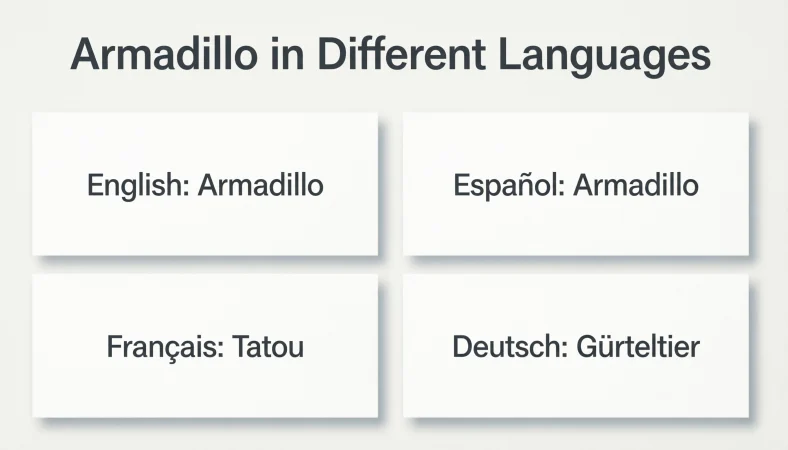
Wondering how to say armadillo in different languages? The word changes dramatically from one language to another.
Some languages use a form closely related to the Spanish word armadillo, while others use names that describe the animal’s armor, such as “belted animal” or “armored one.”
Below, you’ll find 70 armadillo translations, including the native word or phrase, an easy English pronunciation, a natural example sentence, and its English meaning.
The list includes widely spoken languages from Europe, Asia, Africa, and the Americas. Translation references were cross-checked against multilingual dictionary and translation resources. LLogos Dictionary+2
Armadillo in All Languages: 70 Translations
The table below answers the common search query “how to say armadillo in different languages” in a simple, mobile-friendly format. Pronunciations are approximate English-friendly guides rather than formal phonetic transcriptions.
| # | Language | Native phrase | Easy English pronunciation | Example sentence | English meaning |
|---|---|---|---|---|---|
| 1 | English | armadillo | ar-muh-DIL-oh | I saw an armadillo. | I saw an armadillo. |
| 2 | Spanish | armadillo | ar-ma-DEE-yoh | Vi un armadillo. | I saw an armadillo. |
| 3 | Portuguese | tatu | tah-TOO | Eu vi um tatu. | I saw an armadillo. |
| 4 | French | tatou | tah-TOO | J’ai vu un tatou. | I saw an armadillo. |
| 5 | German | Gürteltier | GUER-tel-teer | Ich sah ein Gürteltier. | I saw an armadillo. |
| 6 | Italian | armadillo | ar-ma-DIL-loh | Ho visto un armadillo. | I saw an armadillo. |
| 7 | Dutch | gordeldier | GOR-del-deer | Ik zag een gordeldier. | I saw an armadillo. |
| 8 | Afrikaans | gordeldier | GOR-del-deer | Ek het ’n gordeldier gesien. | I saw an armadillo. |
| 9 | Swedish | bältdjur | BELT-dyoor | Jag såg ett bältdjur. | I saw an armadillo. |
| 10 | Danish | bæltedyr | BEL-teh-deer | Jeg så et bæltedyr. | I saw an armadillo. |
| 11 | Norwegian | beltedyr | BEL-teh-deer | Jeg så et beltedyr. | I saw an armadillo. |
| 12 | Icelandic | beltisdýr | BEL-tis-deer | Ég sá beltisdýr. | I saw an armadillo. |
| 13 | Finnish | vyötiäinen | VUH-tee-eye-nen | Näin vyötiäisen. | I saw an armadillo. |
| 14 | Estonian | soomuselukas | SOO-moo-seh-loo-kas | Ma nägin soomuselukat. | I saw an armadillo. |
| 15 | Latvian | bruņnesis | BROON-neh-sis | Es redzēju bruņnesi. | I saw an armadillo. |
| 16 | Lithuanian | šarvuotis | shar-VOO-oh-tis | Mačiau šarvuotį. | I saw an armadillo. |
| 17 | Polish | pancernik | pan-TSER-neek | Widziałem pancernika. | I saw an armadillo. |
| 18 | Czech | pásovec | PAA-so-vets | Viděl jsem pásovce. | I saw an armadillo. |
| 19 | Slovak | pásavec | PAA-sa-vets | Videl som pásavca. | I saw an armadillo. |
| 20 | Slovenian | pasavec | PA-sa-vets | Videl sem pasavca. | I saw an armadillo. |
| 21 | Croatian | oklopnik | OH-klop-neek | Vidio sam oklopnika. | I saw an armadillo. |
| 22 | Serbian | armadilo | ar-ma-DEE-loh | Video sam armadila. | I saw an armadillo. |
| 23 | Bosnian | armadilo | ar-ma-DEE-loh | Vidio sam armadila. | I saw an armadillo. |
| 24 | Bulgarian | броненосец | broh-neh-NOH-sets | Видях броненосец. | I saw an armadillo. |
| 25 | Macedonian | оклопник | oh-KLOP-neek | Видов оклопник. | I saw an armadillo. |
| 26 | Russian | броненосец | broh-neh-NOH-syets | Я увидел броненосца. | I saw an armadillo. |
| 27 | Ukrainian | броненосець | broh-neh-NOH-sets | Я побачив броненосця. | I saw an armadillo. |
| 28 | Belarusian | браняносец | brah-nya-NOH-syets | Я ўбачыў браняносца. | I saw an armadillo. |
| 29 | Romanian | tatu | tah-TOO | Am văzut un tatu. | I saw an armadillo. |
| 30 | Hungarian | övesállat | UH-vesh-ah-laht | Láttam egy övesállatot. | I saw an armadillo. |
| 31 | Greek | αρμαντίλλο | ar-man-TEE-loh | Είδα ένα αρμαντίλλο. | I saw an armadillo. |
| 32 | Albanian | armadillo | ar-ma-DEE-loh | Pashë një armadillo. | I saw an armadillo. |
| 33 | Armenian | արմադիլո | ar-ma-DEE-loh | Ես տեսա արմադիլո։ | I saw an armadillo. |
| 34 | Georgian | არმადილო | ar-ma-DEE-loh | მე არმადილო ვნახე. | I saw an armadillo. |
| 35 | Turkish | armadillo | ar-ma-DEE-loh | Bir armadillo gördüm. | I saw an armadillo. |
| 36 | Azerbaijani | armadillo | ar-ma-DEE-loh | Mən armadillo gördüm. | I saw an armadillo. |
| 37 | Persian | آرمادیلو | ar-ma-DEE-loh | من یک آرمادیلو دیدم. | I saw an armadillo. |
| 38 | Arabic | أرماديلو | ar-ma-DEE-loh | رأيت أرماديلو. | I saw an armadillo. |
| 39 | Hebrew | ארמדילו | ar-ma-DEE-loh | ראיתי ארמדילו. | I saw an armadillo. |
| 40 | Urdu | آرمڈیلو | ar-ma-DEE-loh | میں نے ایک آرمڈیلو دیکھا۔ | I saw an armadillo. |
| 41 | Hindi | आर्माडिलो | ar-ma-DIL-oh | मैंने एक आर्माडिलो देखा। | I saw an armadillo. |
| 42 | Bengali | আর্মাডিলো | ar-ma-DEE-loh | আমি একটি আর্মাডিলো দেখেছি। | I saw an armadillo. |
| 43 | Punjabi | ਆਰਮਾਡਿਲੋ | ar-ma-DEE-loh | ਮੈਂ ਇੱਕ ਆਰਮਾਡਿਲੋ ਦੇਖਿਆ। | I saw an armadillo. |
| 44 | Gujarati | આર્માડિલો | ar-ma-DEE-loh | મેં એક આર્માડિલો જોયું. | I saw an armadillo. |
| 45 | Marathi | आर्माडिलो | ar-ma-DEE-loh | मी एक आर्माडिलो पाहिला. | I saw an armadillo. |
| 46 | Nepali | आर्माडिलो | ar-ma-DEE-loh | मैले एउटा आर्माडिलो देखें। | I saw an armadillo. |
| 47 | Tamil | அர்மாடில்லோ | ar-ma-DEE-loh | நான் ஒரு அர்மாடில்லோவை பார்த்தேன். | I saw an armadillo. |
| 48 | Telugu | ఆర్మడిల్లో | ar-ma-DIL-loh | నేను ఒక ఆర్మడిల్లోను చూశాను. | I saw an armadillo. |
| 49 | Kannada | ಆರ್ಮಡಿಲ್ಲೊ | ar-ma-DIL-loh | ನಾನು ಆರ್ಮಡಿಲ್ಲೊವನ್ನು ನೋಡಿದೆ. | I saw an armadillo. |
| 50 | Malayalam | ആർമഡില്ലോ | ar-ma-DIL-loh | ഞാൻ ഒരു ആർമഡില്ലോയെ കണ്ടു. | I saw an armadillo. |
| 51 | Sinhala | ආමඩිලෝ | aa-ma-di-LOH | මම ආමඩිලෝවෙක් දැක්කා. | I saw an armadillo. |
| 52 | Chinese (Mandarin) | 犰狳 | chyoh-yoo | 我看到了一只犰狳。 | I saw an armadillo. |
| 53 | Japanese | アルマジロ | a-roo-ma-jee-ro | アルマジロを見ました。 | I saw an armadillo. |
| 54 | Korean | 아르마딜로 | a-reu-ma-dil-lo | 아르마딜로를 봤어요. | I saw an armadillo. |
| 55 | Vietnamese | tatu | tah-TOO | Tôi nhìn thấy một con tatu. | I saw an armadillo. |
| 56 | Thai | ตัวนิ่ม | dtua nim | ฉันเห็นตัวนิ่ม | I saw an armadillo. |
| 57 | Indonesian | armadilo | ar-ma-DEE-loh | Saya melihat armadilo. | I saw an armadillo. |
| 58 | Malay | armadillo | ar-ma-DEE-loh | Saya melihat armadillo. | I saw an armadillo. |
| 59 | Filipino | armadilyo | ar-ma-DIL-yoh | Nakakita ako ng armadilyo. | I saw an armadillo. |
| 60 | Swahili | kakakuona | ka-ka-koo-OH-na | Niliona kakakuona. | I saw an armadillo. |
| 61 | Irish | armadailín | ar-ma-da-LEEN | Chonaic mé armadailín. | I saw an armadillo. |
| 62 | Welsh | armadilo | ar-ma-DEE-loh | Gwelais armadilo. | I saw an armadillo. |
| 63 | Catalan | armadillo | ar-ma-DEE-yoh | Vaig veure un armadillo. | I saw an armadillo. |
| 64 | Galician | armadillo | ar-ma-DEE-lyoh | Vin un armadillo. | I saw an armadillo. |
| 65 | Basque | armadilo | ar-ma-DEE-loh | Armadilo bat ikusi nuen. | I saw an armadillo. |
| 66 | Esperanto | dazipo | da-ZEE-poh | Mi vidis dazipon. | I saw an armadillo. |
| 67 | Latin | armadillo | ar-ma-DIL-loh | Armadillum vidi. | I saw an armadillo. |
| 68 | Guarani | tatu | tah-TOO | Ahecha peteĩ tatu. | I saw an armadillo. |
| 69 | Aymara | khirkhi khiwiña | KEER-khee kee-WEE-nya | Uñjta khirkhi khiwiña. | I saw an armadillo. |
| 70 | Tswana | kgaga | KGAH-ga | Ke bone kgaga. | I saw an armadillo. |
What Does “Armadillo” Mean?
The English word armadillo ultimately comes from Spanish and is associated with the idea of something armored. Armadillos are mammals recognized for their protective bony plates.
In different languages, the animal may have a name that is:
- A direct borrowing of armadillo
- A localized spelling or pronunciation
- A traditional regional animal name
- A descriptive word referring to armor or a protective covering
This explains why armadillo translations can look completely different across language families.
How to Say Armadillo in Different Languages
If you are learning vocabulary, the easiest approach is to focus on the native phrase first and pronunciation second.
For example:
- Spanish: armadillo
- French: tatou
- German: Gürteltier
- Portuguese: tatu
- Japanese: アルマジロ
- Mandarin Chinese: 犰狳
- Korean: 아르마딜로
- Swahili: kakakuona
Several languages use a word closely resembling armadillo, while others have their own established vocabulary. LLogos Dictionary+1
Why Is the Word Different Around the World?
Languages develop vocabulary through history, geography, cultural contact, and local naming traditions.
The armadillo is native to the Americas, so Spanish and Portuguese have especially important historical connections with names for these animals. Other languages adopted versions of the word, while some developed or preserved descriptive terms of their own.
For instance, German Gürteltier literally relates to a “belted animal,” while Portuguese tatu and French tatou belong to a different naming tradition. LLogos Dictionary+1
Armadillo Translations for Travel, Study, and Writing
Knowing armadillo in all languages can be useful for students, travelers, translators, teachers, writers, and anyone researching animals around the world.
When using a translation in real life, remember that the dictionary form may change inside a sentence because of grammar. Gender, case, number, articles, and verb forms can affect the surrounding words.
For casual vocabulary learning, however, the native animal name is the most useful starting point.
Armadillo Around the World
Armadillos are strongly associated with the Americas, but the word appears in many languages far beyond their native range.
A multilingual animal vocabulary list can also reveal interesting patterns. European languages often use descriptive names or adapted forms, while several Asian languages use transliterations or established local terms.
Some African languages likewise use locally recognized names rather than simply copying the English spelling.
This makes armadillo around the world a useful example of how languages name animals differently.
Frequently Asked Questions
1. How do you say armadillo in Spanish?
2. What is armadillo called in French?
The French word for armadillo is tatou. It is commonly used for the animal and is pronounced approximately “tah-TOO.”
3. What is the German word for armadillo?
The German word is Gürteltier. The term is associated with the animal’s banded or armored appearance.
4. How do you say armadillo in Japanese?
5. Which languages use a word similar to “armadillo”?
Spanish, Italian, Turkish, Albanian, Armenian, Georgian, Japanese, Korean, Malay, and several other languages use forms that resemble armadillo. Other languages use substantially different words, such as French tatou, Portuguese tatu, German Gürteltier, Polish pancernik, and Finnish vyötiäinen. LLogos Dictionary+1
Conclusion
Learning armadillo in different languages is a simple way to explore how vocabulary changes across cultures.
From Spanish armadillo and Portuguese tatu to German Gürteltier and Mandarin Chinese 犰狳, the animal has many fascinating names around the world.
if you need armadillo translations for language learning, travel, writing, teaching, or general knowledge, this 70-language list provides a convenient starting point.

I am Danny James, an Administrator at LingoHives, passionate about languages, communication, and cultural diversity. I enjoy helping people discover languages, understand words, and connect with different cultures through simple, useful, and engaging content.