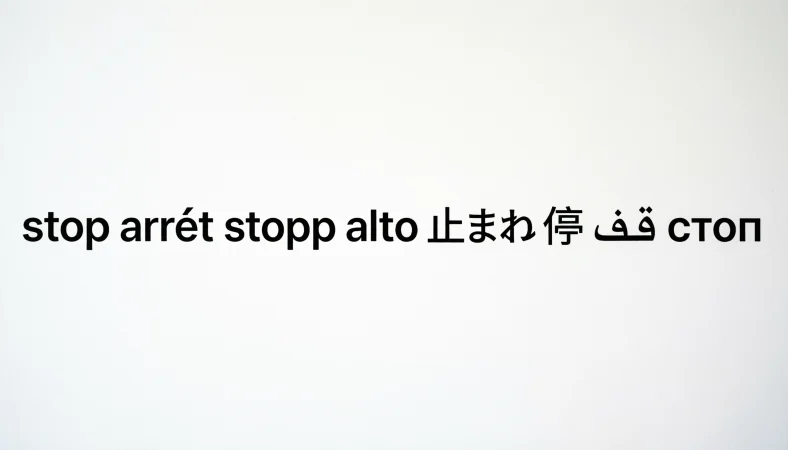
Knowing how to say “stop” in different languages can be useful when traveling, learning a language, communicating with people from different cultures, or simply exploring how everyday words change around the world.
The English word “stop” can express several ideas, including “do not continue,” “halt,” or “cease.”
The translations below focus mainly on the common everyday command meaning “Stop!” Each entry includes the native phrase, an easy English pronunciation, and a practical example so you can understand how the word is naturally used.
Stop in All Languages
Here is a quick guide to stop in all languages covered in this article. Pronunciations are simplified for English speakers and may vary slightly by regional accent.
| # | Language | Native phrase | Easy English pronunciation | Real-life example | English meaning |
|---|---|---|---|---|---|
| 1 | Spanish | ¡Alto! | AHL-toh | ¡Alto! No cruces la calle. | Stop! Don’t cross the street. |
| 2 | French | Arrête ! | Ah-RET | Arrête ! C’est dangereux. | Stop! It’s dangerous. |
| 3 | German | Halt! | Hahlt | Halt! Bleib hier. | Stop! Stay here. |
| 4 | Italian | Fermati! | Fehr-MAH-tee | Fermati! Aspetta un momento. | Stop! Wait a moment. |
| 5 | Portuguese | Pare! | PAH-reh | Pare! O sinal está vermelho. | Stop! The light is red. |
| 6 | Dutch | Stop! | Stop | Stop! Er komt een auto. | Stop! A car is coming. |
| 7 | Swedish | Stanna! | STAHN-nah | Stanna! Vänta på mig. | Stop! Wait for me. |
| 8 | Norwegian | Stopp! | Stop | Stopp! Ikke gå videre. | Stop! Don’t go further. |
| 9 | Danish | Stop! | Stop | Stop! Bilen kommer. | Stop! The car is coming. |
| 10 | Finnish | Pysähdy! | POO-sahd-doo | Pysähdy! Tie on liukas. | Stop! The road is slippery. |
| 11 | Icelandic | Stopp! | Stop | Stopp! Ekki fara þangað. | Stop! Don’t go there. |
| 12 | Irish | Stop! | Stop | Stop! Fan anseo. | Stop! Stay here. |
| 13 | Welsh | Stop! | Stop | Stop! Paid â mynd ymlaen. | Stop! Don’t go on. |
| 14 | Polish | Zatrzymaj się! | Zah-TSHI-mahy shyeh | Zatrzymaj się! Jest niebezpiecznie. | Stop! It’s dangerous. |
| 15 | Czech | Zastav! | ZAH-stahf | Zastav! Počkej na mě. | Stop! Wait for me. |
| 16 | Slovak | Zastav! | ZAH-stahf | Zastav! Počkaj na mňa. | Stop! Wait for me. |
| 17 | Slovenian | Ustavi se! | OOH-stah-vee seh | Ustavi se! Počakaj. | Stop! Wait. |
| 18 | Croatian | Stani! | STAH-nee | Stani! Ne idi dalje. | Stop! Don’t go further. |
| 19 | Serbian | Stani! | STAH-nee | Stani! Sačekaj me. | Stop! Wait for me. |
| 20 | Bosnian | Stani! | STAH-nee | Stani! Opasno je. | Stop! It’s dangerous. |
| 21 | Macedonian | Застани! | ZAH-stah-nee | Застани! Почекај ме. | Stop! Wait for me. |
| 22 | Bulgarian | Спри! | SPREE | Спри! Не мърдай. | Stop! Don’t move. |
| 23 | Russian | Стой! | STOY | Стой! Не двигайся. | Stop! Don’t move. |
| 24 | Ukrainian | Стій! | STEEY | Стій! Не рухайся. | Stop! Don’t move. |
| 25 | Belarusian | Стой! | STOY | Стой! Пачакай мяне. | Stop! Wait for me. |
| 26 | Lithuanian | Sustok! | SOOS-tok | Sustok! Palauk manęs. | Stop! Wait for me. |
| 27 | Latvian | Apstājies! | AHP-stah-yees | Apstājies! Pagaidi mani. | Stop! Wait for me. |
| 28 | Estonian | Peatu! | PAY-ah-too | Peatu! Oota mind. | Stop! Wait for me. |
| 29 | Hungarian | Állj! | AHL-y | Stop! Wait for me. | Stop! Wait for me. |
| 30 | Romanian | Oprește-te! | Oh-PREH-shteh-teh | Oprește-te! E periculos. | Stop! It’s dangerous. |
| 31 | Greek | Σταμάτα! | Sta-MA-ta | Σταμάτα! Είναι επικίνδυνο. | Stop! It’s dangerous. |
| 32 | Albanian | Ndal! | NDAHL | Ndal! Mos shko më tej. | Stop! Don’t go further. |
| 33 | Turkish | Dur! | Door | Dur! Araba geliyor. | Stop! A car is coming. |
| 34 | Azerbaijani | Dayan! | Dah-YAHN | Dayan! Maşın gəlir. | Stop! A car is coming. |
| 35 | Georgian | გაჩერდი! | GAH-cher-dee | გაჩერდი! საშიშია. | Stop! It’s dangerous. |
| 36 | Armenian | Կանգ առ! | Kahng AR | Կանգ առ! Վտանգավոր է։ | Stop! It’s dangerous. |
| 37 | Arabic | توقّف! | Taw-AHK-kaf | توقّف! هذا خطر. | Stop! This is dangerous. |
| 38 | Hebrew | עצור! | Ats-OR | עצור! זה מסוכן. | Stop! This is dangerous. |
| 39 | Persian | بایست! | BY-est | بایست! خطرناک است. | Stop! It’s dangerous. |
| 40 | Urdu | رکو! | ROH-ko | رکو! گاڑی آ رہی ہے۔ | Stop! A car is coming. |
| 41 | Hindi | रुको! | ROO-ko | रुको! गाड़ी आ रही है। | Stop! A car is coming. |
| 42 | Bengali | থামো! | THA-mo | থামো! গাড়ি আসছে। | Stop! A car is coming. |
| 43 | Punjabi | ਰੁਕੋ! | ROO-ko | ਰੁਕੋ! ਗੱਡੀ ਆ ਰਹੀ ਹੈ। | Stop! A car is coming. |
| 44 | Gujarati | રોકો! | ROH-ko | રોકો! ગાડી આવી રહી છે. | Stop! A car is coming. |
| 45 | Marathi | थांबा! | THAHM-bah | थांबा! गाडी येत आहे. | Stop! A car is coming. |
| 46 | Nepali | रोक्नुहोस्! | ROHK-noo-hos | रोक्नुहोस्! गाडी आउँदैछ। | Stop! A car is coming. |
| 47 | Sinhala | නවත්වන්න! | NA-wat-wan-nah | නවත්වන්න! වාහනයක් එනවා. | Stop! A vehicle is coming. |
| 48 | Tamil | நிறுத்து! | Nee-roo-thoo | நிறுத்து! வண்டி வருகிறது. | Stop! A vehicle is coming. |
| 49 | Telugu | ఆపు! | AA-poo | ఆపు! కారు వస్తోంది. | Stop! A car is coming. |
| 50 | Kannada | ನಿಲ್ಲು! | NIL-loo | ನಿಲ್ಲು! ಕಾರು ಬರುತ್ತಿದೆ. | Stop! A car is coming. |
| 51 | Malayalam | നിർത്തൂ! | NEER-thoo | നിർത്തൂ! വണ്ടി വരുന്നു. | Stop! A vehicle is coming. |
| 52 | Odia | ରୁହ! | ROO-ho | ରୁହ! ଗାଡ଼ି ଆସୁଛି। | Stop! A car is coming. |
| 53 | Assamese | ৰবা! | ROH-bah | ৰবা! গাড়ী আহি আছে। | Stop! A car is coming. |
| 54 | Mandarin Chinese | 停下! | Tíng xià | 停下!别动。 | Stop! Don’t move. |
| 55 | Cantonese | 停低! | Ting dai | 停低!唔好郁。 | Stop! Don’t move. |
| 56 | Japanese | 止まって! | Tomatte! | 止まって!危ないよ。 | Stop! It’s dangerous. |
| 57 | Korean | 멈춰! | Meom-chwo | 멈춰! 위험해. | Stop! It’s dangerous. |
| 58 | Vietnamese | Dừng lại! | Zoong lie | Dừng lại! Nguy hiểm đấy. | Stop! It’s dangerous. |
| 59 | Thai | หยุด! | Yoot | หยุด! อย่าขยับ | Stop! Don’t move. |
| 60 | Indonesian | Berhenti! | Ber-HEN-tee | Berhenti! Ada mobil. | Stop! There’s a car. |
| 61 | Malay | Berhenti! | Ber-HEN-tee | Berhenti! Kereta sedang datang. | Stop! A vehicle is coming. |
| 62 | Filipino | Tumigil ka! | Too-mee-GEEL kah | Tumigil ka! Delikado. | Stop! It’s dangerous. |
| 63 | Khmer | ឈប់! | Chhop | ឈប់! កុំទៅមុខ។ | Stop! Don’t go forward. |
| 64 | Lao | ຢຸດ! | Yoot | ຢຸດ! ຢ່າໄປ. | Stop! Don’t go. |
| 65 | Burmese | ရပ်! | Yat | ရပ်! မသွားနဲ့။ | Stop! Don’t go. |
| 66 | Swahili | Simama! | See-MAH-mah | Simama! Usivuke barabara. | Stop! Don’t cross the road. |
| 67 | Zulu | Yima! | YEE-mah | Yima! Kukhona imoto. | Stop! There is a car. |
| 68 | Xhosa | Yima! | YEE-mah | Yima! Imoto iyeza. | Stop! A car is coming. |
| 69 | Afrikaans | Stop! | Stop | Stop! Daar kom ‘n motor. | Stop! A car is coming. |
| 70 | Esperanto | Haltu! | HAHL-too | Haltu! Ne iru plu. | Stop! Don’t go further. |
How to Say “Stop” in Different Languages
The easiest way to learn how to say stop in different languages is to focus on the phrase used as a direct command. However, not every language uses exactly the same form in every situation.
For example, a person may use a short command when stopping someone physically, while a different grammatical form may be preferred when telling someone to stop an activity. Gender, politeness, number, and formality can also affect the wording.
That is why a translation such as “stop” should be understood in context rather than treated as a word-for-word replacement in every sentence.
“Stop” Translations for Travel and Everyday Situations
A short command can be helpful when you need someone to stop walking, moving, driving, or doing something potentially dangerous. In many languages, the imperative form is the natural choice for this purpose.
When speaking to strangers, however, it is often better to use a polite expression when the situation is not urgent. The exact polite form depends on the language and culture.
“Stop” Around the World
The idea of telling someone to stop exists in virtually every language, but the words can sound very different.
In languages such as Hindi, Urdu, Bengali, Punjabi, and Marathi, different forms may be selected depending on politeness and grammatical context.
Across East and Southeast Asia, expressions such as Mandarin 停下!, Korean 멈춰!, Vietnamese Dừng lại!, and Thai หยุด! provide common ways of expressing the idea.
Useful Situations for Saying “Stop”
Knowing these phrases can be particularly useful in several everyday situations:
- Warning someone: Stop before they enter a dangerous area.
- Travel: Tell a driver or another person to stop when appropriate.
- Safety: Use a direct command when immediate action is necessary.
- Conversation: Ask someone to stop an action or behavior.
- Language learning: Compare how the same everyday concept works in different languages.
- Cultural learning: Notice differences between formal, informal, and imperative expressions.
For emergencies, pronunciation and context matter more than perfect grammar. If there is immediate danger, use the clearest short command you know and support it with an obvious gesture when appropriate.
Common Questions About “Stop” in Different Languages
1. What is the most common word for “stop” in different languages?
There is no single word that is universal. Some languages use forms similar to “stop,” while others have completely different words. Examples include Alto in Spanish, Arrête in French, Dur in Turkish, Стой in Russian, and 停下 in Mandarin Chinese.
2. How do you say “stop” in 10 different languages?
Ten examples are Spanish ¡Alto!, French Arrête!, German Halt!, Italian Fermati!, Portuguese Pare!, Turkish Dur!, Russian Стой!, Arabic توقّف!, Hindi रुको!, and Japanese 止まって!
3. Is “stop” the same in every language?
No. Some languages have a word that closely resembles English “stop,” while others use an entirely different expression. Grammar, formality, context, and the person being addressed can also change the appropriate translation.
4. How do you say “stop” politely in another language?
A polite version depends on the language and situation. The expressions in this list are primarily common command forms. For polite requests, learners should use the appropriate polite or formal construction rather than simply repeating a direct command.
5. Why are there different translations for “stop”?
English “stop” can describe several meanings, such as stopping movement, ending an activity, or asking someone not to continue. Other languages may use separate words or grammatical forms for these meanings, so context is important when choosing the correct translation.
Conclusion
Learning stop in different languages is a simple way to expand practical vocabulary while discovering how languages express everyday actions. From Spanish ¡Alto! and Turkish Dur! to Japanese 止まって! and Swahili Simama!, the same basic idea appears in many different linguistic forms.
if you are traveling, studying languages, or searching for “stop” in all languages, understanding the phrase in context will help you use it more naturally and appropriately.

I am Johnny Thomas, a passionate language enthusiast and writer. I enjoy exploring different languages, cultures, words, and expressions. I create helpful, easy-to-understand content to help readers discover languages and communicate confidently.