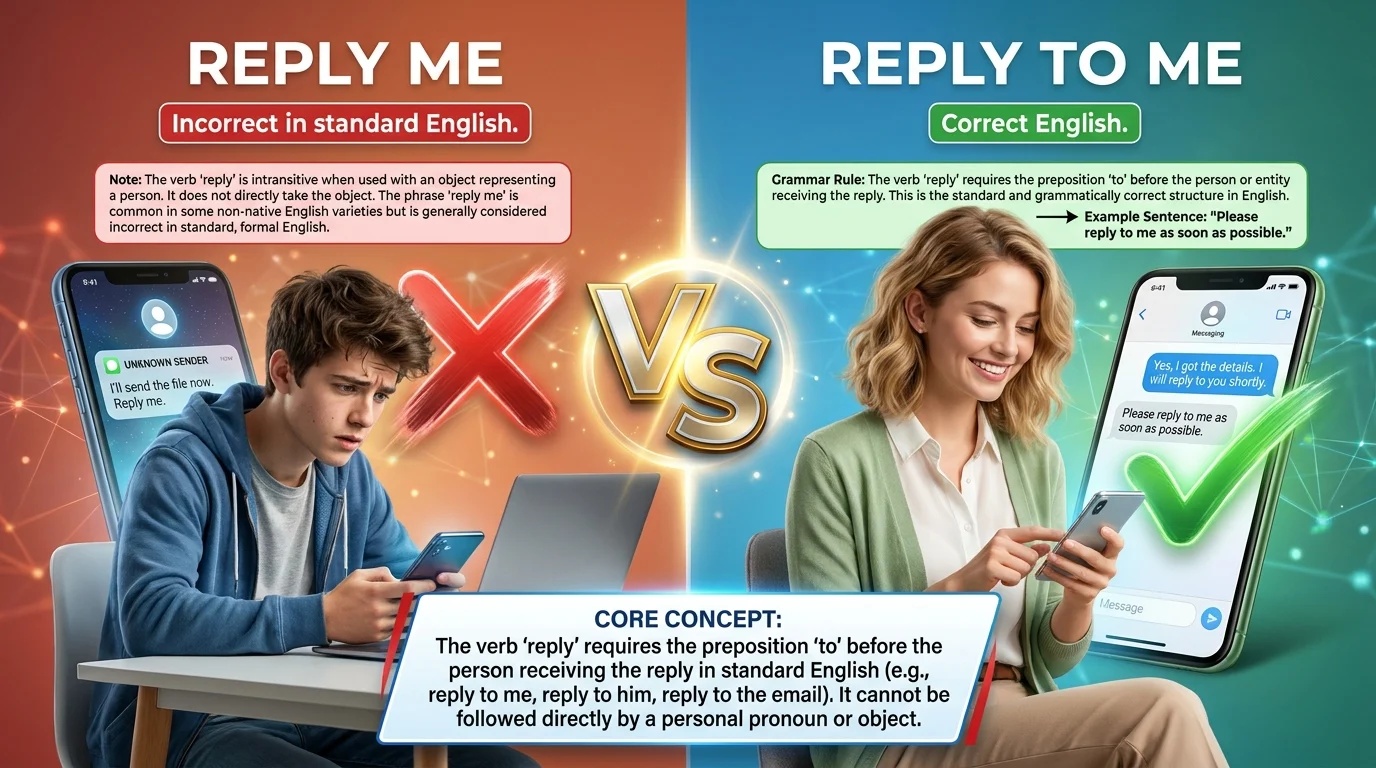
English learners often get confused about whether to say “reply me” or “reply to me.” Both expressions may seem correct because they communicate the same basic idea: asking someone to respond. However, standard English grammar treats them differently. If you want to ask someone to respond to your message, the correct expression is usually “reply to me.”
The confusion happens because some English verbs take a direct object, while others need a preposition before the person or thing receiving the action. For example, we say “answer me” but “reply to me.” Understanding this small grammatical difference can help you write better messages, speak more naturally, and avoid common mistakes in everyday English. In this guide, you will learn the meanings, grammar rules, differences, and practical examples of both expressions.
Quick Answer
“Reply to me” is the grammatically correct expression in standard English. The verb “reply” normally uses the preposition “to” before the person receiving the response. For example, say “Please reply to me” rather than “Please reply me.” However, “reply me” is sometimes heard in informal or nonstandard English.
Why Do People Confuse Reply Me and Reply to Me?
People confuse these expressions because they have similar meanings and are used in the same situations.
The main reason is that English has verbs with different grammatical patterns.
For example:
- Answer me.
- Call me.
- Contact me.
- Reply to me.
- Respond to me.
- Listen to me.
The verb “answer” takes a direct object, so you can say “answer me.” However, “reply” generally requires the preposition “to” when identifying the person receiving the response.
This difference is especially important for English learners because translating expressions directly from another language can sometimes produce grammatically incorrect sentences.
First Word: What Does Reply Mean?
Reply is a verb and noun that refers to responding to someone or something.
As a verb, it means to give an answer or response to a question, message, email, or statement.
Examples:
- Please reply to my email.
- She replied to my question.
- He did not reply to the message.
- I will reply to you tomorrow.
As a noun, “reply” means an answer or response.
Examples:
- I received your reply.
- Her reply was very helpful.
- We are waiting for a reply.
Grammar rule: When “reply” is followed by the person receiving the response, use “to.”
Correct: Please reply to me.
Incorrect in standard English: Please reply me.
Second Phrase: What Does Reply to Me Mean?
“Reply to me” means to respond to me, answer my message, or give me a response.
The word “to” is a preposition that connects the verb “reply” with the person receiving the response.
Examples:
- Please reply to me as soon as possible.
- Can you reply to me today?
- She promised to reply to me.
- Nobody replied to me yesterday.
This expression is grammatically correct in standard American and British English.
You can use it in different situations, including:
- Text messages
- Emails
- Online conversations
- Professional communication
- Personal discussions
- Everyday speaking
Reply Me vs Reply to Me: Key Differences
| Feature | Reply me | Reply to me |
| Grammar | Nonstandard | Standard and correct |
| Meaning | Intended as a response request | Respond to me |
| Preposition | Missing | Uses “to” |
| Formal writing | Avoid | Recommended |
| Everyday English | Sometimes heard | Widely accepted |
| Example | Reply me soon. | Reply to me soon. |
The important difference is grammatical structure. The verb “reply” normally needs the preposition “to” before the person receiving the response.
When Should You Use Each Expression?
When to Use Reply to Me
Use “reply to me” whenever you want someone to respond to you.
It works in both formal and informal situations.
1. In everyday conversations
- Please reply to me when you are free.
- Why didn’t you reply to me?
- Can you reply to me now?
2. In professional emails
- Please reply to me at your earliest convenience.
- I would appreciate it if you could reply to me.
- Kindly reply to me with the required information.
3. In text messages
- Reply to me when you get home.
- Please reply to me soon.
- I am waiting for you to reply to me.
4. In educational situations
- Please reply to me with your answer.
- The teacher asked the students to reply to her.
- I will reply to you after checking the assignment.
When to Use Reply Me
In standard English, avoid using “reply me” when you mean “respond to me.”
Although some speakers use it in casual conversations, it is considered nonstandard in this construction.
Instead, use:
- Reply to me.
- Respond to me.
- Answer me.
Remember that “reply” and “answer” follow different grammatical patterns.
15 Examples of Reply Me vs Reply to Me
Here are practical examples to help you understand the correct usage.
| Incorrect or nonstandard | Correct English |
| Please reply me. | Please reply to me. |
| Reply me quickly. | Reply to me quickly. |
| Why don’t you reply me? | Why don’t you reply to me? |
| She didn’t reply me. | She didn’t reply to me. |
| Can you reply me today? | Can you reply to me today? |
| He will reply me later. | He will reply to me later. |
| Nobody replied me. | Nobody replied to me. |
| Please reply me soon. | Please reply to me soon. |
| I asked him to reply me. | I asked him to reply to me. |
| They never reply me. | They never reply to me. |
Additional examples:
- Correct: Please reply to my message when you have time.
- Correct: I am waiting for you to reply to me.
- Correct: She replied to my email yesterday.
- Correct: Did he reply to you?
- Correct: I will reply to your question shortly.
These examples show how the preposition “to” connects “reply” with the person receiving the response.
Common Mistakes When Using Reply
English learners often make these mistakes when writing messages or emails.
1. Leaving Out the Preposition
Incorrect: Please reply me.
Correct: Please reply to me.
The verb “reply” normally requires “to” before the recipient.
2. Confusing Reply With Answer
Incorrect: Please answer to me.
Correct: Please answer me.
In the usual sense of responding to a question or person, “answer” takes a direct object.
3. Using Reply to Me When Referring to a Message
Sometimes the sentence needs “reply to my message” rather than “reply to me.”
Both are correct, but they communicate slightly different things.
- Reply to me = Respond to me.
- Reply to my message = Respond to the message I sent.
4. Forgetting the Preposition in Formal Emails
Incorrect: I am waiting for you to reply my email.
Correct: I am waiting for you to reply to my email.
Using the correct preposition makes professional communication clearer.
Memory Trick: How to Remember the Difference
Here is an easy way to remember the rule:
REPLY = TO
Whenever you use “reply” before the person or message receiving the response, remember to include “to.”
Examples:
- Reply to me.
- Reply to him.
- Reply to her.
- Reply to them.
- Reply to my email.
Compare this with “answer”:
- Answer me.
- Answer him.
- Answer her.
- Answer the question.
Remembering these two patterns will help you avoid this common grammar mistake.
American vs British English: Is There Any Difference?
There is no important difference between American and British English when it comes to “reply to me.”
Both varieties use “reply to” when identifying the person receiving a response.
| American English | British English |
| Please reply to me. | Please reply to me. |
| She replied to him. | She replied to him. |
| I will reply to your email. | I will reply to your email. |
The expression “reply me” is not considered standard in either variety when used to mean “respond to me.”
Therefore, you can confidently use “reply to me” in international English communication.
Similar Words and Expressions
Understanding similar expressions can improve your English vocabulary and grammar.
| Expression | Meaning | Example |
| Reply to me | Respond to me | Please reply to me. |
| Respond to me | Give me a response | Respond to me soon. |
| Answer me | Give me an answer | Answer me honestly. |
| Get back to me | Contact me again | Get back to me tomorrow. |
| Write back to me | Send me a written response | Write back to me soon. |
| Respond back | Reply or respond | Please respond to my email. |
These expressions are useful in conversations, emails, and professional communication.
Final Verdict: Reply Me or Reply to Me?
The correct expression in standard English is “reply to me.”
Use “reply to me” when asking someone to respond to you, your question, or your communication.
Avoid “reply me” in formal writing, academic work, professional emails, and standard English conversations.
Remember these examples:
- Correct: Please reply to me.
- Incorrect in standard English: Please reply me.
- Correct: Please answer me.
- Correct: Please respond to me.
The easiest rule is to remember that “reply” normally takes the preposition “to” when followed by the recipient.
Frequently Asked Questions
1. Is it correct to say reply me?
No. “Reply me” is generally considered nonstandard English when you mean “respond to me.” The correct expression is “reply to me.”
2. Should I say reply to me or reply me?
You should say “reply to me.” The preposition “to” is needed between “reply” and the person receiving the response.
3. Why do we say reply to me instead of reply me?
Because “reply” normally takes the preposition “to” when introducing the recipient of a response. This is a standard grammatical pattern in English.
4. Is reply to me correct in formal English?
Yes. “Reply to me” is grammatically correct in formal and informal English. In professional emails, you can also say “Please respond to me.”
5. Is reply to me correct in American English?
Yes. American English uses “reply to me.” The same construction is also standard in British English.
6. What is the difference between reply to me and answer me?
“Reply to me” means to respond to someone, while “answer me” means to give someone an answer. The grammatical difference is that “reply” generally takes “to,” whereas “answer” usually takes a direct object.
7. Can I say please reply to my message?
Yes. “Please reply to my message” is completely correct. It means you are asking someone to respond to a particular message.
8. Is respond to me also correct?
Yes. “Respond to me” is grammatically correct and has a similar meaning to “reply to me.” Both expressions use the preposition “to.”
Remember This
- Reply to me = Correct standard English.
- Reply me = Nonstandard in this meaning.
- Answer me = Correct.
- Respond to me = Correct.
- Reply to my message = Correct.
The golden rule: Always remember “TO” after “REPLY” when identifying the person or thing receiving the response.
Conclusion
The difference between “reply me” and “reply to me” is simple but important. In standard English, “reply to me” is the correct expression because the verb “reply” normally requires the preposition “to” before the person receiving the response. Although you might hear “reply me” in some informal conversations, it is better to avoid it in standard communication.
Whether you are writing a text message, sending a professional email, or speaking English in everyday situations, use “reply to me” confidently. Remembering this small grammar rule will help you communicate more naturally and avoid a common English mistake.
Meta Description: Reply me vs reply to me: Learn the correct English expression, grammar rules, key differences, and practical examples with easy explanations.

I am Jimmy Michael, a language enthusiast and writer passionate about exploring different languages, words, and cultures. I create simple, useful content that helps readers understand languages better and discover new ways to communicate globally.