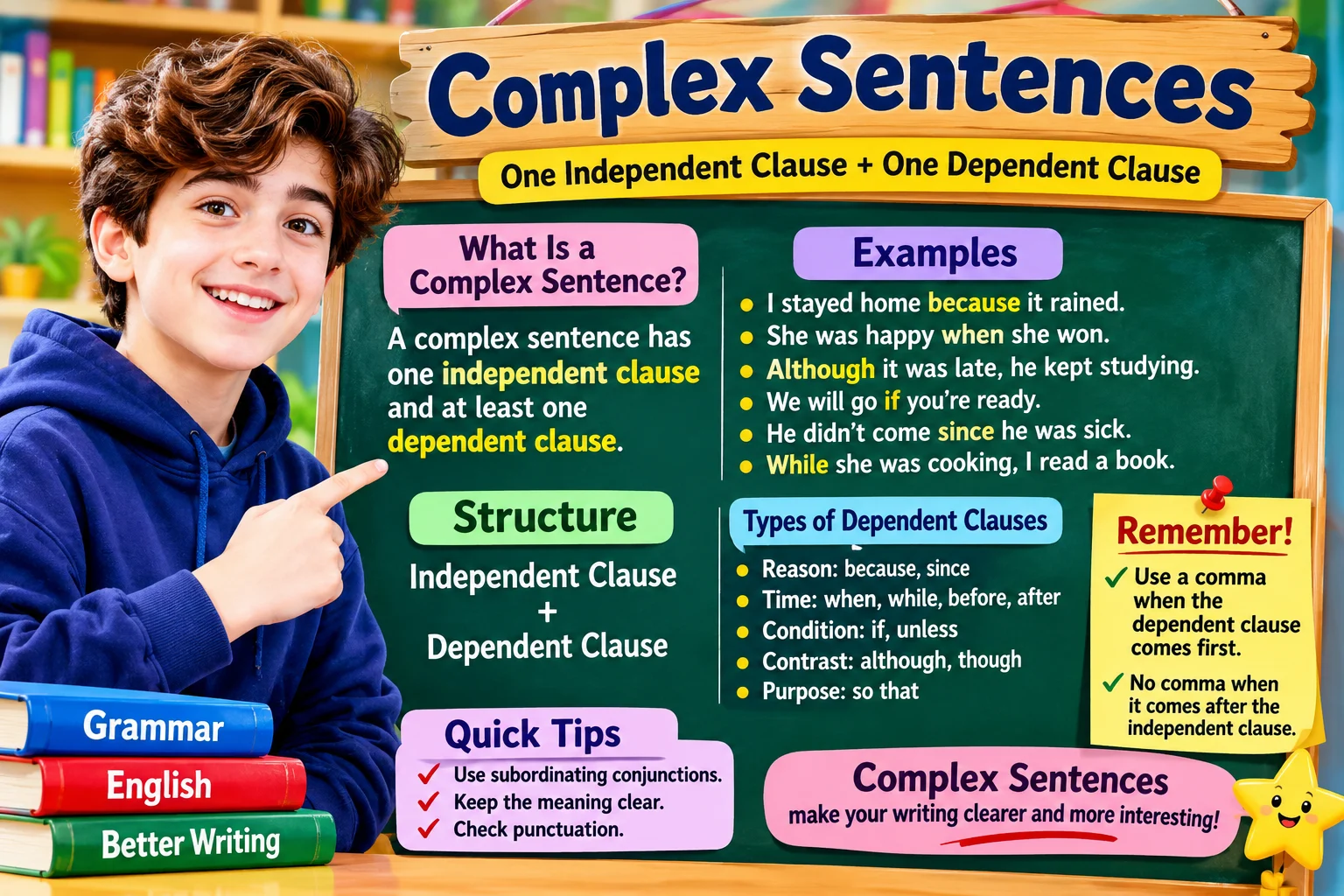
Complex sentences are an important part of English grammar because they help writers connect ideas and express relationships clearly. A complex sentence contains one independent clause and at least one dependent clause. The independent clause expresses a complete thought, while the dependent clause adds information about time, reason, condition, contrast, or another detail.
Understanding complex sentences can help students, ESL learners, and beginners improve their writing, reading, and speaking skills. These sentences are commonly used in everyday conversations, academic writing, professional communication, and storytelling. For example, “I stayed home because it was raining” is a complex sentence. The main idea is that the speaker stayed home, while the dependent clause explains why. Learning how these sentences work makes it easier to create longer, more meaningful sentences without making grammatical mistakes. In this guide, you will learn their definition, structure, types, punctuation rules, and practical examples.
Quick Answer
A complex sentence is a sentence that contains one independent clause and at least one dependent clause. The independent clause expresses a complete idea, while the dependent clause provides additional information. Words such as because, although, when, if, and while often introduce dependent clauses.
Why Do People Confuse Complex Sentences?
Many English learners confuse complex sentences with compound sentences because both structures contain more than one clause.
However, the main difference is how those clauses are connected.
- A complex sentence contains one independent clause and at least one dependent clause.
- A compound sentence contains two or more independent clauses.
- A simple sentence contains one independent clause and no dependent clauses.
Understanding the difference helps you recognize sentence structures and use them correctly.
What Is the First Word? Complex
The word complex means something that has several connected parts or is not simple.
In English grammar, a complex sentence combines an independent clause with one or more dependent clauses.
Examples:
- I went outside because the weather was beautiful.
- Although she was tired, she finished her homework.
- We will leave when the rain stops.
In each example, one clause communicates a complete thought, while another adds information.
What Is an Independent Clause?
An independent clause is a group of words that expresses a complete thought and can stand alone as a sentence.
Examples:
- She is reading a book.
- I enjoy playing football.
- They went to school.
Each example makes complete sense independently.
What Is the Second Word? Sentence
A sentence is a group of words that expresses a complete thought. It usually contains a subject and a verb.
In grammar, sentences can have different structures, including simple, compound, complex, and compound-complex.
Examples:
- The baby is sleeping.
- My brother plays cricket.
- We are learning English.
A sentence can contain one clause or several connected clauses, depending on its structure.
What Is a Dependent Clause?
A dependent clause contains a subject and a verb but does not express a complete thought on its own.
Examples:
- Because I was hungry
- Although she was happy
- When the teacher arrived
- If you study hard
These groups of words leave the reader expecting more information.
For example:
- Incorrect: Because I was hungry.
- Correct: I ate something because I was hungry.
Complex Sentences vs. Other Sentence Types: Comparison Table
| Sentence type | Structure | Example |
| Simple | One independent clause | She sings beautifully. |
| Compound | Two or more independent clauses | I was tired, but I continued working. |
| Complex | One independent and one or more dependent clauses | I slept because I was tired. |
| Compound-complex | Two or more independent clauses and at least one dependent clause | I was tired, but I continued working because the project was important. |
When Should You Use Complex Sentences?
Use complex sentences when you want to explain relationships between different ideas.
Here are some common situations:
1. To explain a reason
Use because or since.
Example: I stayed inside because it was cold.
2. To describe time
Use when, before, after, or while.
Example: Call me when you reach home.
3. To express a condition
Use if or unless.
Example: You will succeed if you work hard.
4. To show contrast
Use although, though, or even though.
Example: Although it was raining, we played football.
5. To explain a purpose
Use so that.
Example: She studies hard so that she can pass the exam.
20+ Examples of Complex Sentences in English
Here are 25 practical examples to help you understand complex sentence structures.
- I went to bed early because I was tired.
- She smiled when she saw her friend.
- Although it was raining, we went shopping.
- I will call you when I arrive.
- He passed the exam because he studied hard.
- If you practice daily, your English will improve.
- We stayed home because the weather was bad.
- While my mother was cooking, I was studying.
- She bought a new dress because she needed one.
- I will help you if I have enough time.
- Although he was sick, he attended the meeting.
- You can watch television after you finish your homework.
- I know that she is honest.
- Since it was getting late, we decided to leave.
- The boy cried because he lost his toy.
- Whenever I visit my grandmother, she makes delicious food.
- I could not sleep because the noise was too loud.
- Before you leave, please close the door.
- Even though she was nervous, she spoke confidently.
- We will start the game when everyone arrives.
- He works hard so that his family can live comfortably.
- If you need help, you can ask me.
- The teacher praised the student because he answered correctly.
- I listened carefully while she explained the lesson.
- Although the journey was long, we enjoyed every moment.
Common Mistakes When Using Complex Sentences
English learners sometimes make mistakes when combining independent and dependent clauses.
Here are some common errors and their corrections.
1. Using a Dependent Clause Alone
Incorrect: Because I was feeling sick.
Correct: I stayed home because I was feeling sick.
A dependent clause usually needs an independent clause to complete its meaning.
2. Forgetting the Comma
Incorrect: Although she was tired she continued working.
Correct: Although she was tired, she continued working.
Use a comma when a dependent clause comes before the independent clause.
3. Confusing Compound and Complex Sentences
Incorrect explanation: I was hungry, so I ate food is a complex sentence.
Correct explanation: It is a compound sentence because both clauses are independent.
4. Using Too Many Connecting Words
Incorrect: Because I was tired, so I went to sleep.
Correct: Because I was tired, I went to sleep.
Avoid unnecessarily using both because and so to connect the same clauses.
5. Creating Incomplete Thoughts
Incorrect: When the teacher entered the classroom.
Correct: Everyone became quiet when the teacher entered the classroom.
Always check whether your sentence expresses a complete thought.
Memory Trick: How to Remember Complex Sentences
Use this simple trick:
Complex = Complete Idea + Extra Information
Remember:
- Independent clause = Complete thought.
- Dependent clause = Incomplete thought.
- Complex sentence = Both clauses connected.
For example:
“I stayed home because I was sick.”
- I stayed home = Complete idea.
- Because I was sick = Extra information.
This simple method can help you identify complex sentences quickly.
American vs. British English
The grammatical structure of complex sentences is the same in American and British English.
Both varieties use independent clauses, dependent clauses, and subordinating conjunctions.
| Feature | American English | British English |
| Sentence structure | Same | Same |
| Because | Common | Common |
| Although | Common | Common |
| When | Common | Common |
| If | Common | Common |
| Comma rules | Generally similar | Generally similar |
There is no major difference in how complex sentences are formed in American and British English.
Similar Words and Related Grammar Terms
Understanding related grammar terms can make complex sentences easier to recognize.
1. Simple Sentence: A sentence with one independent clause.
Example: She likes coffee.
2. Compound Sentence: A sentence with two or more independent clauses.
Example: I wanted to go outside, but it started raining.
3. Compound-Complex Sentence: A sentence containing at least two independent clauses and one dependent clause.
Example: I stayed home because I was sick, and my brother went shopping.
4. Independent Clause: A group of words that expresses a complete thought.
Example: He plays cricket.
5. Dependent Clause: A group of words that cannot stand alone as a complete sentence.
Example: Because he was busy.
6. Subordinating Conjunction: A connecting word that introduces a dependent clause.
Examples: Because, although, since, when, while, and if.
Final Verdict
A complex sentence contains one independent clause and at least one dependent clause. It helps connect ideas and explain relationships such as reason, time, condition, contrast, and purpose.
The easiest way to identify a complex sentence is to find its complete thought and the additional dependent information.
For example, “I studied hard because I wanted to pass the exam” is a complex sentence because it combines an independent clause with a dependent clause.
Frequently Asked Questions
1. What is a complex sentence in simple words?
A complex sentence is a sentence that contains one complete thought and at least one dependent clause. It connects ideas to provide additional information about reasons, time, conditions, or contrast.
Example: I stayed home because I was sick.
2. What are the three parts of a complex sentence?
A complex sentence is built around an independent clause and at least one dependent clause. These clauses are connected through a subordinating word or another suitable grammatical structure.
3. What are 5 examples of complex sentences?
Here are five examples:
- I slept early because I was tired.
- Although she was busy, she helped me.
- Call me when you arrive.
- If it rains, we will stay home.
- He smiled because he was happy.
4. What words are commonly used in complex sentences?
Common subordinating conjunctions include because, although, since, when, while, if, unless, before, after, and even though.
These words introduce dependent clauses and show relationships between ideas.
5. What is the difference between a simple and a complex sentence?
A simple sentence contains one independent clause, while a complex sentence contains one independent clause and at least one dependent clause.
Example of a simple sentence: She is sleeping.
Example of a complex sentence: She is sleeping because she is tired.
6. Can a complex sentence have two dependent clauses?
Yes. A complex sentence can contain one independent clause and multiple dependent clauses.
Example: I stayed home because I was sick and because the weather was terrible.
7. Does a complex sentence always need a comma?
No. A comma is generally used when a dependent clause comes before the independent clause.
Example: Although I was tired, I finished my work.
When the independent clause comes first, a comma is usually unnecessary.
Example: I finished my work although I was tired.
Remember This
- A complex sentence has one independent clause and at least one dependent clause.
- An independent clause expresses a complete thought.
- A dependent clause cannot stand alone as a complete sentence.
- Words like because, although, when, and if often introduce dependent clauses.
- Use commas correctly when arranging clauses.
Conclusion
Complex sentences are an essential part of English grammar. They allow you to combine related ideas, explain reasons, describe situations, and express conditions more clearly. By understanding independent and dependent clauses, you can recognize complex sentences and use them correctly in everyday communication.
The best way to master complex sentences is through regular practice. Start with short examples, identify the clauses, and gradually create longer sentences using words such as because, although, when, and if. With consistent practice, your English writing and speaking will become clearer, more natural, and more effective.

I am Jimmy Michael, a language enthusiast and writer passionate about exploring different languages, words, and cultures. I create simple, useful content that helps readers understand languages better and discover new ways to communicate globally.