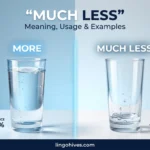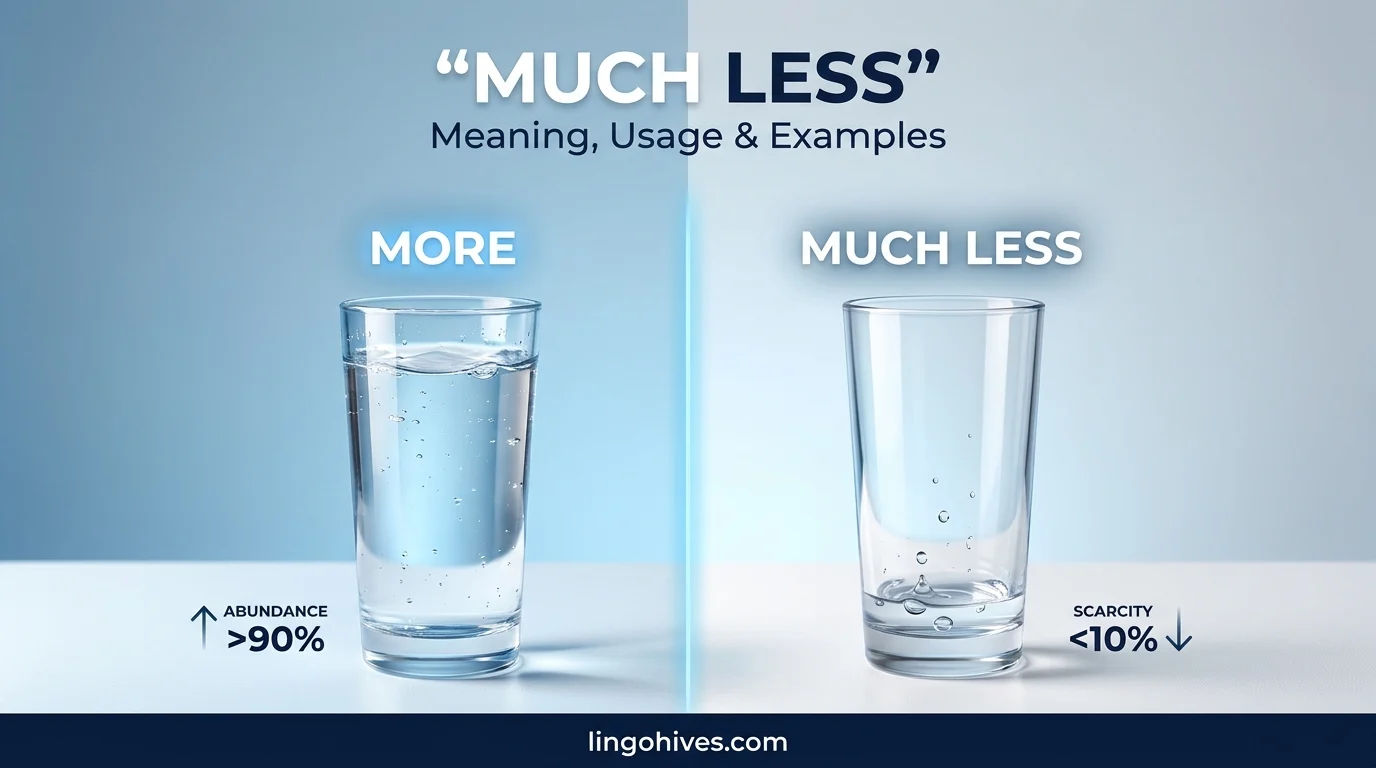
The phrase “much less” is commonly used in English to emphasize that something is even less likely, less possible, or less true than something already mentioned. It helps speakers compare situations and show that if one thing is difficult, unlikely, or impossible, another thing is even more so. Understanding how to use “much less” can make your English sound more natural and precise.
Many English learners confuse “much less” with phrases such as “even less,” “let alone,” and “still less.” Although these expressions are related, they do not always work in exactly the same way. The meaning of “much less” also depends on the sentence and its context. In this guide, you will learn its definition, grammar, common uses, differences from similar expressions, and practical examples to help you use it correctly in everyday conversations and writing.
Quick Answer
Much less is an expression used to emphasize that something is even more difficult, unlikely, or impossible than something already mentioned. It often follows a negative statement. For example: “I cannot afford a small apartment, much less a luxury house.” It means the second thing is even further beyond reach.
Why Do People Confuse Much Less?
People often confuse “much less” because it looks like an ordinary comparison between two quantities. However, it can also connect two situations to emphasize that the second is even less realistic or achievable.
For example:
- I cannot run one mile, much less five miles.
- She does not have time to cook, much less prepare a full dinner.
In both examples, the second situation is more difficult than the first.
Another reason for confusion is that learners sometimes use “much less” when they actually mean “much fewer.” These expressions have different grammatical uses.
First Word: Much
Much is a determiner or pronoun commonly used with uncountable nouns. It refers to a large amount or degree of something.
It can also strengthen comparisons and expressions.
Examples:
- I do not have much money.
- She does not drink much water.
- This task is much harder than I expected.
- He is much less confident today.
Common uses of much:
- Much time
- Much money
- Much effort
- Much better
- Much less expensive
Second Word: Less
Less is used to describe a smaller amount, degree, or quantity.
It is commonly used with uncountable nouns and in comparisons.
Examples:
- I need less sugar in my tea.
- She spends less time watching television.
- This road has less traffic.
- He is less interested in sports.
Common uses of less:
- Less water
- Less money
- Less stress
- Less important
- Less expensive
When combined, “much less” can emphasize a stronger degree of reduction or impossibility.
Much Less vs Much vs Less: Comparison Table
| Expression | Meaning | Example |
| Much | A large amount or degree | I have much work. |
| Less | A smaller amount or degree | I need less sugar. |
| Much less | Even less; a stronger contrast | I cannot buy a car, much less a house. |
| Even less | A still smaller amount or degree | I have even less time today. |
| Much fewer | A considerably smaller number | We have much fewer visitors. |
When Should You Use Much Less?
Use “much less” when you want to emphasize that a second thing is even less possible, likely, or achievable than the first.
1. To Show Impossibility
Use it when the first action is already impossible or difficult.
Example:
– I cannot afford a bicycle, much less a car.
2. To Express Lack of Ability
Use it when someone cannot do something simple, let alone something more challenging.
Example:
– He cannot swim, much less dive underwater.
3. To Show a Stronger Negative Comparison
Use it to emphasize that the second situation is even less likely.
Example:
– She rarely visits her hometown, much less travels abroad.
4. To Emphasize Limited Resources
Use it when someone lacks the resources for a smaller task, making a larger task even less realistic.
Example:
– We do not have enough money for lunch, much less dinner at a restaurant.
15 Examples of Much Less in Sentences
Here are practical examples to help you understand how “much less” works in everyday English.
- I cannot afford a new phone, much less a new laptop.
- He cannot run one kilometer, much less a marathon.
- She does not have time to cook, much less bake a cake.
- I barely understand English, much less speak it fluently.
- They cannot manage a small business, much less a large company.
- He rarely reads books, much less writes them.
- We do not have enough money for rent, much less a vacation.
- She cannot drive a car, much less operate a truck.
- I do not know his address, much less his phone number.
- The child cannot lift a small box, much less a heavy suitcase.
- He has never visited Lahore, much less traveled outside Pakistan.
- I cannot solve a basic problem, much less a complicated equation.
- She does not like coffee, much less strong espresso.
- They cannot finish one project, much less three projects.
- I barely have enough time to sleep, much less watch television.
Common Mistakes When Using Much Less
English learners sometimes make mistakes when using this expression. Here are some common problems and their corrections.
Mistake 1: Using Much Less With a Positive Statement Incorrectly
Incorrect: I can easily buy a car, much less a bicycle.
Correct: I cannot afford a bicycle, much less a car.
Why? The common emphatic construction usually follows a negative or limiting statement.
Mistake 2: Confusing Much Less With Much Fewer
Incorrect: We have much less students this year.
Correct: We have much fewer students this year.
Why? Students are countable, so “fewer” is generally appropriate in formal English.
Mistake 3: Using Much Less Without a Clear Comparison
Unclear: She is much less.
Better: She is much less interested in sports than her brother.
Why? The reader needs enough context to understand what is being compared.
Mistake 4: Reversing the Comparison
Incorrect: I cannot afford a luxury house, much less a small apartment.
Correct: I cannot afford a small apartment, much less a luxury house.
Why? The second situation should normally be more difficult or less achievable than the first.
Memory Trick: How to Remember Much Less
Remember this simple rule:
Much Less = Not Even the Easier Thing, Let Alone the Harder Thing.
Think about this example:
“I cannot buy a bicycle, much less a car.”
- Bicycle = Less expensive.
- Car = More expensive.
- If you cannot afford the bicycle, buying a car is even less possible.
This simple pattern will help you remember the expression.
American vs British English
“Much less” is commonly understood and used in both American and British English. There is no major difference in its meaning or basic grammatical structure.
| Feature | American English | British English |
| Expression | Much less | Much less |
| Meaning | Even less; let alone | Even less; let alone |
| Usage | Common | Common |
| Grammar | Same basic structure | Same basic structure |
Examples:
American English:
I cannot afford a small apartment, much less a big house.
British English:
I cannot afford a small flat, much less a large house.
The main difference here is vocabulary, such as “apartment” in American English and “flat” in British English, not the expression itself.
Similar Words and Expressions
Several English expressions have meanings similar to “much less.” However, their usage can vary depending on the context.
| Expression | Meaning | Example |
| Let alone | Used to emphasize something even less possible | I cannot walk, let alone run. |
| Even less | A smaller degree or amount | I have even less time today. |
| Still less | Even less; especially in formal usage | He cannot read, still less write. |
| Far less | A considerably smaller amount or degree | She earns far less than him. |
| Not to mention | Adds another relevant point | He is tired, not to mention hungry. |
| Much fewer | A considerably smaller number | We have much fewer customers. |
Important: “Let alone” is often the closest alternative to “much less” in sentences expressing impossibility or difficulty.
Final Verdict
“Much less” is a useful English expression that emphasizes how something is even less possible, likely, or achievable than another situation.
It is especially common after negative statements and helps create clear comparisons. Remember that it is often used with the meaning of “let alone,” rather than simply describing a smaller quantity.
Frequently Asked Questions
1. What does much less mean in English?
“Much less” means even less, especially when emphasizing that something is more difficult, unlikely, or impossible than something already mentioned.
Example: I cannot afford a bicycle, much less a car.
2. Is much less grammatically correct?
Yes, “much less” is grammatically correct. It is commonly used to emphasize a negative comparison or a smaller degree.
Example: He cannot read French, much less speak it.
3. What is another word for much less?
Depending on the context, similar expressions include “let alone,” “even less,” “still less,” and “far less.” “Let alone” is particularly useful when emphasizing impossibility.
4. What is the difference between much less and fewer?
“Less” generally refers to amounts or degrees, while “fewer” generally refers to countable items.
Examples:
- I have less money.
- I have fewer books.
5. Can much less be used in positive sentences?
Yes, although it is most commonly used after negative or limiting statements.
Example: She rarely visits the city, much less stays there overnight.
6. Is much less the same as let alone?
They are often interchangeable in negative comparisons, but not in every context.
Example:
- I cannot walk, much less run.
- I cannot walk, let alone run.
Both sentences express the same general idea.
7. How do you use much less in a sentence?
Place “much less” before a second action, object, or situation that is even more difficult or unlikely than the first.
Example: I cannot complete one assignment, much less five assignments.
Remember This
- Much less emphasizes an even greater degree of difficulty or impossibility.
- It commonly follows negative or limiting statements.
- It often means “let alone.”
- Use “less” for amounts and “fewer” for countable numbers in standard formal usage.
- The expression is used in both American and British English.
Conclusion
Learning the meaning of “much less” can help you communicate comparisons more clearly and naturally. It is especially useful when explaining that if one thing is already difficult or impossible, another thing is even more challenging. Understanding its structure and meaning will also help you avoid common grammar mistakes.
Practice using “much less” in everyday conversations, writing exercises, and English sentences. Start with simple examples such as “I cannot afford a bicycle, much less a car.” With regular practice, you will become more confident using this expression correctly.

I am Jimmy Michael, a language enthusiast and writer passionate about exploring different languages, words, and cultures. I create simple, useful content that helps readers understand languages better and discover new ways to communicate globally.