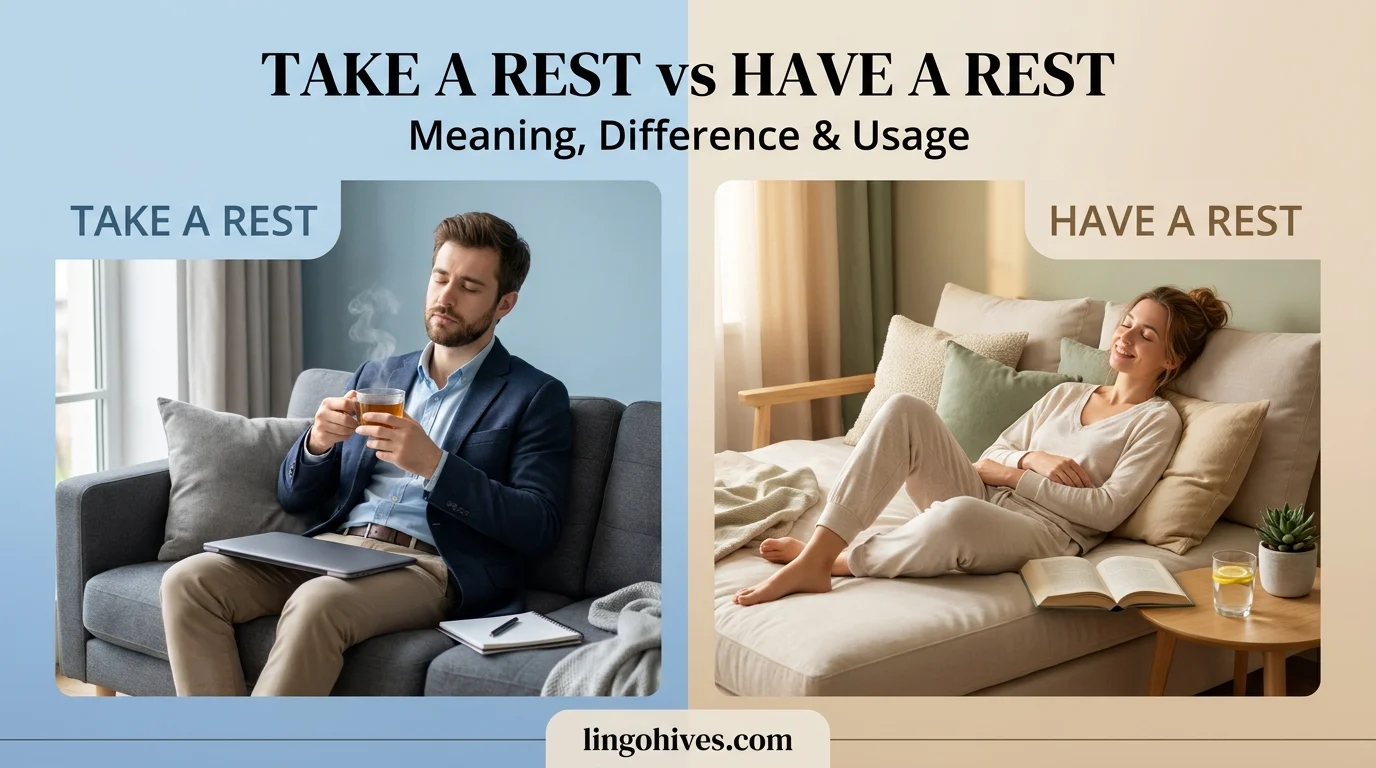
English learners often come across the phrases “take a rest” and “have a rest.” Both expressions are used when someone wants to stop working, studying, walking, or doing an activity for a short time to relax or recover energy. Because they have almost the same meaning, many people wonder whether these phrases are interchangeable or if there is a difference between them.
The good news is that both phrases are grammatically correct and natural in English. However, their usage can depend on the speaker, regional preferences, and the context of the sentence. “Take a rest” is commonly used in international and American English, while “have a rest” is particularly common in British English. Understanding this small difference can help you sound more natural and confident when speaking or writing English.
Quick Answer
“Take a rest” and “have a rest” both mean to stop an activity temporarily to relax or regain energy. “Take a rest” is widely understood in American and international English, while “have a rest” is especially common in British English. Both expressions are correct and can often be used interchangeably.
Why Do People Confuse Take a Rest vs Have a Rest?
People confuse these expressions because both use different verbs with the same noun, “rest.”
In English, certain nouns naturally combine with particular verbs. These combinations are called collocations.
For example:
- Take a break.
- Have a break.
- Take a rest.
- Have a rest.
Both “take” and “have” can be used with “rest,” making it difficult for learners to understand whether one is more correct than the other.
The main difference is not their basic meaning but their regional usage and commonness in everyday conversation.
First Word: What Does Take a Rest Mean?
Take a rest means to stop doing something for a while so that you can relax, recover, or regain your energy.
The verb “take” suggests allowing yourself some time away from an activity.
It is commonly used when someone feels tired after working, exercising, studying, or traveling.
Examples of Take a Rest
- You look tired. You should take a rest.
- I need to take a rest after working all day.
- The players took a rest after the football match.
- She decided to take a rest before continuing her studies.
- Take a rest if you feel exhausted.
When Is Take a Rest Commonly Used?
Use “take a rest” when:
- Someone feels physically tired.
- You need to recover after exercise.
- You want to pause your work.
- You need some time to relax.
- You are advising someone to stop and recover.
Example: After walking for three hours, we decided to take a rest.
Second Word: What Does Have a Rest Mean?
Have a rest means to relax or stop an activity temporarily to recover your energy.
It has the same basic meaning as “take a rest.”
This expression is particularly common in British English and everyday British conversation.
Examples of Have a Rest
- You look tired. Why don’t you have a rest?
- I want to have a rest after lunch.
- The children had a rest after playing outside.
- She needs to have a rest before going to work.
- Let’s have a rest for a few minutes.
When Is Have a Rest Commonly Used?
Use “have a rest” when:
- You want to relax for a short time.
- You are speaking in British English.
- You are suggesting that someone take a break.
- You want to describe a period of relaxation.
Example: After finishing the housework, my mother decided to have a rest.
Take a Rest vs Have a Rest: Comparison Table
| Feature | Take a Rest | Have a Rest |
| Meaning | Relax or recover energy | Relax or recover energy |
| Grammar | Correct | Correct |
| Main verb | Take | Have |
| British English | Used | Very common |
| American English | Understood and used | Less common |
| Context | Work, exercise, tiredness | Relaxation, everyday conversation |
| Interchangeable | Usually yes | Usually yes |
When Should You Use Each Expression?
Although both expressions are correct, choosing the right one can make your English sound more natural.
1. Use Take a Rest for General and International English
“Take a rest” is widely understood across different English-speaking regions.
Examples:
- I need to take a rest after exercising.
- You should take a rest before driving again.
- He took a rest after completing his work.
2. Use Have a Rest in British English
“Have a rest” is particularly natural in British English.
Examples:
- Let’s have a rest before dinner.
- You should have a rest after your journey.
- The baby is having a rest.
3. Use Either Expression When Giving Advice
Both phrases work when advising someone to relax.
Examples:
- You look tired. Take a rest.
- You look tired. Have a rest.
Both sentences are grammatically correct.
12 Examples: Take a Rest vs Have a Rest in Sentences
Here are practical examples to help you understand how both expressions work.
| Take a Rest | Have a Rest |
| I need to take a rest. | I need to have a rest. |
| Take a rest after lunch. | Have a rest after lunch. |
| She took a rest yesterday. | She had a rest yesterday. |
| We should take a rest now. | We should have a rest now. |
| He wants to take a rest. | He wants to have a rest. |
| They took a rest outside. | They had a rest outside. |
| You need to take a rest. | You need to have a rest. |
| Let’s take a rest here. | Let’s have a rest here. |
| I took a rest after walking. | I had a rest after walking. |
| The workers took a rest. | The workers had a rest. |
| She is taking a rest. | She is having a rest. |
| He takes a rest every afternoon. | He has a rest every afternoon. |
Examples in Everyday Conversations
Conversation 1
Ali: You look exhausted. Are you okay?
Ahmed: Yes, I just need to take a rest.
Conversation 2
Mother: You have been studying for hours.
Daughter: I know. I’ll have a rest for a few minutes.
Conversation 3
Friend: Why are you sitting here?
You: I’ve been walking all morning, so I’m taking a rest.
Common Mistakes to Avoid
English learners sometimes make mistakes when using these expressions.
Mistake 1: Using the Wrong Verb Form
Incorrect: I am have a rest.
Correct: I am having a rest.
Correct: I am taking a rest.
Remember to use the -ing form after the helping verb “am.”
Mistake 2: Forgetting the Article
Incorrect: I need to take rest.
Correct: I need to take a rest.
Correct: I need to have a rest.
In these expressions, the article “a” is normally required.
Mistake 3: Using Have Instead of Has
Incorrect: She have a rest every afternoon.
Correct: She has a rest every afternoon.
Use “has” with he, she, and it in the simple present tense.
Mistake 4: Using the Wrong Past Form
Incorrect: I have a rest yesterday.
Correct: I had a rest yesterday.
Correct: I took a rest yesterday.
Use the past tense when describing something that happened in the past.
Memory Trick: How to Remember the Difference
Remember this simple trick:
- Take a rest: Think of taking some time away from work.
- Have a rest: Think of having some relaxing time.
Both expressions describe the same general activity.
You can also remember this:
Take = Take time off.
Have = Have some relaxation.
The easiest way to avoid confusion is to remember that both expressions are correct.
American vs British English
One noticeable difference between these expressions is their regional popularity.
American English
In American English, “take a rest” is understood and used, although Americans often prefer expressions such as:
- Take a break.
- Get some rest.
- Rest for a while.
Example: You have been working all day. You should take a break.
British English
In British English, “have a rest” is particularly common and sounds natural in everyday conversation.
Example: You’ve been working hard. You should have a rest.
British speakers also use “take a rest,” so it is not incorrect in British English.
Important: These are differences in preference, not strict grammatical rules. Both expressions are understood in both varieties of English.
Similar Words and Expressions
Several other English expressions communicate a similar idea.
| Expression | Meaning | Example |
| Take a break | Stop an activity temporarily | Let’s take a break. |
| Have a break | Spend time away from work | We can have a break now. |
| Get some rest | Recover energy through relaxation or sleep | You need to get some rest. |
| Take a nap | Sleep for a short time | I want to take a nap. |
| Relax | Become calm and comfortable | Try to relax. |
| Rest for a while | Stop and recover temporarily | You should rest for a while. |
Although these expressions are related, they are not always interchangeable.
For example, “take a nap” specifically suggests sleeping, while “take a rest” does not necessarily mean sleeping.
Final Verdict: Take a Rest or Have a Rest?
Both “take a rest” and “have a rest” are grammatically correct English expressions. They share almost the same meaning: to stop an activity temporarily and relax or recover energy.
Choose “take a rest” for widely understood general English, and “have a rest” when using a British English style.
Neither expression is universally more correct than the other. Your choice depends mainly on regional preference and personal speaking style.
Frequently Asked Questions
1. Is it correct to say take a rest?
Yes. “Take a rest” is grammatically correct. It means to stop an activity temporarily to relax or recover energy.
Example: You look tired. You should take a rest.
2. Is it correct to say have a rest?
Yes. “Have a rest” is also grammatically correct and particularly common in British English.
Example: I want to have a rest after work.
3. What is the difference between take a rest and have a rest?
Both expressions have the same basic meaning. The main difference is regional preference. “Have a rest” is especially common in British English, while “take a rest” is widely understood internationally.
4. Which is more common in American English: take a rest or have a rest?
“Take a rest” is generally more familiar in American English than “have a rest.” However, Americans often prefer “take a break” or “get some rest” in everyday situations.
5. Which is more common in British English?
“Have a rest” is particularly common and natural in British English. However, British speakers also use “take a rest.”
6. Can I use take a rest and have a rest interchangeably?
Yes. In most everyday situations, you can use them interchangeably without changing the basic meaning.
Example:
- I need to take a rest.
- I need to have a rest.
Both sentences are correct.
7. Is take a rest the same as take a break?
They have similar meanings, but there can be a small difference. “Take a rest” emphasizes relaxation and recovering energy, while “take a break” means temporarily stopping an activity. A break does not always involve resting.
Remember This
- Take a rest = Stop and recover energy.
- Have a rest = Stop and relax.
- Both expressions are grammatically correct.
- “Have a rest” is particularly common in British English.
- “Take a rest” is widely understood internationally.
The key is to understand that the difference is mainly about regional usage, not meaning.
Conclusion
Understanding the difference between “take a rest” and “have a rest” is simple once you know that both expressions describe the same basic action. They are used when someone wants to stop working, studying, exercising, or doing another activity to relax and regain energy. Both are correct, so you do not need to worry about making a grammatical mistake when choosing either phrase.
For natural everyday English, remember the regional preferences: “have a rest” is especially common in British English, while “take a rest” is widely understood in American and international English. Learning these small differences will help you communicate more naturally and confidently.

I am Jimmy Michael, a language enthusiast and writer passionate about exploring different languages, words, and cultures. I create simple, useful content that helps readers understand languages better and discover new ways to communicate globally.