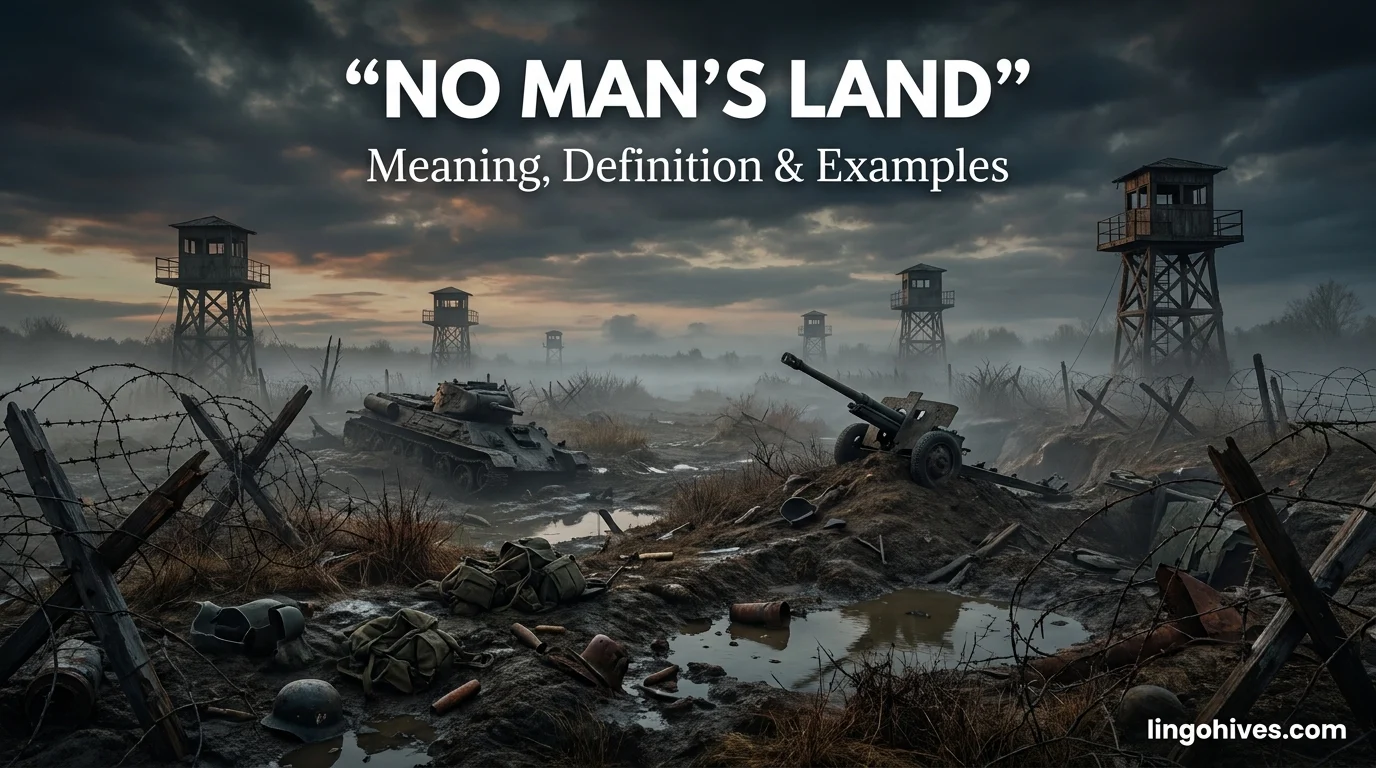
The phrase “no man’s land” is commonly used to describe a place or situation that belongs to nobody, is not controlled by anyone, or exists between two opposing sides. It can refer to a physical area, such as an empty piece of land between two countries, or a dangerous space between enemy forces during a war. In everyday English, it can also describe a situation where nobody has responsibility, authority, or control.
Understanding the meaning of no man’s land helps English learners recognize how this expression works in different contexts. Although the phrase contains the word “man,” it is not limited to men. It is a traditional expression used in general English. You may encounter it in history books, news reports, conversations, literature, and descriptions of unfamiliar places. This guide explains its meaning, origin, usage, examples, common mistakes, and related expressions in simple English.
Quick Answer
No man’s land means an area that is not owned, occupied, or controlled by anyone. Historically, it often referred to the dangerous ground between opposing armies during war. In everyday English, it can also describe an uncertain situation or place between two different areas or conditions.
Why Do People Confuse It?
People sometimes misunderstand “no man’s land” because its meaning changes slightly depending on the context.
For example:
- Literal meaning: An area that nobody owns or controls.
- Military meaning: Land between opposing armies, especially during wartime.
- Figurative meaning: A situation where someone feels stuck between two choices, groups, or conditions.
Another reason for confusion is that learners may interpret the word “man” literally. However, the expression is an established English idiom and generally refers to an unclaimed or uncontrolled area, not a place exclusively for men.
First Word: No
The word “no” is used to express the absence of something. It can mean not any, none, or zero.
Examples:
- There is no water in the bottle.
- No students were absent today.
- There is no information about the incident.
- We have no reason to worry.
In “no man’s land,” the word “no” helps express the idea that the land does not belong to or is not controlled by anyone.
Second Word: Man’s Land
The expression “man’s land” contains two important parts:
- Man’s: A possessive form traditionally referring to a person or human being.
- Land: An area of ground, territory, or property.
Together with “no,” the expression forms a phrase describing land that is not claimed or controlled by anyone.
The phrase has historical roots in territorial and military language, where it described land outside the control of opposing forces.
No Man’s Land vs. Related Expressions
| Expression | Meaning | Example |
| No man’s land | Unclaimed or uncontrolled area | The valley became no man’s land. |
| Nobody’s land | Land belonging to nobody | The empty field was treated as nobody’s land. |
| Neutral territory | An area not controlled by either opposing side | The meeting took place in neutral territory. |
| Borderland | Land near a border | They lived in the borderland. |
| Wasteland | An unused or neglected area | The factory stood in a wasteland. |
When Should You Use No Man’s Land?
Use “no man’s land” when describing a physical area or an uncertain situation that is not clearly controlled, occupied, or claimed.
1. In Military Contexts
Use it when discussing the dangerous area between opposing armies.
Example: Soldiers were afraid to cross no man’s land during the battle.
2. In Geography and Territory
Use it when describing an area that does not clearly belong to any country or authority.
Example: The disputed region was described as no man’s land.
3. In Everyday Conversations
Use it figuratively when describing a place or situation that feels isolated or disconnected.
Example: After changing careers, he felt he was in no man’s land.
4. In Sports
The phrase can describe an area on a playing field where neither team has clear control.
Example: The ball remained in no man’s land between the two players.
15 Examples of No Man’s Land in Sentences
Here are 15 examples showing how to use this expression correctly:
- The soldiers had to cross no man’s land to reach the enemy position.
- The abandoned building stood in what looked like no man’s land.
- Nobody wanted to enter the dangerous no man’s land.
- The border area became no man’s land after the conflict.
- The soldiers carefully watched the empty ground between the trenches.
- After leaving his old job, he felt stuck in no man’s land.
- The two countries argued over the disputed territory.
- The abandoned railway station looked like no man’s land.
- The football landed in no man’s land between two defenders.
- The village became isolated and almost like no man’s land.
- The land between the two military positions was extremely dangerous.
- She felt caught in no man’s land between childhood and adulthood.
- The abandoned industrial area had become a modern no man’s land.
- The two departments disagreed about who was responsible, leaving the project in no man’s land.
- The explorers entered a remote area that seemed like no man’s land.
Common Mistakes When Using No Man’s Land
English learners sometimes make mistakes when writing or speaking this expression.
Mistake 1: Writing It as One Word
Incorrect: Noman’sland
Correct: No man’s land
The expression is written as three separate words.
Mistake 2: Forgetting the Apostrophe
Incorrect: No mans land
Correct: No man’s land
The apostrophe is necessary because “man’s” is possessive.
Mistake 3: Using It Only for War
Although the expression has a strong historical connection with warfare, it can also describe uncertain situations, abandoned places, and areas without clear control.
Mistake 4: Assuming It Always Means Unowned Land
Not every area described as no man’s land is legally unowned. Sometimes it simply means that nobody occupies or controls it.
Mistake 5: Confusing It with Neutral Territory
Neutral territory is an area recognized as neutral under particular circumstances. No man’s land generally describes an area outside clear ownership, occupation, or control. The expressions are not always interchangeable.
Memory Trick: How to Remember No Man’s Land
A simple way to remember this expression is:
No + Man’s + Land = Land belonging to nobody.
Imagine an empty field with no houses, people, soldiers, or clear authority. This picture can help you remember the expression.
You can also remember:
- No = None
- Man’s = Person’s
- Land = Area of ground
Together, the phrase describes an area that nobody claims or controls.
American vs. British English
The expression “no man’s land” is used in both American and British English.
There is no major difference in its spelling or basic meaning between the two varieties.
| Feature | American English | British English |
| Spelling | No man’s land | No man’s land |
| Meaning | Unclaimed or uncontrolled area | Unclaimed or uncontrolled area |
| Military usage | Common | Common |
| Figurative usage | Common | Common |
Both American and British speakers use this expression in military discussions, historical writing, news reports, and everyday conversations.
Similar Words and Expressions
Several English expressions have meanings related to “no man’s land.” However, their exact meanings can differ.
- Neutral ground: An area where opposing sides agree not to fight or where neither side has an advantage.
- Nobody’s land: An informal expression for land that belongs to nobody.
- Borderland: An area close to a national or regional border.
- Wilderness: A natural area that is largely untouched by people.
- Wasteland: An area that is empty, neglected, or unsuitable for normal use.
- Unclaimed territory: Land that nobody has officially claimed.
- Dead zone: An area where activity or life is extremely limited.
- Middle ground: A position between two opposing opinions or choices.
Final Verdict
No man’s land is an established English expression that describes an area without clear ownership, occupation, or control. Its historical meaning is closely connected with warfare, especially the dangerous ground between opposing armies.
Today, it is also used figuratively to describe uncertain situations, isolated places, and circumstances in which nobody has clear responsibility. Understanding both meanings will help you use this expression naturally and correctly.
Frequently Asked Questions
1. What does no man’s land mean?
No man’s land means an area that is not owned, occupied, or controlled by anyone. It can also describe an uncertain situation between two different conditions or groups.
2. Why is it called no man’s land?
It is called no man’s land because it traditionally refers to an area that belongs to nobody or is not controlled by any particular person, group, or authority.
3. Is no man’s land an idiom?
Yes. It is an established English expression that can be used literally for an uncontrolled area or figuratively for an uncertain situation.
4. Is no man’s land related to war?
Yes. The expression is strongly associated with warfare, particularly World War I, when it described the dangerous ground between opposing trenches.
5. What is an example of no man’s land?
An example is the dangerous area between two opposing armies during a battle. Another example is an abandoned area that nobody occupies or controls.
6. Is no man’s land the same as neutral territory?
No. Neutral territory is an area recognized as neutral between opposing sides, while no man’s land generally refers to an area outside clear ownership or control.
7. Is no man’s land one word or three words?
It is written as three separate words: “no man’s land.” The apostrophe in “man’s” is important.
8. Can no man’s land be used figuratively?
Yes. For example, someone changing careers might say, “I feel like I am in no man’s land,” meaning they are in an uncertain position between two stages of life.
Remember This
- No man’s land means an area without clear ownership or control.
- It is historically associated with warfare.
- It can describe physical places and uncertain situations.
- It is written as three words.
- It is used in both American and British English.
Conclusion
“No man’s land” is a useful English expression with both literal and figurative meanings. It traditionally describes an area that nobody owns or controls, especially the dangerous ground between opposing armies during war. In modern English, it can also describe abandoned places and uncertain situations.
Learning this phrase will improve your understanding of English conversations, historical texts, news articles, and everyday expressions. Remember its basic meaning, study the examples, and practice using it in your own sentences.

I am Jimmy Michael, a language enthusiast and writer passionate about exploring different languages, words, and cultures. I create simple, useful content that helps readers understand languages better and discover new ways to communicate globally.