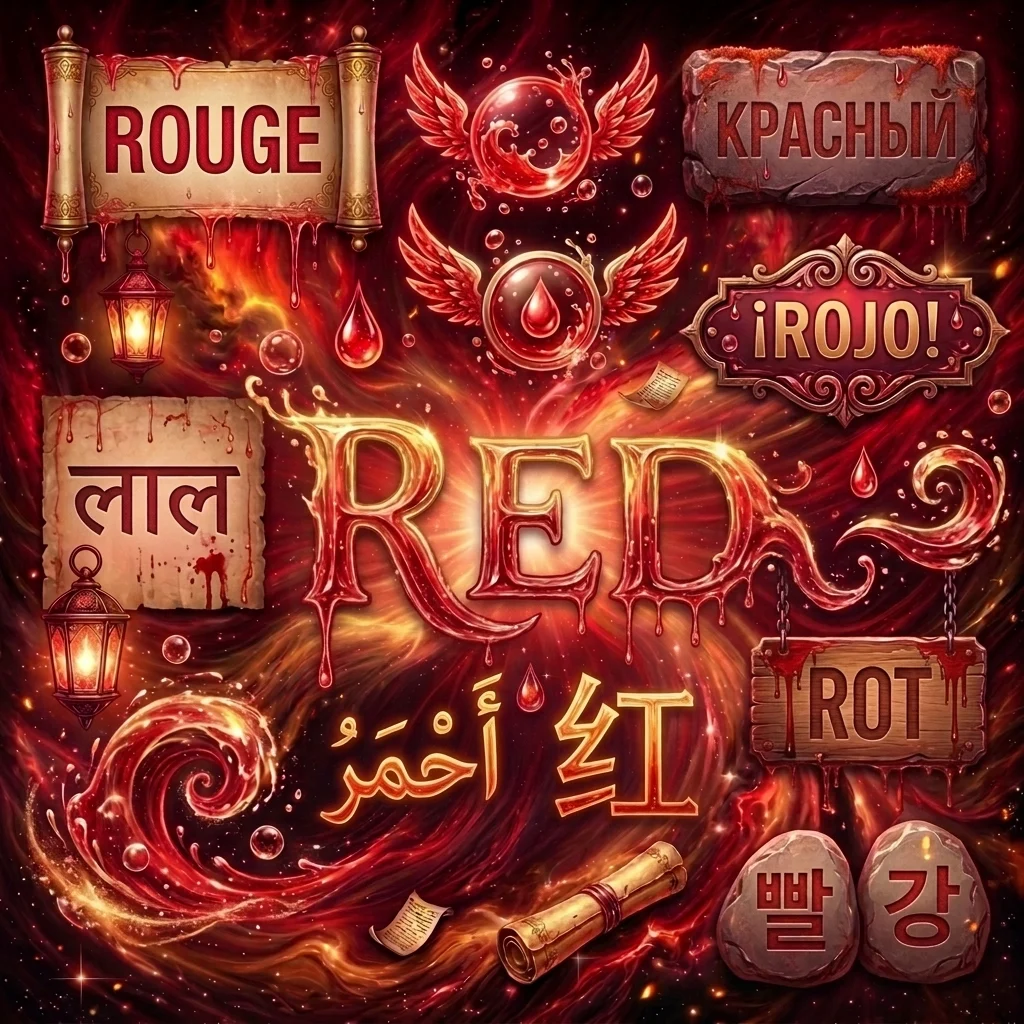
Red is one of the most recognizable colors in the world. It can represent love, passion, courage, celebration, danger, or good fortune, depending on the culture and context.
Learning how to say red in different languages is a useful way to expand your vocabulary, explore other cultures, and communicate with people from around the world.
Whether you are learning a new language, traveling abroad, teaching children about colors, or searching for red translations for a writing project, this guide makes it easy to get started.
In this article, you will discover red in 70 different languages, including each language’s native word, an easy English pronunciation guide, a practical example sentence, and its English meaning.
Red in All Languages: Quick Overview
The word for red varies across languages. For example, it is rojo in Spanish, rouge in French, rot in German, and rosso in Italian. Other languages use different writing systems, such as Arabic, Hindi, Japanese, and Chinese.
Some languages also change the word for red depending on grammatical gender, the noun being described, or the sentence structure. The table below provides a practical starting point, using common forms and simple everyday examples.
How to Say Red in Different Languages: 70 Translations
The following table includes 70 languages from Europe, Asia, Africa, the Middle East, and other regions. Pronunciations are approximate English-friendly guides, and example sentences show how the word for red is used in everyday situations.
| # | Language | Red in native language | Easy pronunciation | Example sentence | English meaning |
|---|---|---|---|---|---|
| 1 | English | Red | red | The apple is red. | The apple is red. |
| 2 | Spanish | Rojo / Roja | ROH-hoh / ROH-hah | La rosa es roja. | The rose is red. |
| 3 | French | Rouge | roozh | La pomme est rouge. | The apple is red. |
| 4 | German | Rot | roht | Das Auto ist rot. | The car is red. |
| 5 | Italian | Rosso / Rossa | ROHS-soh / ROHS-sah | La mela è rossa. | The apple is red. |
| 6 | Portuguese | Vermelho / Vermelha | vehr-MEH-lyoo / vehr-MEH-lyah | A rosa é vermelha. | The rose is red. |
| 7 | Dutch | Rood | roht | De appel is rood. | The apple is red. |
| 8 | Swedish | Röd | ruhd | Bilen är röd. | The car is red. |
| 9 | Norwegian | Rød | ruhd | Huset er rødt. | The house is red. |
| 10 | Danish | Rød | ruhth | Bilen er rød. | The car is red. |
| 11 | Finnish | Punainen | POO-nah-ee-nen | Omena on punainen. | The apple is red. |
| 12 | Icelandic | Rauður | RÖY-thur | Bíllinn er rauður. | The car is red. |
| 13 | Irish | Dearg | jair-ug | Tá an carr dearg. | The car is red. |
| 14 | Welsh | Coch | kohkh | Mae’r car yn goch. | The car is red. |
| 15 | Scottish Gaelic | Dearg | jair-ug | Tha an càr dearg. | The car is red. |
| 16 | Polish | Czerwony / Czerwona | cher-VOH-nih / cher-VOH-nah | Jabłko jest czerwone. | The apple is red. |
| 17 | Czech | Červený / Červená | CHER-veh-nee / CHER-veh-naa | Auto je červené. | The car is red. |
| 18 | Slovak | Červený / Červená | CHER-veh-nee / CHER-veh-naa | Auto je červené. | The car is red. |
| 19 | Slovenian | Rdeč / Rdeča | r-dehch / r-deh-chah | Avto je rdeč. | The car is red. |
| 20 | Croatian | Crven / Crvena | TSR-ven / TSR-veh-nah | Ruža je crvena. | The rose is red. |
| 21 | Serbian | Црвен / Црвена | TSR-ven / TSR-veh-nah | Ружа је црвена. | The rose is red. |
| 22 | Bosnian | Crven / Crvena | TSR-ven / TSR-veh-nah | Ruža je crvena. | The rose is red. |
| 23 | Bulgarian | Червен / Червена | cher-VEN / cher-VEH-nah | Розата е червена. | The rose is red. |
| 24 | Macedonian | Црвен / Црвена | TSR-ven / TSR-veh-nah | Розата е црвена. | The rose is red. |
| 25 | Russian | Красный / Красная | KRAS-nih / KRAS-nah-yah | Роза красная. | The rose is red. |
| 26 | Ukrainian | Червоний / Червона | cher-VOH-nih / cher-VOH-nah | Троянда червона. | The rose is red. |
| 27 | Belarusian | Чырвоны / Чырвоная | chir-VOH-nih / chir-VOH-nah-yah | Ружа чырвоная. | The rose is red. |
| 28 | Greek | Κόκκινο | KOH-kee-noh | Το μήλο είναι κόκκινο. | The apple is red. |
| 29 | Albanian | I kuq / E kuqe | ee kooch / eh KOO-cheh | Molla është e kuqe. | The apple is red. |
| 30 | Romanian | Roșu / Roșie | ROH-shoo / ROH-shee-eh | Mărul este roșu. | The apple is red. |
| 31 | Hungarian | Piros | PEE-rosh | Az alma piros. | The apple is red. |
| 32 | Estonian | Punane | POO-nah-neh | Õun on punane. | The apple is red. |
| 33 | Latvian | Sarkans / Sarkana | SAR-kans / sar-KAH-nah | Ābols ir sarkans. | The apple is red. |
| 34 | Lithuanian | Raudonas / Raudona | row-DOH-nas / row-DOH-nah | Obuolys yra raudonas. | The apple is red. |
| 35 | Turkish | Kırmızı | kuhr-muh-ZUH | Elma kırmızı. | The apple is red. |
| 36 | Azerbaijani | Qırmızı | kuh-ruh-muh-ZUH | Alma qırmızıdır. | The apple is red. |
| 37 | Persian (Farsi) | قرمز | gher-MEZ | سیب قرمز است. | The apple is red. |
| 38 | Arabic | أحمر / حمراء | AH-mar / HAM-raa | التفاحة حمراء. | The apple is red. |
| 39 | Hebrew | אדום / אדומה | ah-DOHM / ah-doo-MAH | התפוח אדום. | The apple is red. |
| 40 | Urdu | لال / سرخ | laal / surkh | سیب لال ہے۔ | The apple is red. |
| 41 | Hindi | लाल | laal | सेब लाल है। | The apple is red. |
| 42 | Bengali | লাল | laal | আপেলটি লাল। | The apple is red. |
| 43 | Punjabi | ਲਾਲ | laal | ਸੇਬ ਲਾਲ ਹੈ। | The apple is red. |
| 44 | Gujarati | લાલ | laal | સફરજન લાલ છે. | The apple is red. |
| 45 | Marathi | लाल | laal | सफरचंद लाल आहे. | The apple is red. |
| 46 | Nepali | रातो | RAA-toh | स्याउ रातो छ। | The apple is red. |
| 47 | Sinhala | රතු | rah-too | ඇපල් ගෙඩිය රතුයි. | The apple is red. |
| 48 | Tamil | சிவப்பு | see-vap-poo | ஆப்பிள் சிவப்பாக உள்ளது. | The apple is red. |
| 49 | Telugu | ఎరుపు | eh-roo-poo | ఆపిల్ ఎరుపు రంగులో ఉంది. | The apple is red. |
| 50 | Kannada | ಕೆಂಪು | kem-poo | ಸೇಬು ಕೆಂಪಾಗಿದೆ. | The apple is red. |
| 51 | Malayalam | ചുവപ്പ് | choo-vap-poo | ആപ്പിൾ ചുവപ്പാണ്. | The apple is red. |
| 52 | Thai | สีแดง | see daeng | แอปเปิลสีแดง | The apple is red. |
| 53 | Lao | ສີແດງ | see daeng | ໝາກແອັບເປິ້ນສີແດງ | The apple is red. |
| 54 | Khmer | ក្រហម | kro-hom | ផ្លែប៉ោមពណ៌ក្រហម។ | The apple is red. |
| 55 | Vietnamese | Đỏ | daw | Quả táo màu đỏ. | The apple is red. |
| 56 | Indonesian | Merah | MEH-rah | Apel itu merah. | The apple is red. |
| 57 | Malay | Merah | MEH-rah | Epal itu merah. | The apple is red. |
| 58 | Filipino (Tagalog) | Pula | POO-lah | Pula ang mansanas. | The apple is red. |
| 59 | Javanese | Abang | AH-bang | Apelé abang. | The apple is red. |
| 60 | Sundanese | Beureum | buh-rum | Apél téh beureum. | The apple is red. |
| 61 | Mandarin Chinese | 红色 (紅色) | hóng sè | 这个苹果是红色的。 | This apple is red. |
| 62 | Japanese | 赤い | ah-kah-ee | りんごは赤いです。 | The apple is red. |
| 63 | Korean | 빨간색 | ppal-gan-saek | 사과는 빨간색이에요. | The apple is red. |
| 64 | Mongolian | Улаан | oo-LAAN | Алим улаан байна. | The apple is red. |
| 65 | Kazakh | Қызыл | kuh-ZUHL | Алма қызыл. | The apple is red. |
| 66 | Uzbek | Qizil | kuh-ZEEL | Olma qizil. | The apple is red. |
| 67 | Swahili | Nyekundu | nyeh-KOON-doo | Tufaha ni jekundu. | The apple is red. |
| 68 | Amharic | ቀይ | keh-y | ፖሙ ቀይ ነው። | The apple is red. |
| 69 | Yoruba | Pupa | POO-pah | Àpù náà pupa. | The apple is red. |
| 70 | Zulu | Bomvu | BOM-voo | I-apula libomvu. | The apple is red. |
Note: Pronunciation guides are approximations, not exact phonetic transcriptions. Some languages change color words to match the gender, number, or grammatical form of the noun. Everyday usage may also vary by region.
Red Around the World: What Does the Color Symbolize?
Red is more than a color name. Its meaning often depends on local traditions, customs, and everyday associations.
- Love and romance: Red roses, hearts, and gifts are commonly associated with romantic love in many parts of the world.
- Luck and celebration: Red is an important festive color in Chinese culture and is widely used in Lunar New Year decorations.
- Energy and courage: Red can suggest strength, determination, passion, and confidence.
- Warning and danger: Red is frequently used on warning signs, traffic signals, and emergency indicators.
- Festivals and ceremonies: Red clothing and decorations appear in various cultural and religious celebrations, although the meanings differ by community.
Understanding these associations can help you use red-related vocabulary appropriately when traveling, studying languages, or communicating across cultures.
Tips for Learning Red in Different Languages
Learning color words becomes easier when you connect each word to something you see every day. Try these simple methods to remember red translations and use them naturally.
1. Practice With Everyday Objects
Choose three red objects, such as an apple, a flower, and a shirt. Say the word for red in your target language whenever you see one of them.
2. Learn the Word in a Complete Sentence
Memorizing a color word is useful, but learning it in context helps you understand how it works grammatically. Practice simple sentences such as “The flower is red” or “I have a red bag.”
3. Pay Attention to Pronunciation
Some languages use sounds that do not exist in English. Listen carefully to native speakers when possible, and remember that the pronunciation guides in the table are intended to make your first attempt easier.
4. Notice Differences Between Languages
Several European languages have similar-looking words for red, while many Asian languages use entirely different words and writing systems. Comparing these forms can make vocabulary more memorable.
Why Learn Color Names in Multiple Languages?
Learning how to say red in different languages can be useful for several reasons:
- Travel: Recognize and describe clothing, products, signs, and other objects.
- Language learning: Build a foundation for describing people, places, and things.
- Education: Help children learn colors through multilingual activities.
- Writing and translation: Choose suitable color words for stories, descriptions, and creative projects.
- Cultural understanding: Explore how different communities use color in celebrations, traditions, and daily life.
Even a single word can be a practical starting point for learning more about another language.
Frequently Asked Questions
1. How do you say red in different languages?
Red has different translations around the world. It is rojo in Spanish, rouge in French, rot in German, rosso in Italian, laal in Hindi and Urdu, and hóng sè in Mandarin Chinese.
2. What is the word for red in all languages?
There is no single word for red that is used in every language. Each language has its own vocabulary, and some languages have multiple forms depending on grammar, context, or the shade of red being described.
3. How do you say red in Japanese and Korean?
In Japanese, red is commonly expressed as 赤い (akai) when describing something red. In Korean, 빨간색 (ppalgansaek) is a common word for the color red.
4. What does red symbolize in different cultures?
Red can symbolize love, passion, luck, celebration, courage, or danger. Its meaning varies according to cultural traditions and the situation in which the color appears.
5. Are red translations the same for every type of object?
Not always. Some languages change the form of a color adjective to agree with a noun’s gender or number. Others use different expressions depending on whether you are naming the color itself or describing an object.
Conclusion
Learning red in different languages is a simple way to explore vocabulary, pronunciation, and cultural diversity. From rojo in Spanish and rouge in French to laal in Hindi and aka i in Japanese, each language offers its own way to describe this familiar color.
Use the 70-language table as a reference, practice the example sentences aloud, and revisit the words that interest you most. With regular practice, you can build your vocabulary and become more confident describing colors around the world.

I am Danny James, an Administrator at LingoHives, passionate about languages, communication, and cultural diversity. I enjoy helping people discover languages, understand words, and connect with different cultures through simple, useful, and engaging content.