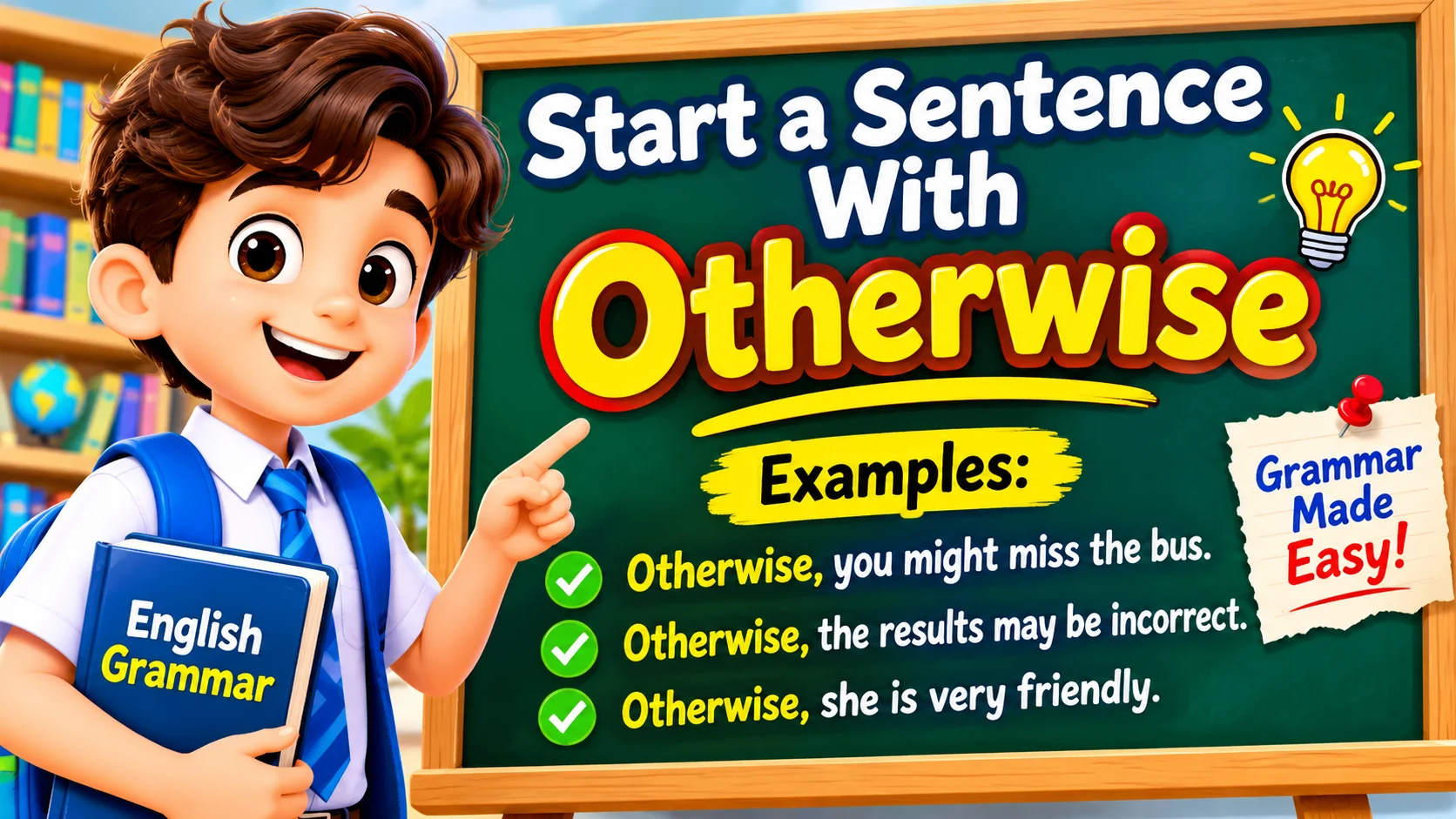
Starting a sentence with otherwise is a useful way to connect ideas, explain possible consequences, and show what may happen if someone does not follow advice or meet a condition. In English, otherwise usually means “if not,” “or else,” or “in a different way.” It helps writers and speakers express warnings, alternatives, and contrasting situations clearly. For example, “Finish your homework; otherwise, you may not have time to play.” In this sentence, otherwise introduces the possible result of not finishing the homework.
Many students and English learners wonder whether it is grammatically correct to begin a sentence with otherwise. The answer is yes. You can start a sentence with otherwise when the meaning is clear and the punctuation is correct. However, it is important to understand how otherwise connects to the previous sentence and when a comma is necessary. This guide explains its meaning, grammar rules, common mistakes, and practical examples to help you use it naturally in everyday English and formal writing.
Quick Answer: Can You Start a Sentence With Otherwise?
Yes, you can start a sentence with otherwise. It is grammatically correct when otherwise introduces an alternative, warning, or possible consequence connected to the previous idea. Place a comma after otherwise when it appears at the beginning of a sentence. For example: “Leave now. Otherwise, you will miss the bus.”
Why Do People Confuse It?
People sometimes confuse the use of otherwise because it can express several related meanings. Depending on the context, it can mean “if not,” “or else,” “in another way,” or “apart from that.”
Another reason for confusion is punctuation. Some writers believe otherwise must always appear in the middle of a sentence. However, it can also begin a completely new sentence.
Consider these examples:
- At the beginning: Study regularly. Otherwise, you may fail the examination.
- In the middle: Study regularly; otherwise, you may fail the examination.
- At the end: The room was small but otherwise comfortable.
All three examples are grammatically correct, but otherwise performs a slightly different function in each one.
First Word: Start
The word start is a verb and means to begin something or cause something to begin.
It is commonly used when talking about activities, conversations, journeys, projects, and processes.
Examples:
- I start my work at 9 a.m.
- Let’s start the English lesson.
- She wants to start a new business.
- The movie will start in ten minutes.
- You can start a sentence with a transition word.
In the phrase “start a sentence with otherwise,” start describes the action of placing a particular word at the beginning of a sentence.
Second Word: Otherwise
The word otherwise is an adverb that has several meanings in English.
Its most common uses include:
- If not: Describes what may happen if an action is not completed.
- Or else: Introduces a possible consequence or warning.
- In another way: Describes a different method or situation.
- Apart from that: Introduces an additional observation or qualification.
Examples:
- Hurry up. Otherwise, we will be late.
- You must follow the instructions; otherwise, the machine may stop working.
- I thought otherwise.
- The hotel was expensive but otherwise excellent.
Understanding these meanings makes it easier to use otherwise correctly at the beginning of a sentence.
Start a Sentence With Otherwise vs. Use Otherwise in the Middle
| Feature | Otherwise at the Beginning | Otherwise in the Middle |
|---|---|---|
| Position | Begins a new sentence | Appears within a sentence |
| Main purpose | Introduces a consequence or alternative | Connects two related clauses |
| Punctuation | Usually followed by a comma | Often preceded by a semicolon or comma, depending on structure |
| Example | Leave now. Otherwise, you will be late. | Leave now; otherwise, you will be late. |
| Writing style | Clear and direct | Compact and connected |
Both structures are correct. Choose the one that makes your writing easier to understand.
When to Use Each?
Knowing when to use otherwise at the beginning of a sentence can make your English more natural and effective.
1. When Giving a Warning
Use otherwise when explaining a possible negative result.
Example:
- Wear your seat belt. Otherwise, you could get seriously injured.
2. When Explaining a Consequence
Use it to show what might happen if someone does not follow an instruction.
Example:
- Submit your application today. Otherwise, it may be rejected.
3. When Giving Advice
Otherwise can make advice sound practical and clear.
Example:
- Save some money every month. Otherwise, unexpected expenses may become difficult to manage.
4. When Presenting an Alternative
Use otherwise to introduce another possibility.
Example:
- We should leave early. Otherwise, we can take the evening train.
5. When Making a Formal Argument
It can help connect ideas in academic and professional writing.
Example:
- The evidence must be verified. Otherwise, the conclusion may be unreliable.
15 Examples of Starting a Sentence With Otherwise
Here are 15 practical examples showing how to use otherwise at the beginning of a sentence.
- Finish your breakfast. Otherwise, you will be hungry at school.
- Take an umbrella. Otherwise, you might get wet in the rain.
- Follow the teacher’s instructions. Otherwise, you may make mistakes.
- Charge your phone tonight. Otherwise, its battery may run out tomorrow.
- Leave the house early. Otherwise, you could miss your flight.
- Practice English daily. Otherwise, improving your speaking skills may take longer.
- Lock the door before leaving. Otherwise, your belongings may not be safe.
- Drink enough water. Otherwise, you may become dehydrated.
- Read the question carefully. Otherwise, you might misunderstand it.
- Save your document regularly. Otherwise, you could lose your work.
- Wear warm clothes. Otherwise, you may feel uncomfortable in the cold.
- Check the address before driving. Otherwise, you might reach the wrong location.
- Complete the assignment on time. Otherwise, your teacher may deduct marks.
- Turn off the lights. Otherwise, electricity will be wasted.
- Prepare for the interview. Otherwise, you may struggle to answer important questions.
These examples show that otherwise is particularly useful when the second sentence explains a possible consequence of ignoring the first sentence.
Common Mistakes When Starting a Sentence With Otherwise
Although starting a sentence with otherwise is correct, some mistakes can make your writing confusing.
Mistake 1: Forgetting the Comma
Incorrect: Leave now. Otherwise you will miss the bus.
Better: Leave now. Otherwise, you will miss the bus.
A comma after introductory otherwise is the standard punctuation choice.
Mistake 2: Using Otherwise Without a Clear Connection
Incorrect: I bought a new phone. Otherwise, my brother likes football.
Better: I bought a new phone. Otherwise, I would have continued using my old one.
The word should introduce an alternative, consequence, or related idea that makes sense in context.
Mistake 3: Confusing Otherwise With However
Otherwise and however do not always have the same meaning.
- Otherwise: Leave now. Otherwise, you will miss the train.
- However: I wanted to leave. However, it started raining.
Otherwise often introduces a condition or alternative, while however introduces contrast.
Mistake 4: Using a Comma Splice
Incorrect: You should study harder, otherwise you may fail.
Better: You should study harder; otherwise, you may fail.
You can also write: You should study harder. Otherwise, you may fail.
A semicolon or full stop correctly separates the independent clauses.
Memory Trick: How to Remember Otherwise
Remember this simple rule:
Otherwise = If not, or else, or in another way.
When otherwise introduces a possible consequence, ask yourself:
“What will happen if the first action does not happen?”
For example:
- Study hard. Otherwise, you may fail.
Ask: What happens if you do not study hard?
Answer: You may fail.
If this relationship makes sense, otherwise is probably the right word.
American vs. British English
There is no significant difference between American and British English when starting a sentence with otherwise.
Both varieties use otherwise in the same way, with the same basic meanings and grammatical rules.
Examples:
American English:
- Finish your work. Otherwise, you will have to stay late.
British English:
- Finish your work. Otherwise, you will have to stay late.
The spelling, meaning, and punctuation are the same in both varieties. Otherwise is accepted in everyday conversations, academic writing, and professional communication in both countries.
Similar Words to Otherwise
Several English words and expressions can have meanings similar to otherwise. However, they are not always interchangeable.
| Word or Phrase | Meaning | Example |
|---|---|---|
| Or else | If not | Hurry up, or else we will be late. |
| If not | If something does not happen | Leave now. If not, you may miss the bus. |
| Alternatively | As another choice | We can take a taxi. Alternatively, we can walk. |
| Instead | In place of something | I will stay home instead. |
| However | Introduces contrast | It was raining. However, we continued playing. |
| Apart from that | Except for another detail | The food was good but otherwise ordinary. |
Choose the word that communicates your intended meaning most clearly.
Final Verdict: Is It Correct to Start a Sentence With Otherwise?
Yes, starting a sentence with otherwise is completely grammatically correct.
Use it when introducing a possible consequence, alternative, or different situation connected to an earlier statement. When it appears at the beginning of a sentence, place a comma after it.
“Complete your homework today. Otherwise, you may not have enough time tomorrow.”
Remember that otherwise should have a logical connection to the surrounding ideas.
Frequently Asked Questions
1. Can you start a sentence with otherwise?
Yes. You can start a sentence with otherwise when introducing a consequence, alternative, or related situation. For example: “Hurry up. Otherwise, we will miss the train.”
2. Should you put a comma after otherwise at the beginning of a sentence?
Yes. A comma is normally used after introductory otherwise. For example: “Take your medicine. Otherwise, you may feel worse.”
3. Is starting a sentence with otherwise formal or informal?
It is appropriate in both formal and informal English. You can use it in conversations, emails, essays, reports, and academic writing.
4. What does otherwise mean at the beginning of a sentence?
At the beginning of a sentence, otherwise commonly means “if not” or “or else.” It introduces a possible result if the previous action or condition does not happen.
5. Can otherwise connect two sentences?
Yes. Otherwise can connect two related independent clauses. For example: “You should leave now. Otherwise, you will be late.”
6. Is otherwise the same as however?
No. Otherwise commonly introduces a consequence or alternative, while however introduces a contrast between two ideas. For example: “Study hard. Otherwise, you may fail” and “I studied hard. However, the test was difficult.”
7. Can I use otherwise in academic writing?
Yes. Otherwise is suitable for academic writing when used correctly. It can explain consequences, conditions, and alternative possibilities in a clear and concise way.
8. What is another word for otherwise?
Depending on the context, alternatives include “if not,” “or else,” “alternatively,” and “in another way.” The best replacement depends on the intended meaning.
Remember This
- Starting a sentence with otherwise is grammatically correct.
- Use a comma after introductory otherwise.
- Otherwise often means “if not” or “or else.”
- It can introduce consequences, alternatives, and different situations.
- Make sure it connects logically to the previous idea.
- Do not confuse otherwise with however.
Conclusion
Starting a sentence with otherwise is an effective way to express consequences, alternatives, and different possibilities in English. It is grammatically correct in both formal and informal writing. When you use it at the beginning of a sentence, remember to place a comma after it and make sure the following idea connects naturally to the previous statement.
For students, beginners, and ESL learners, the easiest way to understand otherwise is to remember its common meaning: “if not” or “or else.” With regular practice and the examples in this guide, you can use otherwise confidently in conversations, school assignments, emails, and professional writing.