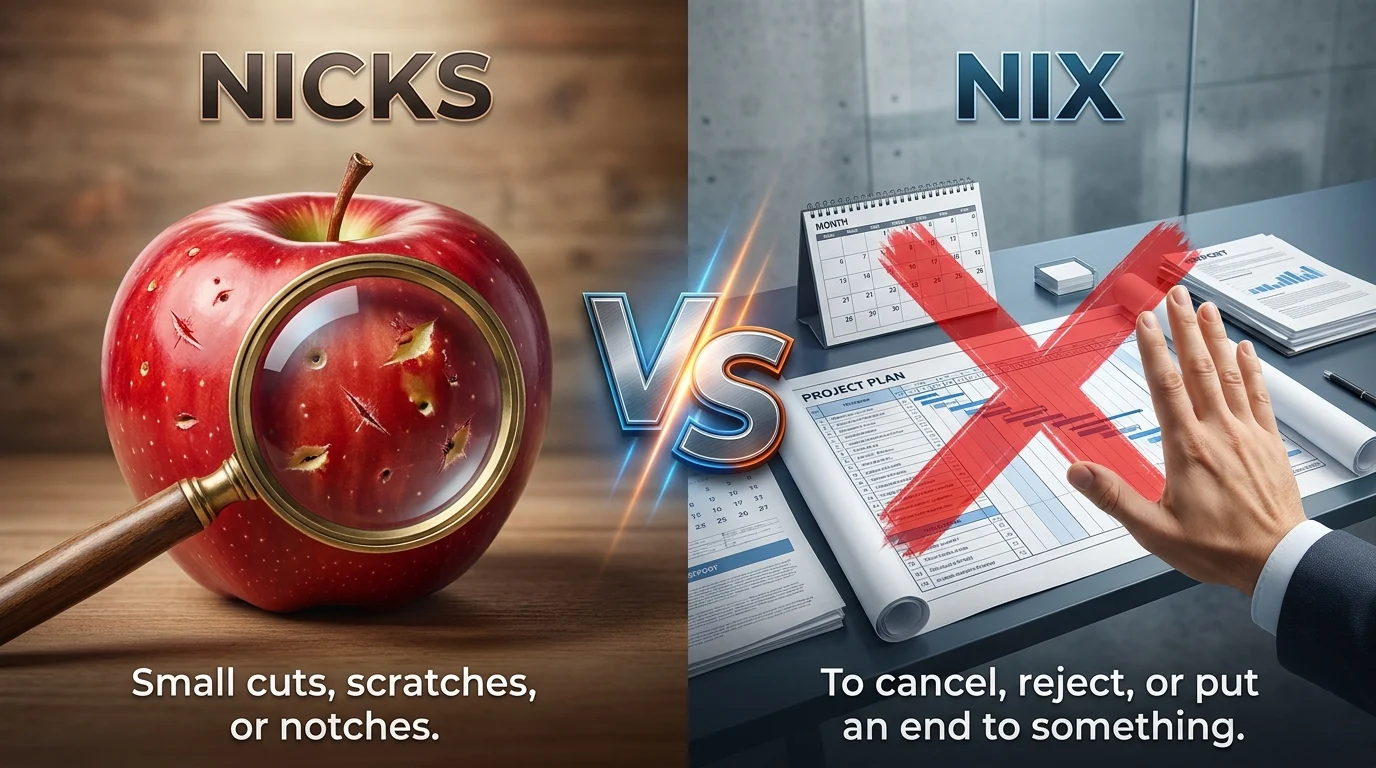
The English words nicks and nix may look and sound similar, but they have different meanings and grammatical uses. Understanding the difference between nicks vs. nix can help you choose the correct word when writing, speaking, or learning English. Although both words are relatively short, they belong to different word forms and are used in different contexts.
The word nicks can refer to small cuts, scratches, or notches. It can also be the third-person singular form of the verb nick, meaning to make a small cut or steal something. In contrast, nix is an informal verb meaning to reject, cancel, stop, or refuse something. It is commonly used in casual conversations, workplace discussions, and informal writing. Learning their definitions, examples, and common uses will make it easier to recognize when each word belongs in a sentence.
Quick Answer: Nicks vs. Nix
Nicks refers to small cuts, scratches, or notches, and it can also mean making a small cut or stealing something. Nix is an informal verb meaning to reject, cancel, or stop something. Use nicks when discussing small marks or cuts and nix when talking about rejecting or canceling an idea or plan.
Why Do People Confuse Nicks and Nix?
People often confuse nicks and nix because they are short English words with similar spellings and pronunciations.
Both contain the letters N and I, and both end with a consonant sound that can make them seem interchangeable to beginners.
However, their meanings are quite different:
- Nicks: Usually refers to small cuts, scratches, or notches.
- Nix: Means to reject, cancel, or prohibit something.
Another reason for confusion is that nicks has multiple grammatical uses. It can function as a plural noun or a verb form, while nix is commonly used as a verb.
Understanding the context of a sentence is the easiest way to identify the correct word.
What Does Nicks Mean?
Nicks is the plural form of the noun nick or the third-person singular form of the verb nick.
As a noun, a nick is a small cut, chip, or notch on a surface. It often describes minor damage to an object, such as a knife, glass, or wooden table.
As a verb, nicks describes making a small cut or notch in something. In informal British English, nick can also mean to steal something.
Examples of Nicks in Sentences
- There are several nicks on the kitchen knife.
- The old wooden table has a few small nicks.
- He nicks his finger while cutting vegetables.
- The barber nicks the customer’s skin accidentally.
- The sharp tool nicks the surface of the wood.
Other Meanings of Nicks
Depending on the context, nicks can also refer to:
- Small scratches on a surface.
- Minor cuts on the skin.
- Small chips along an object’s edge.
- Stealing something, in informal British English.
Simple definition: Nicks generally describes small cuts, marks, or notches, or the action of making them.
What Does Nix Mean?
Nix is an informal English verb meaning to reject, cancel, refuse, or put an end to something.
It is commonly used when someone decides not to accept an idea, proposal, suggestion, or plan.
For example, if a manager rejects a proposed project, you can say that the manager nixed the idea.
The word can also function as a noun meaning nothing or zero in informal American usage, although this use is less common.
Examples of Nix in Sentences
- The manager decided to nix the proposal.
- We had to nix our weekend travel plans.
- The committee may nix the new policy.
- They nixed the idea because it was too expensive.
- My parents nixed the plan to stay out late.
Other Uses of Nix
The word nix is commonly associated with:
- Rejecting an idea.
- Canceling an arrangement.
- Refusing a suggestion.
- Stopping a proposed activity.
- Prohibiting something from happening.
Simple definition: Nix means to reject, cancel, or stop something.
Nicks vs. Nix: Comparison Table
| Feature | Nicks | Nix |
| Main meaning | Small cuts or scratches | Reject or cancel |
| Part of speech | Noun or verb | Mainly verb |
| Root word | Nick | Nix |
| Common use | Physical marks or cuts | Plans and decisions |
| Example | The blade has nicks. | They nixed the plan. |
| English variety | British and American | Especially informal American English |
When Should You Use Nicks or Nix?
Choosing between these words becomes simple when you understand what you want to communicate.
When to Use Nicks
Use nicks when discussing small cuts, scratches, or marks on a physical object.
Examples:
- The glass has two small nicks.
- My phone screen has several nicks.
- The knife nicks the wooden cutting board.
You can also use nicks when describing someone stealing something in informal British English.
Example:
– He nicks food from the refrigerator.
When to Use Nix
Use nix when someone rejects, cancels, or stops an idea, plan, or activity.
Examples:
- The school decided to nix the event.
- We should nix that expensive proposal.
- The company nixed the original design.
Easy rule: If you are talking about scratches, choose nicks. If you are talking about rejecting something, choose nix.
12 Examples of Nicks vs. Nix in Sentences
Here are practical examples to help you understand the difference.
Examples Using Nicks
- The kitchen knife has several small nicks along its edge.
- I noticed a few nicks on my new phone.
- The carpenter nicks the wood while working.
- There are tiny nicks on the glass surface.
- The razor nicks his skin while shaving.
- The old scissors have several nicks.
Examples Using Nix
- The director decided to nix the original movie idea.
- We had to nix our vacation plans.
- The teacher nixed the suggestion.
- The company may nix the project next month.
- They decided to nix the unnecessary expenses.
- The organizers nixed the outdoor event because of bad weather.
These examples show that nicks generally relates to small physical marks, while nix relates to decisions and cancellations.
Common Mistakes When Using Nicks and Nix
English learners sometimes use these words incorrectly because their spellings are similar.
Here are common mistakes to avoid.
Mistake 1: Using nix to describe a scratch
Incorrect: There is a nix on my phone screen.
Correct: There is a nick on my phone screen.
Mistake 2: Using nicks to describe canceling a plan
Incorrect: The manager nicks the proposal.
Correct: The manager nixes the proposal.
Mistake 3: Confusing the plural noun with a verb
Incorrect: The knife has several nix.
Correct: The knife has several nicks.
Mistake 4: Assuming both words have the same meaning
Although they look similar, nicks and nix are not interchangeable. Always consider the meaning and context before choosing one.
Memory Trick: How to Remember Nicks vs. Nix
A simple memory trick can help you remember these words.
- Nicks = Notches: Think of small marks or scratches on an object.
- Nix = No: Think of saying no to an idea, suggestion, or plan.
Remember this simple association:
Nicks make marks, while nix means no.
This short trick can help beginners and ESL learners use both words correctly.
American vs. British English: Nicks vs. Nix
Both words can appear in American and British English, but their everyday usage can differ.
Nicks in American English
In American English, nicks commonly refers to small cuts, scratches, or chips.
Example:
– There are a few nicks on the metal surface.
Nicks in British English
British English uses nicks in the same physical sense. Additionally, the informal verb nick commonly means to steal something.
Example:
– Someone nicks a bicycle from outside the shop.
Nix in American English
Nix is particularly familiar in informal American English. It means to reject, cancel, or stop something.
Example:
– The committee decided to nix the proposal.
Nix in British English
Nix is also understood in British English, although alternatives such as scrap, reject, and cancel may be more familiar in everyday conversation.
The main distinction is not a strict American-versus-British spelling difference. It is the meaning and context in which each word is used.
Similar Words to Nicks and Nix
Learning related vocabulary can help you expand your English knowledge.
Words Similar to Nicks
- Scratch: A thin mark or cut on a surface.
- Notch: A small cut or indentation.
- Chip: A small broken piece from an object’s edge.
- Cut: An opening made by something sharp.
- Gouge: A deep cut or indentation.
Words Similar to Nix
- Reject: Refuse to accept something.
- Cancel: Decide that something will not happen.
- Scrap: Abandon or get rid of a plan.
- Refuse: Say no to something.
- Abandon: Stop doing or supporting something.
These alternatives can make your writing clearer and help you express ideas more precisely.
Final Verdict: Nicks or Nix?
The correct choice depends on the meaning you want to express.
Use nicks when referring to small cuts, scratches, chips, or notches. It can also describe making a small cut or, in informal British English, stealing something.
Use nix when you mean to reject, cancel, refuse, or stop an idea, proposal, or plan.
Although the words look similar, their meanings are different. Remembering their individual uses will help you avoid spelling and vocabulary mistakes.
Frequently Asked Questions
1. What is the main difference between nicks and nix?
Nicks refers to small cuts, scratches, or notches, while nix means to reject, cancel, or stop something. They have different meanings and cannot be used interchangeably.
2. Is nicks the plural of nick?
Yes. Nicks is the regular plural form of the noun nick. For example, “The knife has several nicks along its edge.”
3. What does nix mean in slang?
In informal English, nix means to reject, cancel, or refuse something. For example, “The manager decided to nix the proposal.”
4. Is nix a formal or informal word?
Nix is generally considered informal. It is common in casual conversations and informal workplace discussions. In formal writing, words such as reject, cancel, or prohibit may be more appropriate.
5. Can nicks be used as a verb?
Yes. Nicks is the third-person singular present-tense form of nick. For example, “He nicks his finger while preparing dinner.”
6. Does nix mean no?
Yes. In informal usage, nix can communicate rejection or refusal. It is often used to express the idea of saying no to a proposal or plan.
7. Are nicks and nix pronounced the same?
No. Nicks is pronounced /nɪks/, while nix is pronounced /nɪks/ as well. They are homophones, meaning they sound alike but have different spellings and meanings.
Remember This
- Nicks: Small cuts, scratches, or notches.
- Nix: To reject, cancel, or stop something.
- Nicks can be a plural noun or a verb.
- Nix is mainly an informal verb.
- Both words sound alike but have different meanings.
Conclusion
Understanding the difference between nicks and nix is easy once you learn their meanings and grammatical uses. Although they share the same pronunciation, they serve different purposes in English. Nicks describes small cuts, scratches, or notches, while nix means rejecting or canceling something.
For better English communication, pay attention to the context of each sentence. Use nicks when describing physical marks and nix when discussing rejected ideas or canceled plans. With regular practice and these simple examples, you can use both words confidently in everyday conversations and writing.

I am Jimmy Michael, a language enthusiast and writer passionate about exploring different languages, words, and cultures. I create simple, useful content that helps readers understand languages better and discover new ways to communicate globally.