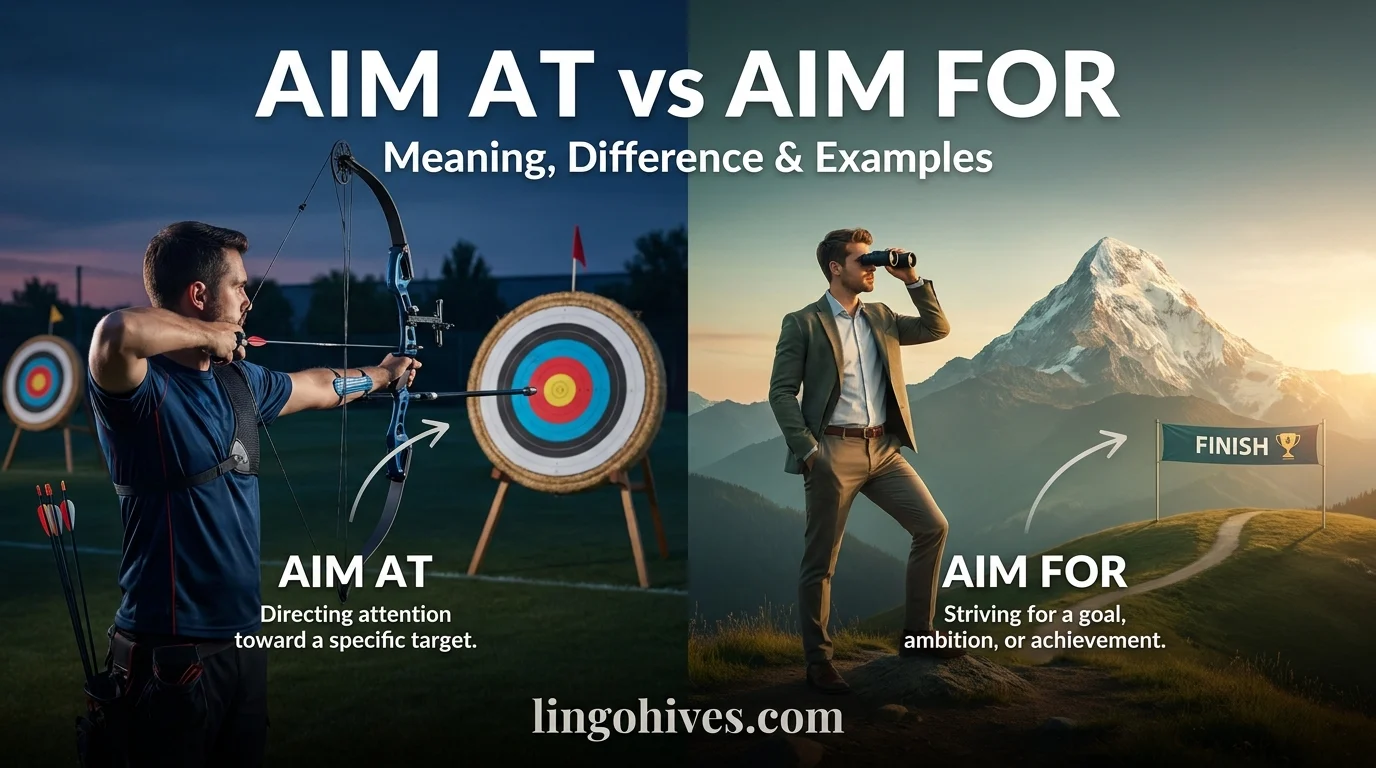
The expressions aim at vs aim for are often confusing because both describe a goal, target, or direction. However, they are not always interchangeable. Understanding the difference helps you choose the correct phrase in everyday conversations, academic writing, professional communication, and English exams. Although both expressions can refer to something you want to achieve, they emphasize different ideas.
The main difference is that aim at often describes directing something toward a specific target or focusing on a particular person, group, or objective. In contrast, aim for usually describes trying to achieve, obtain, or reach a desired result. For example, you can aim at improving your English, but you can also aim for a higher test score. Learning when to use each expression will make your English sound clearer and more natural.
Quick Answer
Aim at means to direct something toward a target or focus on a particular objective, person, or group. Aim for means to try to achieve or obtain something. Use “aim at” for targets and focus, and “aim for” for desired results, goals, or achievements.
Why Do People Confuse Aim At and Aim For?
People confuse these expressions because both can describe intentions, objectives, and things someone wants to accomplish.
For example:
- We aim at improving customer satisfaction.
- We aim for better customer satisfaction.
Both sentences communicate a similar intention, but the emphasis is slightly different.
The confusion happens because the prepositions at and for have different functions:
- At often identifies a target, direction, or focus.
- For often identifies a desired outcome or something someone wants to obtain.
Understanding this small difference makes it easier to select the correct expression.
First Word: What Does Aim At Mean?
Aim at means to direct something toward a particular target, focus on a specific objective, or intend to affect someone or something.
It is commonly used when discussing targets, intentions, audiences, and specific purposes.
Common Uses of Aim At
1. Directing something toward a target
Use “aim at” when pointing or directing something toward a particular object or person.
Examples:
- He aimed the camera at the mountain.
- The hunter aimed at the target.
- She aimed the flashlight at the door.
2. Focusing on a particular objective
“Aim at” can also describe an activity or effort directed toward a particular purpose.
Examples:
- This course aims at improving communication skills.
- The campaign aims at reducing plastic waste.
- The new policy is aimed at helping small businesses.
3. Targeting a particular audience
Use “aimed at” when describing products, services, advertisements, or content designed for a particular group.
Examples:
- This book is aimed at beginners.
- The advertisement is aimed at young adults.
- The program is aimed at school students.
Grammar Tip: When “aim at” is followed by a verb, use the -ing form.
Correct: We aim at improving our services.
Incorrect: We aim at improve our services.
Second Word: What Does Aim For Mean?
Aim for means to try to achieve, reach, obtain, or accomplish something desirable.
It is especially common when discussing personal ambitions, professional goals, academic achievements, and future plans.
Common Uses of Aim For
1. Trying to achieve a goal
Use “aim for” when describing something you want to accomplish.
Examples:
- I aim for success in my career.
- She is aiming for a promotion.
- We aim for better results this year.
2. Setting a target or standard
Use “aim for” when identifying a specific level or result you want to reach.
Examples:
- Aim for a score of 90%.
- He is aiming for a higher salary.
- Students should aim for excellence.
3. Trying to reach something desirable
It can also describe working toward a particular outcome in life.
Examples:
- They aim for a better future.
- I am aiming for financial independence.
- Our team aims for first place.
Grammar Tip: “Aim for” is commonly followed by a noun or noun phrase. When followed by a verb, use the -ing form.
Correct: I aim for becoming a better writer.
More natural: I aim to become a better writer.
Aim At vs Aim For: Comparison Table
| Feature | Aim At | Aim For |
| Main meaning | Direct toward or focus on | Try to achieve or obtain |
| Main emphasis | Target or purpose | Desired result |
| Common use | Targeting an audience | Setting a goal |
| Followed by | Noun or -ing verb | Noun or -ing verb |
| Example | Aim at the target | Aim for success |
| Another example | Aimed at children | Aimed for first place |
When to Use Aim At vs Aim For
Knowing the context makes choosing between these expressions much easier.
When to Use Aim At
Use “aim at” when:
- You are directing something toward a physical target.
- You are focusing on a specific objective.
- You are describing the intended audience of a product or service.
- You are explaining what an activity or campaign is designed to accomplish.
Examples:
- The teacher aimed the projector at the screen.
- This website is aimed at English learners.
- The organization aims at reducing poverty.
When to Use Aim For
Use “aim for” when:
- You want to achieve a particular goal.
- You are setting a performance target.
- You are trying to reach a specific result.
- You are discussing ambitions or future achievements.
Examples:
- I aim for a better position.
- She aims for the highest marks.
- We are aiming for success.
Important: These expressions sometimes overlap. For example, “aim at improving your English” and “aim for better English skills” can both describe the same general intention, but the emphasis differs.
12 Examples of Aim At vs Aim For in Sentences
Here are practical examples to help you understand how both expressions work.
Examples of Aim At
- The boy aimed the ball at the goal.
- This educational program is aimed at beginners.
- Our company aims at improving customer service.
- She aimed her camera at the beautiful sunset.
- The campaign is aimed at raising public awareness.
- His comments were aimed at criticizing the new policy.
Examples of Aim For
- I aim for success in everything I do.
- She is aiming for a higher position at work.
- We should aim for better results next year.
- He aims for a score of 100 in mathematics.
- They are aiming for financial freedom.
- Our team aims for first place in the competition.
Examples Using Both Expressions
- The course is aimed at beginners who aim for professional fluency.
- The campaign is aimed at young people and aims for greater awareness.
These examples show that both expressions can appear naturally in the same sentence because they serve different purposes.
Common Mistakes When Using Aim At and Aim For
English learners sometimes use these expressions incorrectly. Here are common mistakes and their corrections.
| Incorrect Sentence | Correct Sentence |
| I aim at success. | I aim for success. |
| She aims for the target with a gun. | She aims at the target with a gun. |
| We aim at achieve better results. | We aim at achieving better results. |
| He aims for a promotion. | He aims for a promotion. |
| This book is aimed for children. | This book is aimed at children. |
| I aim at become a teacher. | I aim to become a teacher. |
Mistake 1: Using At Instead of For
Incorrect: I aim at a better future.
Better: I aim for a better future.
When you are talking about a desired outcome, “aim for” is generally the more natural choice.
Mistake 2: Using For Instead of At
Incorrect: The advertisement is aimed for teenagers.
Correct: The advertisement is aimed at teenagers.
When identifying the intended audience, use “aimed at.”
Mistake 3: Using the Wrong Verb Form
Incorrect: We aim at improve our English.
Correct: We aim at improving our English.
After the preposition “at,” use a noun or an -ing verb when a verb follows.
Memory Trick: How to Remember the Difference
Remember these two simple ideas:
- AT = Target: Think of pointing something at a particular target.
- FOR = Goal: Think of working for something you want to achieve.
For example:
- Aim at the target.
- Aim for success.
A simple question can also help:
Are you directing something toward a target? Use “aim at.”
Are you trying to achieve something? Use “aim for.”
American vs British English
There is no major difference between American and British English in the basic meanings of “aim at” and “aim for.
Both varieties use these expressions in similar ways.
| Expression | American English | British English |
| Aim at the target | Correct | Correct |
| Aim for success | Correct | Correct |
| Aimed at children | Correct | Correct |
| Aiming for promotion | Correct | Correct |
The choice depends on meaning and context, not regional spelling or pronunciation.
Similar Words and Expressions
Several English expressions have meanings related to “aim at” and “aim for.
1. Aim To
Means to intend or plan to do something.
Example: I aim to improve my writing skills.
2. Strive For
Means to make a serious effort to achieve something.
Example: She strives for excellence.
3. Work Toward
Means to make progress toward a particular goal.
Example: He is working toward a university degree.
4. Target
Means to direct an effort toward a particular person, group, or objective.
Example: The company targets young customers.
5. Aspire To
Means to have a strong ambition to achieve something.
Example: She aspires to become a doctor.
6. Focus On
Means to give attention to a particular subject or activity.
Example: We need to focus on improving our performance.
Final Verdict: Aim At vs Aim For
The difference between “aim at” and “aim for” depends mainly on what you want to express.
- Aim at: Use it when directing something toward a target, focusing on an objective, or identifying an intended audience.
- Aim for: Use it when trying to achieve a goal, reach a standard, or obtain a desired result.
For example, “The course is aimed at beginners” identifies the audience, while “I aim for excellent results” describes a personal goal.
Both expressions are correct English. Choosing the right one depends on the meaning of your sentence.
Frequently Asked Questions
1. What is the difference between aim at and aim for?
“Aim at” means to direct something toward a target or focus on an objective. “Aim for” means to try to achieve or obtain something. For example, aim at the target but aim for success.
2. Is it correct to say aim at success?
Yes, “aim at success” is grammatically possible, particularly when success is presented as an objective being pursued. However, “aim for success” is generally more natural when describing a desired achievement.
3. Should I use aim at or aim for a goal?
“Aim for a goal” is generally the more natural expression when discussing something you want to achieve. “Aim at a goal” can also be used when emphasizing a target or objective.
4. Is aim at followed by a verb?
When “aim at” is followed by a verb, the verb normally takes the -ing form because “at” is a preposition.
Example: We aim at improving our performance.
5. Is aim for followed by a noun or verb?
“Aim for” is commonly followed by a noun or noun phrase. When followed by a verb, the -ing form can be used.
Example: She is aiming for winning the competition.
However, “She is aiming to win the competition” sounds more natural.
6. Can aim at and aim for be used interchangeably?
Sometimes, both expressions can communicate a similar general intention, but they are not always interchangeable. “Aim at” emphasizes a target or focus, while “aim for” emphasizes a desired achievement or result.
7. Is aimed at correct English?
Yes. “Aimed at” is correct and commonly used to describe the intended audience, purpose, or target of something.
Example: This course is aimed at beginners.
Remember This
- Aim at = Direct toward a target or focus on something.
- Aim for = Try to achieve or reach something.
- Aimed at children = Designed for children.
- Aim for success = Try to achieve success.
- Aim at improving = Focus on improving.
The easiest way to remember the difference is: Aim AT a target, but aim FOR a goal.
Conclusion
Understanding the difference between “aim at” and “aim for” helps you communicate your intentions more clearly. Although both expressions relate to targets and objectives, “aim at” usually emphasizes direction, focus, or an intended audience, while “aim for” emphasizes achieving a particular result or reaching a goal. Learning these distinctions will help you avoid common grammar mistakes.
Whether you are writing an academic assignment, preparing for an English exam, or speaking in everyday conversations, use these expressions according to their meaning. Remember that you aim at a target and aim for success. With regular practice and simple examples, choosing the correct expression will become easier and more natural.

I am Jimmy Michael, a language enthusiast and writer passionate about exploring different languages, words, and cultures. I create simple, useful content that helps readers understand languages better and discover new ways to communicate globally.