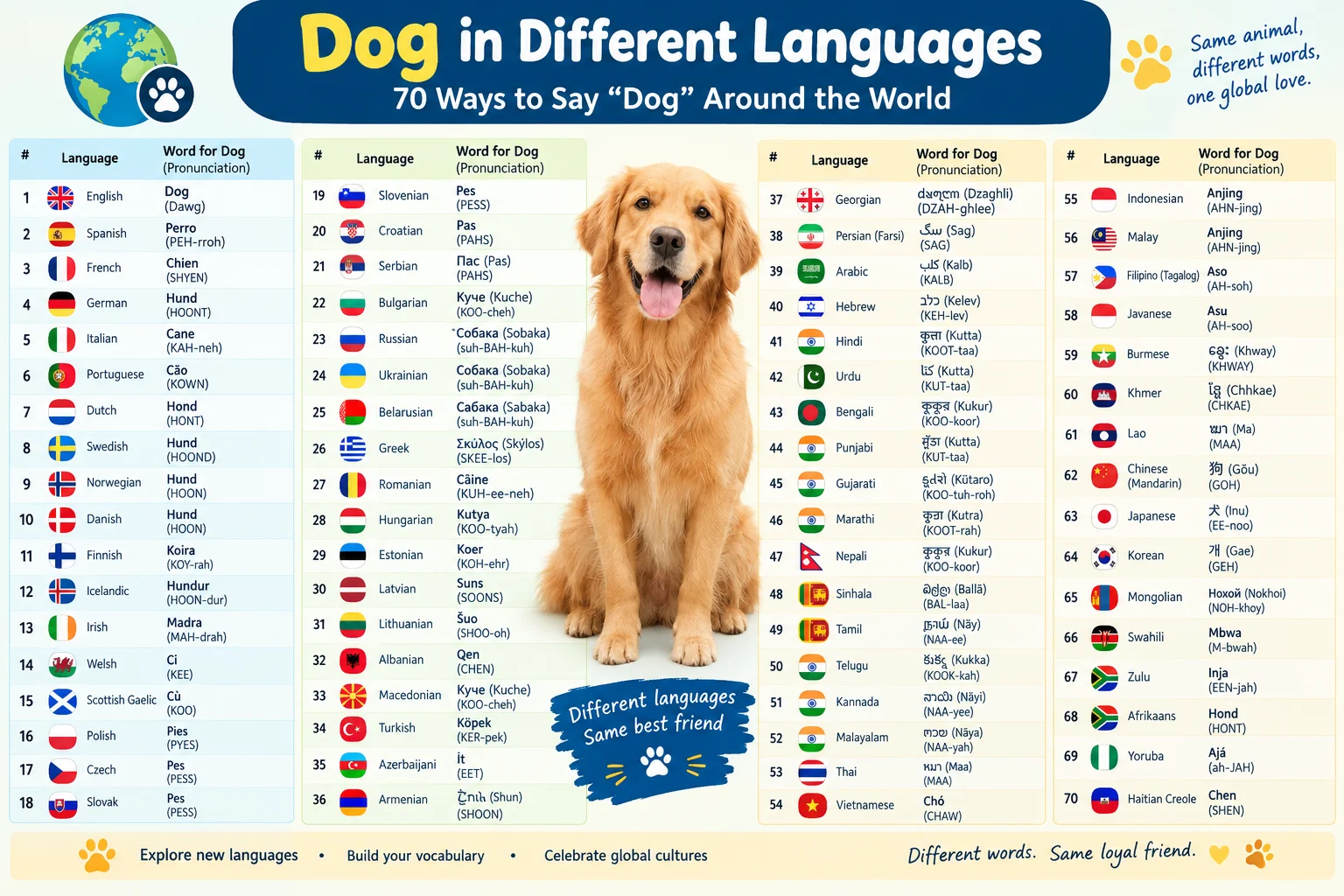
Dogs are beloved companions around the world, known for their loyalty, intelligence, and playful nature.
if you are learning a new language, traveling abroad, studying vocabulary, or simply curious about how people describe their furry friends, learning the word for “dog” in different languages is a fun way to explore global cultures.
The word “dog” has many translations, from the familiar Spanish perro to the French chien and the Japanese inu.
In this guide, you will discover dog in different languages, including native translations, easy English pronunciations, practical example sentences, and their English meanings.
Dog in Different Languages: Quick Overview
Here are some popular dog translations to help you get started.
| Language | Word for Dog | Easy Pronunciation |
|---|---|---|
| Spanish | Perro | PEH-rroh |
| French | Chien | SHYEN |
| German | Hund | HOONT |
| Italian | Cane | KAH-neh |
| Portuguese | Cão | KOWN |
| Japanese | 犬 (犬) | Ee-noo |
| Korean | 개 | Gae |
| Chinese (Mandarin) | 狗 (狗) | Gǒu |
| Arabic | كلب | Kalb |
| Hindi | कुत्ता | Koot-taa |
How to Say Dog in Different Languages: 70 Translations
The following table includes exactly 70 languages, with the native word for dog, a simplified pronunciation guide, a short example sentence, and its English meaning.
Pronunciations are approximate and designed for English speakers. Some languages use different words depending on grammatical gender, context, or regional usage. The examples use natural, everyday expressions where possible.
| No. | Language | Native Word for Dog | Pronunciation | Example Sentence | English Meaning |
|---|---|---|---|---|---|
| 1 | English | Dog | Dawg | The dog is friendly. | The dog is friendly. |
| 2 | Spanish | Perro | PEH-rroh | El perro corre. | The dog runs. |
| 3 | French | Chien | SHYEN | Le chien joue. | The dog plays. |
| 4 | German | Hund | HOONT | Der Hund schläft. | The dog is sleeping. |
| 5 | Italian | Cane | KAH-neh | Il cane corre. | The dog runs. |
| 6 | Portuguese | Cão | KOWN | O cão brinca. | The dog plays. |
| 7 | Dutch | Hond | HONT | De hond slaapt. | The dog sleeps. |
| 8 | Swedish | Hund | HOOND | Hunden springer. | The dog runs. |
| 9 | Norwegian | Hund | HOON | Hunden leker. | The dog plays. |
| 10 | Danish | Hund | HOON | Hunden sover. | The dog sleeps. |
| 11 | Finnish | Koira | KOY-rah | Koira juoksee. | The dog runs. |
| 12 | Icelandic | Hundur | HOON-dur | Hundurinn sefur. | The dog sleeps. |
| 13 | Irish | Madra | MAH-drah | Tá an madra ag rith. | The dog is running. |
| 14 | Welsh | Ci | KEE | Mae’r ci’n cysgu. | The dog is sleeping. |
| 15 | Scottish Gaelic | Cù | KOO | Tha an cù a’ ruith. | The dog is running. |
| 16 | Polish | Pies | PYES | Pies szczeka. | The dog barks. |
| 17 | Czech | Pes | PESS | Pes běží. | The dog runs. |
| 18 | Slovak | Pes | PESS | Pes spí. | The dog sleeps. |
| 19 | Slovenian | Pes | PESS | Pes laja. | The dog barks. |
| 20 | Croatian | Pas | PAHS | Pas trči. | The dog runs. |
| 21 | Serbian | Пас (Pas) | PAHS | Пас спава. | The dog sleeps. |
| 22 | Bulgarian | Куче (Kuche) | KOO-cheh | Кучето спи. | The dog sleeps. |
| 23 | Russian | Собака (Sobaka) | suh-BAH-kuh | Собака бежит. | The dog runs. |
| 24 | Ukrainian | Собака (Sobaka) | suh-BAH-kuh | Собака спить. | The dog sleeps. |
| 25 | Belarusian | Сабака (Sabaka) | suh-BAH-kuh | Сабака бяжыць. | The dog runs. |
| 26 | Greek | Σκύλος (Skýlos) | SKEE-los | Ο σκύλος τρέχει. | The dog runs. |
| 27 | Romanian | Câine | KUH-ee-neh | Câinele doarme. | The dog sleeps. |
| 28 | Hungarian | Kutya | KOO-tyah | A kutya fut. | The dog runs. |
| 29 | Estonian | Koer | KOH-ehr | Koer magab. | The dog sleeps. |
| 30 | Latvian | Suns | SOONS | Suns skrien. | The dog runs. |
| 31 | Lithuanian | Šuo | SHOO-oh | Šuo miega. | The dog sleeps. |
| 32 | Albanian | Qen | CHEN | Qeni vrapon. | The dog runs. |
| 33 | Macedonian | Куче (Kuche) | KOO-cheh | Кучето трча. | The dog runs. |
| 34 | Turkish | Köpek | KER-pek | Köpek koşuyor. | The dog is running. |
| 35 | Azerbaijani | İt | EET | İt qaçır. | The dog runs. |
| 36 | Armenian | Շուն (Shun) | SHOON | Շունը վազում է։ | The dog is running. |
| 37 | Georgian | ძაღლი (Dzaghli) | DZAH-ghlee | ძაღლი დარბის. | The dog runs. |
| 38 | Persian (Farsi) | سگ (Sag) | SAG | سگ میدود. | The dog runs. |
| 39 | Arabic | كلب (Kalb) | KALB | الكلب يلعب. | The dog plays. |
| 40 | Hebrew | כלב (Kelev) | KEH-lev | הכלב ישן. | The dog sleeps. |
| 41 | Hindi | कुत्ता (Kutta) | KOOT-taa | कुत्ता दौड़ता है। | The dog runs. |
| 42 | Urdu | کتا (Kutta) | KUT-taa | کتا بھاگتا ہے۔ | The dog runs. |
| 43 | Bengali | কুকুর (Kukur) | KOO-koor | কুকুরটি দৌড়ায়। | The dog runs. |
| 44 | Punjabi | ਕੁੱਤਾ (Kutta) | KUT-taa | ਕੁੱਤਾ ਦੌੜਦਾ ਹੈ। | The dog runs. |
| 45 | Gujarati | કૂતરો (Kūtaro) | KOO-tuh-roh | કૂતરો દોડે છે. | The dog runs. |
| 46 | Marathi | कुत्रा (Kutra) | KOOT-rah | कुत्रा धावतो. | The dog runs. |
| 47 | Nepali | कुकुर (Kukur) | KOO-koor | कुकुर दौडिन्छ। | The dog runs. |
| 48 | Sinhala | බල්ලා (Ballā) | BAL-laa | බල්ලා දුවනවා. | The dog runs. |
| 49 | Tamil | நாய் (Nāy) | NAA-ee | நாய் ஓடுகிறது. | The dog runs. |
| 50 | Telugu | కుక్క (Kukka) | KOOK-kah | కుక్క పరుగెడుతుంది. | The dog runs. |
| 51 | Kannada | ನಾಯಿ (Nāyi) | NAA-yee | ನಾಯಿ ಓಡುತ್ತದೆ. | The dog runs. |
| 52 | Malayalam | നായ (Nāya) | NAA-yah | നായ ഓടുന്നു. | The dog runs. |
| 53 | Thai | หมา (Maa) | MAA | หมาวิ่ง | The dog runs. |
| 54 | Vietnamese | Chó | CHAW | Con chó chạy. | The dog runs. |
| 55 | Indonesian | Anjing | AHN-jing | Anjing itu berlari. | The dog runs. |
| 56 | Malay | Anjing | AHN-jing | Anjing itu tidur. | The dog sleeps. |
| 57 | Filipino (Tagalog) | Aso | AH-soh | Tumatakbo ang aso. | The dog runs. |
| 58 | Javanese | Asu | AH-soo | Asu ku turu. | My dog sleeps. |
| 59 | Burmese | ခွေး (Khway) | KHWAY | ခွေး ပြေးနေတယ်။ | The dog is running. |
| 60 | Khmer | ឆ្កែ (Chhkae) | CHKAE | ឆ្កែរត់។ | The dog runs. |
| 61 | Lao | ໝາ (Ma) | MAA | ໝາແລ່ນ. | The dog runs. |
| 62 | Chinese (Mandarin) | 狗 (Gǒu) | GOH | 狗在跑。 | The dog is running. |
| 63 | Japanese | 犬 (Inu) | EE-noo | 犬が走ります。 | The dog runs. |
| 64 | Korean | 개 (Gae) | GEH | 개가 달려요. | The dog runs. |
| 65 | Mongolian | Нохой (Nokhoi) | NOH-khoy | Нохой гүйж байна. | The dog is running. |
| 66 | Swahili | Mbwa | M-bwah | Mbwa anakimbia. | The dog runs. |
| 67 | Zulu | Inja | EEN-jah | Inja iyagijima. | The dog runs. |
| 68 | Afrikaans | Hond | HONT | Die hond hardloop. | The dog runs. |
| 69 | Yoruba | Ajá | ah-JAH | Ajá ń sáré. | The dog runs. |
| 70 | Haitian Creole | Chen | SHEN | Chen an ap kouri. | The dog is running. |
Dog Translations Around the World
The word for dog varies widely across languages. These differences reflect each language’s history, sounds, and grammatical structure.
For example, Spanish uses perro, French uses chien, and Italian uses cane. These Romance languages developed from Latin, yet their everyday words for dogs are quite different.
Germanic languages often share similar vocabulary. German Hund, Dutch hond, Swedish hund, and Afrikaans hond have recognizable similarities.
In Asian languages, the differences are equally interesting. Japanese uses inu, Mandarin Chinese uses gǒu, and Korean uses gae. Each has its own writing system and pronunciation conventions.
Exploring dog translations in different languages is an enjoyable way to build vocabulary and understand how languages express familiar ideas.
Why Do Different Languages Have Different Words for Dog?
Languages develop through centuries of cultural exchange, migration, and linguistic change. As communities evolve, their words can change in pronunciation, spelling, and meaning.
Some languages also distinguish between male and female dogs, puppies and adult dogs, or pets and wild canines.
For instance, Spanish commonly uses perro for a male dog and perra for a female dog. English uses the general word “dog,” while more specific terms such as “puppy” describe a young dog.
These differences show why learning a word in another language sometimes involves more than memorizing a single translation.
Common Dog-Related Words in Different Languages
Learning a few related words can help you use dog vocabulary in everyday conversations.
| English Word | Spanish | French | German | Italian |
|---|---|---|---|---|
| Dog | Perro | Chien | Hund | Cane |
| Puppy | Cachorro | Chiot | Welpe | Cucciolo |
| Pet | Mascota | Animal de compagnie | Haustier | Animale domestico |
| Animal | Animal | Animal | Tier | Animale |
| Tail | Cola | Queue | Schwanz | Coda |
| Bark | Ladrido | Aboiement | Bellen | Abbaio |
| Paw | Pata | Patte | Pfote | Zampa |
| Walk | Paseo | Promenade | Spaziergang | Passeggiata |
The exact word choice may vary with context. For example, Spanish pata can refer to an animal’s leg or paw, while other languages may use different terms depending on the body part.
How to Learn Dog Vocabulary Faster
Learning the word for dog in 70 languages can be easier when you practice a few words at a time.
- Start with familiar languages: Learn Spanish perro, French chien, and German Hund first.
- Practice pronunciation: Read each word aloud and pay attention to unfamiliar sounds.
- Use short sentences: Practice phrases such as “The dog runs” or “The dog sleeps.”
- Learn native scripts: Recognizing words such as 犬, 개, and कुत्ता can help you remember them.
- Review regularly: Revisit a small group of words each day instead of memorizing all 70 at once.
- Connect words with pictures: Associate each word with an image of a dog to strengthen recall.
These techniques are useful for language learners, teachers, travelers, and anyone curious about vocabulary around the world.
Frequently Asked Questions
1. How do you say dog in different languages?
The word “dog” changes across languages. Common translations include perro in Spanish, chien in French, Hund in German, cane in Italian, inu in Japanese, and kutta in Hindi.
2. What is the word for dog in all languages?
There is no single word for dog across all languages. Each language has its own vocabulary, and some languages have multiple words depending on a dog’s age, sex, or context. This article covers 70 languages and their common translations.
3. How do you say dog in Japanese and Chinese?
In Japanese, dog is 犬 (inu). In Mandarin Chinese, it is 狗 (gǒu). Both words are commonly used in everyday conversation.
4. What is dog called in Hindi and Urdu?
In Hindi, dog is कुत्ता (kutta). In Urdu, it is کتا (kutta). The words are closely related and have similar pronunciations, although their scripts differ.
5. Why are dog translations different across languages?
Dog translations differ because languages developed independently and changed over time. Historical influences, local pronunciation patterns, and grammar all contribute to the variety of words used around the world.
Conclusion
Learning the word for dog in different languages is a simple and enjoyable way to explore global vocabulary.
From perro in Spanish and chien in French to inu in Japanese and mbwa in Swahili, each translation offers a small glimpse into another language and culture.
Use this list of 70 dog translations to expand your vocabulary, practice pronunciation, and discover how people around the world talk about their canine companions.

I am Ashley Marie, a passionate language enthusiast who loves exploring different languages, cultures, words, and expressions. I enjoy sharing simple, useful language insights that help readers communicate confidently and discover the beauty of languages.