Cats are among the most beloved animals in the world, known for their playful behavior, independent nature, and affectionate personalities.
But have you ever wondered what people in different countries call a cat? The word changes from one language to another, offering a fascinating glimpse into cultures and everyday communication.
Learning cat in different languages is useful for language learners, travelers, teachers, writers, and animal lovers.
if you want to learn how to say cat in another language, discover interesting cat translations, or teach children animal vocabulary, this guide makes it easy.
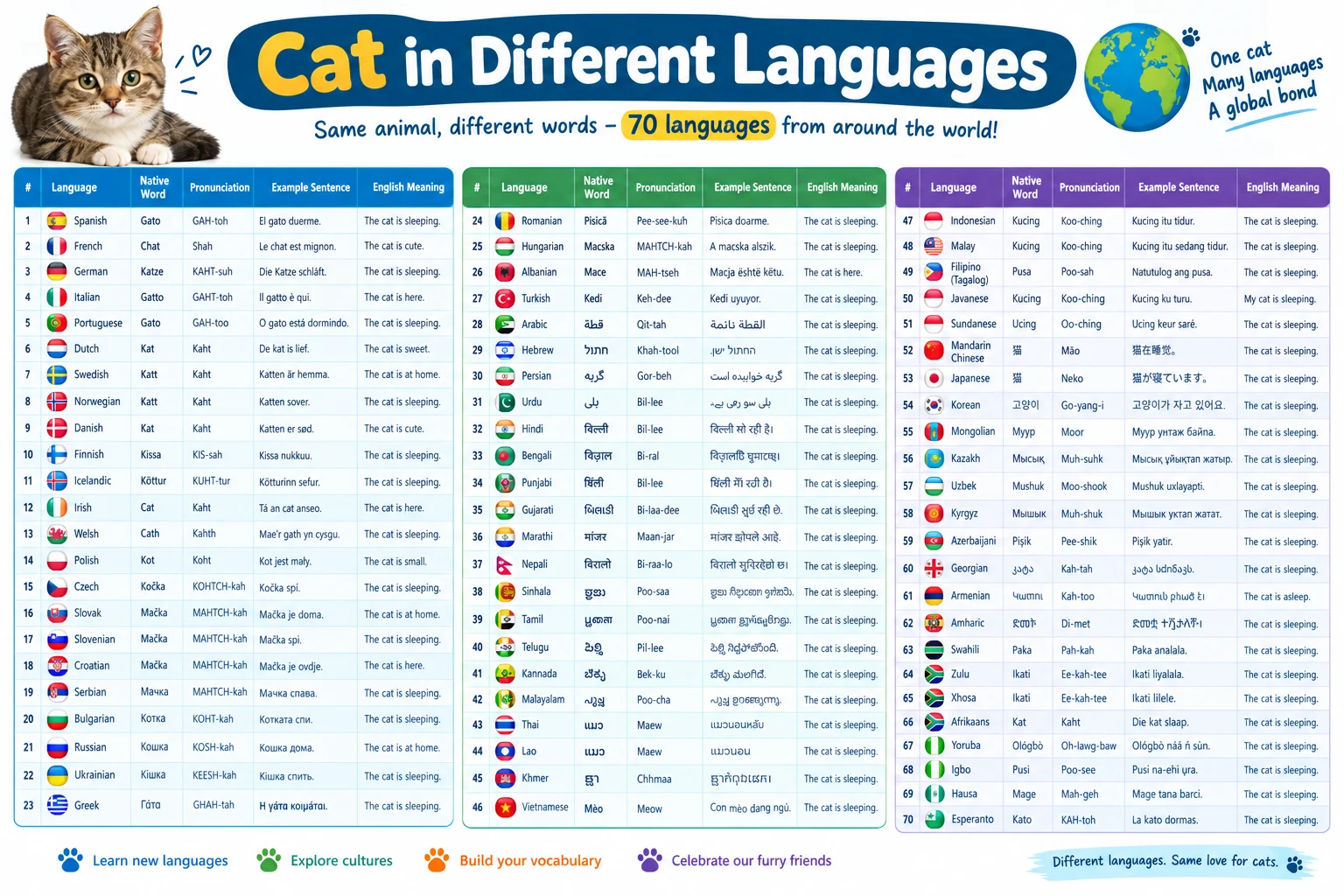
In this article, you will find cat translations in 70 languages, including the native word, an easy English pronunciation, a practical example sentence, and its English meaning.
Cat in Different Languages: Quick Overview
The word for cat varies widely across languages. For example, it is gato in Spanish, chat in French, Katze in German, and neko in Japanese.
Here are a few popular translations to get you started.
| Language | Word for Cat | Easy Pronunciation |
|---|---|---|
| English | Cat | Kat |
| Spanish | Gato | GAH-toh |
| French | Chat | Shah |
| German | Katze | KAHT-suh |
| Italian | Gatto | GAHT-toh |
| Portuguese | Gato | GAH-too |
| Japanese | 猫 (猫) | NEH-koh |
| Chinese (Mandarin) | 猫 (猫) | Māo |
| Korean | 고양이 | Go-yang-i |
| Arabic | قطة | Qit-ta |
Cat in All Languages: 70 Languages With Examples
The following table covers 70 languages from different regions of the world. Each entry includes the native word for cat, an approximate English pronunciation, a short example sentence, and the English translation.
Pronunciations are simplified guides for English speakers. Some languages distinguish between male and female cats or use different words in casual and formal contexts. The examples use natural, everyday expressions where possible.
| No. | Language | Native Word | Pronunciation | Example Sentence | English Meaning |
|---|---|---|---|---|---|
| 1 | Spanish | Gato | GAH-toh | El gato duerme. | The cat is sleeping. |
| 2 | French | Chat | Shah | Le chat est mignon. | The cat is cute. |
| 3 | German | Katze | KAHT-suh | Die Katze schläft. | The cat is sleeping. |
| 4 | Italian | Gatto | GAHT-toh | Il gatto è qui. | The cat is here. |
| 5 | Portuguese | Gato | GAH-too | O gato está dormindo. | The cat is sleeping. |
| 6 | Dutch | Kat | Kaht | De kat is lief. | The cat is sweet. |
| 7 | Swedish | Katt | Kaht | Katten är hemma. | The cat is at home. |
| 8 | Norwegian | Katt | Kaht | Katten sover. | The cat is sleeping. |
| 9 | Danish | Kat | Kaht | Katten er sød. | The cat is cute. |
| 10 | Finnish | Kissa | KIS-sah | Kissa nukkuu. | The cat is sleeping. |
| 11 | Icelandic | Köttur | KUHT-tur | Kötturinn sefur. | The cat is sleeping. |
| 12 | Irish | Cat | Kaht | Tá an cat anseo. | The cat is here. |
| 13 | Welsh | Cath | Kahth | Mae’r gath yn cysgu. | The cat is sleeping. |
| 14 | Polish | Kot | Koht | Kot jest mały. | The cat is small. |
| 15 | Czech | Kočka | KOHTCH-kah | Kočka spí. | The cat is sleeping. |
| 16 | Slovak | Mačka | MAHTCH-kah | Mačka je doma. | The cat is at home. |
| 17 | Slovenian | Mačka | MAHTCH-kah | Mačka spi. | The cat is sleeping. |
| 18 | Croatian | Mačka | MAHTCH-kah | Mačka je ovdje. | The cat is here. |
| 19 | Serbian | Мачка | MAHTCH-kah | Мачка спава. | The cat is sleeping. |
| 20 | Bulgarian | Котка | KOHT-kah | Котката спи. | The cat is sleeping. |
| 21 | Russian | Кошка | KOSH-kah | Кошка дома. | The cat is at home. |
| 22 | Ukrainian | Кішка | KEESH-kah | Кішка спить. | The cat is sleeping. |
| 23 | Greek | Γάτα | GHAH-tah | Η γάτα κοιμάται. | The cat is sleeping. |
| 24 | Romanian | Pisică | Pee-see-kuh | Pisica doarme. | The cat is sleeping. |
| 25 | Hungarian | Macska | MAHTCH-kah | A macska alszik. | The cat is sleeping. |
| 26 | Albanian | Mace | MAH-tseh | Macja është këtu. | The cat is here. |
| 27 | Turkish | Kedi | Keh-dee | Kedi uyuyor. | The cat is sleeping. |
| 28 | Arabic | قطة | Qit-tah | القطة نائمة. | The cat is sleeping. |
| 29 | Hebrew | חתול | Khah-tool | החתול ישן. | The cat is sleeping. |
| 30 | Persian | گربه | Gor-beh | گربه خوابیده است. | The cat is sleeping. |
| 31 | Urdu | بلی | Bil-lee | بلی سو رہی ہے۔ | The cat is sleeping. |
| 32 | Hindi | बिल्ली | Bil-lee | बिल्ली सो रही है। | The cat is sleeping. |
| 33 | Bengali | বিড়াল | Bi-ral | বিড়ালটি ঘুমাচ্ছে। | The cat is sleeping. |
| 34 | Punjabi | ਬਿੱਲੀ | Bil-lee | ਬਿੱਲੀ ਸੌਂ ਰਹੀ ਹੈ। | The cat is sleeping. |
| 35 | Gujarati | બિલાડી | Bi-laa-dee | બિલાડી સૂઈ રહી છે. | The cat is sleeping. |
| 36 | Marathi | मांजर | Maan-jar | मांजर झोपले आहे. | The cat is sleeping. |
| 37 | Nepali | बिरालो | Bi-raa-lo | बिरालो सुतिरहेको छ। | The cat is sleeping. |
| 38 | Sinhala | පූසා | Poo-saa | පූසා නිදාගෙන ඉන්නවා. | The cat is sleeping. |
| 39 | Tamil | பூனை | Poo-nai | பூனை தூங்குகிறது. | The cat is sleeping. |
| 40 | Telugu | పిల్లి | Pil-lee | పిల్లి నిద్రపోతోంది. | The cat is sleeping. |
| 41 | Kannada | ಬೆಕ್ಕು | Bek-ku | ಬೆಕ್ಕು ಮಲಗಿದೆ. | The cat is sleeping. |
| 42 | Malayalam | പൂച്ച | Poo-cha | പൂച്ച ഉറങ്ങുന്നു. | The cat is sleeping. |
| 43 | Thai | แมว | Maew | แมวนอนหลับ | The cat is sleeping. |
| 44 | Lao | ແມວ | Maew | ແມວນອນ | The cat is sleeping. |
| 45 | Khmer | ឆ្មា | Chhmaa | ឆ្មាកំពុងដេក។ | The cat is sleeping. |
| 46 | Vietnamese | Mèo | Meow | Con mèo đang ngủ. | The cat is sleeping. |
| 47 | Indonesian | Kucing | Koo-ching | Kucing itu tidur. | The cat is sleeping. |
| 48 | Malay | Kucing | Koo-ching | Kucing itu sedang tidur. | The cat is sleeping. |
| 49 | Filipino (Tagalog) | Pusa | Poo-sah | Natutulog ang pusa. | The cat is sleeping. |
| 50 | Javanese | Kucing | Koo-ching | Kucing ku turu. | My cat is sleeping. |
| 51 | Sundanese | Ucing | Oo-ching | Ucing keur saré. | The cat is sleeping. |
| 52 | Mandarin Chinese | 猫 | Māo | 猫在睡觉。 | The cat is sleeping. |
| 53 | Japanese | 猫 | Neko | 猫が寝ています。 | The cat is sleeping. |
| 54 | Korean | 고양이 | Go-yang-i | 고양이가 자고 있어요. | The cat is sleeping. |
| 55 | Mongolian | Муур | Moor | Муур унтаж байна. | The cat is sleeping. |
| 56 | Kazakh | Мысық | Muh-suhk | Мысық ұйықтап жатыр. | The cat is sleeping. |
| 57 | Uzbek | Mushuk | Moo-shook | Mushuk uxlayapti. | The cat is sleeping. |
| 58 | Kyrgyz | Мышык | Muh-shuk | Мышык уктап жатат. | The cat is sleeping. |
| 59 | Azerbaijani | Pişik | Pee-shik | Pişik yatır. | The cat is sleeping. |
| 60 | Georgian | კატა | Kah-tah | კატა სძინავს. | The cat is sleeping. |
| 61 | Armenian | Կատու | Kah-too | Կատուն քնած է։ | The cat is asleep. |
| 62 | Amharic | ድመት | Di-met | ድመቷ ተኝታለች። | The cat is sleeping. |
| 63 | Swahili | Paka | Pah-kah | Paka analala. | The cat is sleeping. |
| 64 | Zulu | Ikati | Ee-kah-tee | Ikati liyalala. | The cat is sleeping. |
| 65 | Xhosa | Ikati | Ee-kah-tee | Ikati lilele. | The cat is sleeping. |
| 66 | Afrikaans | Kat | Kaht | Die kat slaap. | The cat is sleeping. |
| 67 | Yoruba | Ológbò | Oh-lawg-baw | Ológbò náà ń sùn. | The cat is sleeping. |
| 68 | Igbo | Pusi | Poo-see | Pusi na-ehi ụra. | The cat is sleeping. |
| 69 | Hausa | Mage | Mah-geh | Mage tana barci. | The cat is sleeping. |
| 70 | Esperanto | Kato | KAH-toh | La kato dormas. | The cat is sleeping. |
How to Say Cat in Different Languages
Learning how to say cat in different languages is easier when you group words by region or language family. Many European languages have similar-sounding words, while Asian and African languages often use distinct vocabulary.
For example, Spanish and Portuguese both use gato. Dutch uses kat, while German uses Katze. In several South Asian languages, including Hindi, Urdu, and Punjabi, the word for cat sounds similar.
In East Asia, the Japanese word is neko, the Korean word is goyangi, and Mandarin Chinese uses māo. These differences make animal vocabulary an enjoyable way to begin learning a new language.
Cat Translations Around the World
Cat translations reflect the diversity of human language. Although the animal is familiar worldwide, its name can differ significantly depending on the region.
Here are a few interesting comparisons:
- Gato: Used in Spanish and Portuguese.
- Kat: Found in Dutch and Afrikaans, as well as English dialects and related forms.
- Kucing: The common word for cat in Indonesian and Malay.
- Paka: The Swahili word for cat.
- Neko: The Japanese word for cat.
- Māo: The Mandarin Chinese word for cat.
- Pusa: The Filipino (Tagalog) word for cat.
Remember that a dictionary form may not always be the word used in every sentence. Some languages change nouns according to gender, number, grammatical case, or the role the word plays in a sentence.
Male Cat, Female Cat, and Kitten in Different Languages
The general word for cat does not always identify the animal’s sex or age. Many languages have separate terms for male cats, female cats, and kittens.
In German, Katze is the general feminine noun for a cat, while Kater refers to a male cat. Japanese uses neko as the general word, with more specific expressions available when sex or age matters.
Tips for Learning Cat in Different Languages
You do not need to memorize all 70 translations at once. A few simple strategies can help you remember them more effectively.
1. Start with familiar languages. Learn the words that resemble English or another language you already know.
2. Practice pronunciation aloud. Read each word slowly, then repeat it in a short sentence.
3. Connect each word with a picture. Visual associations can help you remember vocabulary.
4. Learn complete sentences. Remembering a phrase such as “The cat is sleeping” helps you understand how the word works in context.
5. Review a few words daily. Practicing five to ten words at a time is often easier than memorizing the entire list in one sitting.
6. Listen to native speakers. Pronunciation guides are helpful, but listening to natural speech gives you a better understanding of sounds, stress, and rhythm.
Why Is Learning Animal Names in Other Languages Useful?
Animal vocabulary is a practical starting point for language learning because it connects familiar concepts with new words.
Learning the word for cat in different languages can help you:
- Build basic vocabulary for travel and conversation.
- Introduce children to languages and cultural differences.
- Understand simple sentences in books, videos, and language lessons.
- Communicate with international friends and fellow animal lovers.
- Improve your pronunciation and reading skills.
It is also a simple way to explore how languages differ in spelling, sounds, and sentence structure.
Frequently Asked Questions
1. What is the word for cat in 10 different languages?
The word for cat in 10 languages is: Spanish — gato; French — chat; German — Katze; Italian — gatto; Portuguese — gato; Japanese — neko; Mandarin Chinese — māo; Korean — goyangi; Arabic — qittah; and Hindi — billi.
2. How do you say cat in different languages?
You say gato in Spanish, chat in French, Katze in German, neko in Japanese, māo in Mandarin Chinese, and kucing in Indonesian. The exact word depends on the language you are speaking.
3. What is the Japanese word for cat?
The Japanese word for cat is 猫, written in kanji and pronounced neko. For example, 猫がいます means “There is a cat.”
4. What is the most common word for cat around the world?
There is no single word that is most common in every country. Words such as gato, chat, kat, and neko are widely used within their respective language communities. The right word depends on the language and region.
5. Are the words for cat similar in different languages?
Yes, some words are similar. Spanish gato and Portuguese gato are identical in spelling, while Dutch kat and Afrikaans kat are also the same. Other languages, such as Japanese (neko) and Mandarin Chinese (māo), use quite different words.
Conclusion
Learning cat in different languages is a fun and practical way to explore vocabulary from around the world.
From gato in Spanish to neko in Japanese and paka in Swahili, each translation offers a small insight into how people communicate across cultures.
Use this list of 70 languages to practice pronunciation, learn everyday sentences, and expand your vocabulary.
if you are studying a new language, teaching children, or simply curious about cats, these translations provide an easy starting point for exploring words for this much-loved animal.

I am Johnny Thomas, a passionate language enthusiast and writer. I enjoy exploring different languages, cultures, words, and expressions. I create helpful, easy-to-understand content to help readers discover languages and communicate confidently.