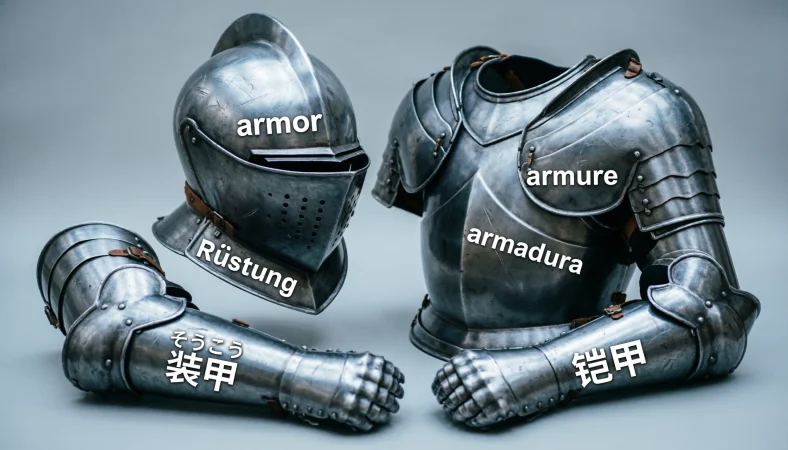
If you want to know how to say armor in different languages, you have come to the right place. The word “armor” has fascinating equivalents across Europe, Asia, Africa, and the Americas, and many languages have their own historical or modern terms for protective equipment.
if you are researching languages, writing a fantasy story, studying history, creating a character, or simply curious about armor translations, this guide gives you 70 useful examples in one easy-to-read list.
Below, you will find armor in all languages with the native word or phrase, an easy English pronunciation, a short real-life example, and the English meaning of that example.
Armor in Different Languages
| # | Language | Native phrase | Easy English pronunciation | Example sentence | English meaning |
|---|---|---|---|---|---|
| 1 | English | armor | AR-mər | The soldier wore heavy armor. | The soldier wore heavy protective clothing. |
| 2 | Spanish | armadura | ar-mah-DOO-rah | El caballero llevaba una armadura. | The knight was wearing armor. |
| 3 | French | armure | ar-MUR | Le chevalier porte une armure. | The knight is wearing armor. |
| 4 | German | Rüstung | ROOS-toong | Der Ritter trägt eine Rüstung. | The knight is wearing armor. |
| 5 | Italian | armatura | ar-mah-TOO-rah | Il cavaliere indossa un’armatura. | The knight is wearing armor. |
| 6 | Portuguese | armadura | ar-mah-doo-RAH | O cavaleiro usa uma armadura. | The knight wears armor. |
| 7 | Dutch | harnas | HAR-nas | De ridder draagt een harnas. | The knight wears armor. |
| 8 | Swedish | rustning | ROOST-ning | Riddaren bär en rustning. | The knight wears armor. |
| 9 | Norwegian | rustning | ROOST-ning | Ridderen har på seg rustning. | The knight is wearing armor. |
| 10 | Danish | rustning | ROOST-ning | Ridderen bærer rustning. | The knight wears armor. |
| 11 | Finnish | haarniska | HAAR-nis-kah | Ritari käyttää haarniskaa. | The knight uses armor. |
| 12 | Icelandic | brynja | BRIN-yah | Riddarinn klæðist brynju. | The knight wears armor. |
| 13 | Irish | armúr | AR-moor | Chaith an ridire armúr. | The knight wore armor. |
| 14 | Welsh | arfwisg | ar-VOOSG | Mae’r marchog yn gwisgo arfwisg. | The knight is wearing armor. |
| 15 | Scottish Gaelic | armachd | AR-makhk | Tha an ridire a’ caitheamh armachd. | The knight is wearing armor. |
| 16 | Latin | armatura | ar-mah-TOO-rah | Miles armaturam gerit. | The soldier wears armor. |
| 17 | Greek | πανοπλία | pa-no-PLEE-ah | Ο ιππότης φοράει πανοπλία. | The knight is wearing armor. |
| 18 | Russian | броня | bra-NYAH | Солдат носит броню. | The soldier wears armor. |
| 19 | Ukrainian | броня | bro-NYAH | Солдат носить броню. | The soldier wears armor. |
| 20 | Belarusian | браня | BRA-nya | Салдат носіць браню. | The soldier wears armor. |
| 21 | Polish | zbroja | ZBROH-yah | Rycerz nosi zbroję. | The knight wears armor. |
| 22 | Czech | brnění | BRN-yeh-nee | Rytíř nosí brnění. | The knight wears armor. |
| 23 | Slovak | brnenie | BRNEH-nyeh | Rytier nosí brnenie. | The knight wears armor. |
| 24 | Slovenian | oklep | OH-klep | Vitez nosi oklep. | The knight wears armor. |
| 25 | Croatian | oklop | OH-klop | Vitez nosi oklop. | The knight wears armor. |
| 26 | Serbian | оклоп | OH-klop | Vitez nosi oklop. | The knight wears armor. |
| 27 | Bosnian | oklop | OH-klop | Vitez nosi oklop. | The knight wears armor. |
| 28 | Bulgarian | броня | BROH-nya | Войникът носи броня. | The soldier wears armor. |
| 29 | Macedonian | оклоп | OH-klop | Војникот носи оклоп. | The soldier wears armor. |
| 30 | Romanian | armură | ar-MOOR-uh | Cavalerul poartă armură. | The knight wears armor. |
| 31 | Hungarian | páncél | PAAN-tsale | A lovag páncélt visel. | The knight wears armor. |
| 32 | Estonian | soomus | SOH-moos | Sõdur kannab soomust. | The soldier wears armor. |
| 33 | Latvian | bruņas | BROO-nyas | Kareivis valkā bruņas. | The soldier wears armor. |
| 34 | Lithuanian | šarvai | SHAR-vai | Karys dėvi šarvus. | The warrior wears armor. |
| 35 | Albanian | armaturë | ar-mah-TOOR-uh | Kalorësi mban armaturë. | The knight wears armor. |
| 36 | Armenian | զրահ | zeh-RAH | Զինվորը զրահ է կրում։ | The soldier wears armor. |
| 37 | Georgian | ჯავშანი | JAV-sha-nee | ჯარისკაცი ჯავშანს ატარებს. | The soldier wears armor. |
| 38 | Persian | زره | zeh-REH | سرباز زره پوشیده است. | The soldier is wearing armor. |
| 39 | Arabic | درع | DIR | الجندي يرتدي درعًا. | The soldier is wearing armor. |
| 40 | Hebrew | שריון | shir-YON | החייל לובש שריון. | The soldier is wearing armor. |
| 41 | Turkish | zırh | ZUHR | Asker zırh giyiyor. | The soldier is wearing armor. |
| 42 | Azerbaijani | zireh | zee-REH | Əsgər zireh geyinir. | The soldier wears armor. |
| 43 | Kazakh | сауыт | sah-OO-it | Жауынгер сауыт киеді. | The warrior wears armor. |
| 44 | Uzbek | zirh | ZEERKH | Jangchi zirh kiyadi. | The warrior wears armor. |
| 45 | Kyrgyz | соот | SOH-ot | Жоокер соот кийет. | The warrior wears armor. |
| 46 | Tajik | зиреҳ | zee-REH | Сарбоз зиреҳ мепӯшад. | The soldier wears armor. |
| 47 | Hindi | कवच | kuh-VACH | सैनिक कवच पहनता है। | The soldier wears armor. |
| 48 | Urdu | زرہ | ZUR-ra | سپاہی زرہ پہنتا ہے۔ | The soldier wears armor. |
| 49 | Bengali | বর্ম | BORMO | সৈনিক বর্ম পরে। | The soldier wears armor. |
| 50 | Punjabi | ਕਵਚ | kuh-VACH | ਸਿਪਾਹੀ ਕਵਚ ਪਾਉਂਦਾ ਹੈ। | The soldier wears armor. |
| 51 | Gujarati | બખ્તર | BAKH-tar | સૈનિક બખ્તર પહેરે છે. | The soldier wears armor. |
| 52 | Marathi | चिलखत | CHIL-khat | सैनिक चिलखत घालतो. | The soldier wears armor. |
| 53 | Nepali | कवच | kuh-VACH | सैनिकले कवच लगाउँछ। | The soldier wears armor. |
| 54 | Sinhala | සන්නාහය | san-NAH-hah-yah | සෙබළා සන්නාහය පැළඳ සිටී. | The soldier is wearing armor. |
| 55 | Tamil | கவசம் | kuh-vuh-SAM | வீரர் கவசம் அணிகிறார். | The warrior wears armor. |
| 56 | Telugu | కవచం | kuh-vuh-CHAM | సైనికుడు కవచం ధరిస్తాడు. | The soldier wears armor. |
| 57 | Kannada | ಕವಚ | kuh-vuh-CHA | ಸೈನಿಕನು ಕವಚವನ್ನು ಧರಿಸುತ್ತಾನೆ. | The soldier wears armor. |
| 58 | Malayalam | കവചം | kuh-vuh-CHAM | സൈനികൻ കവചം ധരിക്കുന്നു. | The soldier wears armor. |
| 59 | Odia | କବଚ | kuh-BA-cha | ସୈନିକ କବଚ ପିନ୍ଧେ। | The soldier wears armor. |
| 60 | Assamese | কৱচ | kuh-WOCH | সৈনিকে কৱচ পিন্ধে। | The soldier wears armor. |
| 61 | Chinese | 盔甲 | KWAY-jyah | 士兵穿着盔甲。 | The soldier is wearing armor. |
| 62 | Japanese | 鎧 | YO-roy | 騎士は鎧を着ています。 | The knight is wearing armor. |
| 63 | Korean | 갑옷 | gah-BOT | 기사가 갑옷을 입고 있습니다. | The knight is wearing armor. |
| 64 | Vietnamese | áo giáp | ow ZYAP | Người lính mặc áo giáp. | The soldier wears armor. |
| 65 | Thai | เกราะ | GRAW | ทหารสวมเกราะ | The soldier wears armor. |
| 66 | Indonesian | zirah | ZEE-rah | Prajurit memakai zirah. | The soldier wears armor. |
| 67 | Malay | perisai badan | puh-ree-SAI BAH-dan | Askar memakai perisai badan. | The soldier wears body armor. |
| 68 | Filipino | baluti | bah-LOO-tee | Nakasuot ng baluti ang sundalo. | The soldier is wearing armor. |
| 69 | Swahili | silaha za kujikinga | see-LAH-hah zah koo-jee-KING-ah | Askari anavaa silaha za kujikinga. | The soldier wears protective armor. |
| 70 | Afrikaans | wapenrusting | VAH-pən-ROOS-ting | Die ridder dra ‘n wapenrusting. | The knight wears armor. |
How to Say Armor in Different Languages
The translation of “armor” can change depending on the type of protection being discussed. In historical contexts, the word may refer to metal armor worn by knights or soldiers. In modern contexts, it can refer to body armor, protective equipment, or armored military vehicles.
For example, European languages often have words directly associated with traditional armor. Spanish uses armadura, French uses armure, Italian uses armatura, and German uses Rüstung.
In South Asian languages, words such as कवच (kavach) and زرہ (zarah/zarra) have strong historical associations with protective armor.
East Asian languages also have distinctive terms. Chinese uses 盔甲, Japanese uses 鎧, and Korean uses 갑옷.
Armor Translations Around the World
Looking at armor around the world reveals an interesting pattern: many languages have words connected to military protection, warriors, shields, or defensive equipment.
Some translations are especially associated with historical warriors and knights. Others are broader terms that can describe protective equipment used by modern soldiers.
The exact translation can therefore depend on context. If you are translating a medieval story, for example, the most natural word may differ from the term used for modern bulletproof body armor.
Armor in European Languages
Romance languages such as Spanish, French, Italian, Portuguese, and Romanian use related words derived from historical terms associated with armor. Germanic languages often have their own established vocabulary, such as Rüstung in German and harnas in Dutch.
Slavic languages also have several distinctive forms. Polish uses zbroja, while Czech uses brnění and Croatian uses oklop.
These differences are useful when translating historical fiction, museum descriptions, games, novels, and educational material.
Armor in Asian Languages
Asian languages offer some of the most culturally distinctive translations of armor.
In Hindi, Sanskrit-derived कवच is a well-known term connected with protective armor. Similar forms occur in several South Asian languages.
Chinese 盔甲, Japanese 鎧, and Korean 갑옷 are commonly associated with traditional armor and warriors.
In Turkish, zırh is the standard word for armor. Persian uses زره, while Arabic commonly uses درع.
Because armor has played an important role in the military history of Asia, many languages have specialized vocabulary for protective equipment.
Armor in Ancient and Historical Contexts
Armor has existed in many forms throughout human history. Early protective equipment could be made from leather, cloth, wood, bone, or other available materials. Later developments included metal helmets, shields, chain mail, plate armor, and specialized military protection.
When translating historical texts, context is especially important. A word used for a medieval suit of armor may not be the same term used for modern protective gear.
For this reason, how to say armor in different languages is not always simply a matter of replacing one English word with one foreign word. The historical period and intended meaning can influence the best translation.
Armor vs. Body Armor
Traditional armor usually refers to equipment worn by warriors, such as helmets, breastplates, chain mail, or plate armor.
Body armor, by contrast, usually refers to modern protective equipment designed to protect the wearer from specific threats. Depending on the language, a translation for modern body armor may be different from the traditional word for a knight’s armor.
If you are translating a modern military, police, or security text, check whether the intended meaning is general armor or specifically body armor.
Why Armor Has Different Names in Different Languages
Armor was independently developed and adapted by many civilizations. As a result, languages developed their own terms for protective equipment.
Some words are closely related to older terms for weapons or military equipment. Others specifically describe clothing or coverings designed to protect the body.
This is why armor translations can be linguistically and historically interesting even when the basic concept is the same.
Common Uses of the Word Armor
The word “armor” can appear in several contexts:
- Historical descriptions of knights and warriors
- Military discussions
- Medieval and fantasy fiction
- Video games
- Movies and television
- Museums and historical research
- Modern body protection
- Metaphorical descriptions of emotional protection
The correct translation can depend on which of these meanings is intended.
For example, a fantasy game may use a traditional word for a complete suit of armor, while a modern safety manual may need a more specific term for protective body equipment.
Tips for Using Armor Translations Correctly
When using one of these translations, consider the context first.
If you are writing about a medieval knight, choose the traditional term used for armor in that language. If you are discussing modern protective equipment, verify whether the language distinguishes between armor, body armor, protective clothing, and military armor.
It is also useful to check grammatical context. Some languages change nouns depending on case, gender, number, or their role within a sentence.
The examples in the table are intentionally short so you can see how the word works in an everyday sentence.
Frequently Asked Questions
1. How do you say armor in different languages?
“Armor” has many translations. Examples include armadura in Spanish, armure in French, Rüstung in German, armatura in Italian, कवच in Hindi, 盔甲 in Chinese, 鎧 in Japanese, and 갑옷 in Korean.
2. What is the word for armor in the most common languages?
In Spanish it is armadura, in French armure, in German Rüstung, in Italian armatura, in Portuguese armadura, in Russian броня, in Hindi कवच, in Arabic درع, and in Turkish zırh.
3. How do you say armor in Asian languages?
Examples include 盔甲 in Chinese, 鎧 in Japanese, 갑옷 in Korean, เกราะ in Thai, áo giáp in Vietnamese, કવચ in Gujarati, and கவசம் in Tamil.
4. Is the translation for armor the same as body armor?
Not always. “Armor” is a broad term that can describe traditional or military protection, while “body armor” specifically refers to protective equipment worn on the body. Many languages use different expressions depending on the context.
5. What is the oldest word for armor?
There is no single universally accepted “oldest word for armor.” Different civilizations developed their own terms for protective equipment, and surviving words come from different ancient languages and historical periods.
Conclusion
Learning how to say armor in different languages is more than memorizing 70 translations. The vocabulary reflects centuries of military history, cultural development, and linguistic change.
From European terms such as armadura, armure, and Rüstung to Asian words such as कवच, 盔甲, 鎧, and 갑옷, each language provides a different window into the idea of protection.
if you need armor in all languages for language learning, historical research, creative writing, gaming, or translation, this collection provides a practical starting point for exploring armor around the world.

I am Danny James, an Administrator at LingoHives, passionate about languages, communication, and cultural diversity. I enjoy helping people discover languages, understand words, and connect with different cultures through simple, useful, and engaging content.