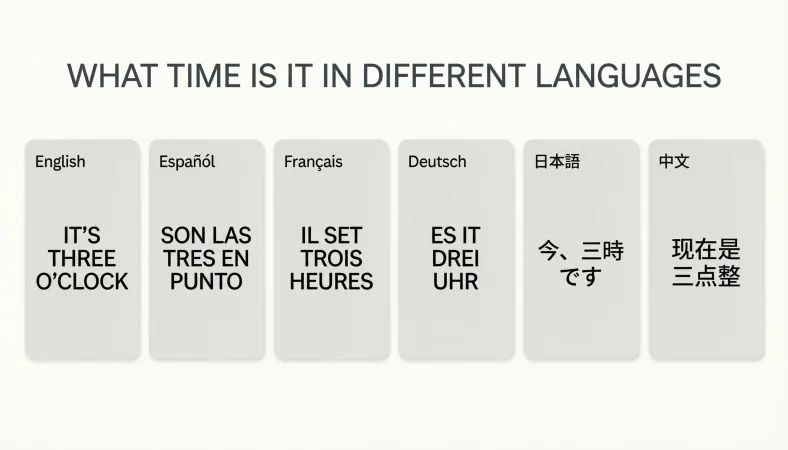
Knowing how to ask “what time is it?” in another language is one of the most useful phrases for travelers, language learners, and anyone communicating internationally.
if you are checking the time at a train station, arranging an online meeting, or simply practicing a new language, this simple question can make everyday conversations much easier.
Below, you’ll find what time is it in all languages in a practical, easy-to-scan format. Each entry includes the native phrase, an easy English pronunciation, a natural example sentence, and the English meaning.
What Time Is It in Different Languages?
The following table covers 70 languages from different regions of the world. Pronunciations are simplified for English speakers, so they are intended as practical guides rather than exact phonetic transcriptions.
| # | Language | Correct native phrase | Easy English pronunciation | Real-life example sentence | English meaning |
|---|---|---|---|---|---|
| 1 | English | What time is it? | wuht taim iz it | Excuse me, what time is it? | Asking someone for the current time. |
| 2 | Spanish | ¿Qué hora es? | kay OR-ah es | Perdón, ¿qué hora es? | Excuse me, what time is it? |
| 3 | French | Quelle heure est-il ? | kel UR eh-TEEL | Excusez-moi, quelle heure est-il ? | Excuse me, what time is it? |
| 4 | German | Wie spät ist es? | vee shpayt ist es | Entschuldigung, wie spät ist es? | Excuse me, what time is it? |
| 5 | Italian | Che ore sono? | kay OR-eh SOH-no | Scusi, che ore sono? | Excuse me, what time is it? |
| 6 | Portuguese | Que horas são? | kay OR-ahz sow | Desculpe, que horas são? | Excuse me, what time is it? |
| 7 | Dutch | Hoe laat is het? | hoo laat iz het | Pardon, hoe laat is het? | Excuse me, what time is it? |
| 8 | Swedish | Vad är klockan? | vahd air KLOK-an | Ursäkta, vad är klockan? | Excuse me, what time is it? |
| 9 | Norwegian | Hva er klokka? | vah air KLOK-ah | Unnskyld, hva er klokka? | Excuse me, what time is it? |
| 10 | Danish | Hvad er klokken? | veh air KLOK-en | Undskyld, hvad er klokken? | Excuse me, what time is it? |
| 11 | Finnish | Paljonko kello on? | PAL-yon-ko KEL-lo on | Anteeksi, paljonko kello on? | Excuse me, what time is it? |
| 12 | Icelandic | Hvað er klukkan? | kvath air KLU-kan | Afsakið, hvað er klukkan? | Excuse me, what time is it? |
| 13 | Irish | Cén t-am é? | kayn tom ay | Gabh mo leithscéal, cén t-am é? | Excuse me, what time is it? |
| 14 | Welsh | Faint o’r gloch yw hi? | fainte or glohk yoo hee | Esgusodwch fi, faint o’r gloch yw hi? | Excuse me, what time is it? |
| 15 | Scottish Gaelic | Dè an uair a tha e? | jay an oo-er a ha eh | Dè an uair a tha e a-nis? | What time is it now? |
| 16 | Polish | Która jest godzina? | KTOO-ra yest go-JEE-na | Przepraszam, która jest godzina? | Excuse me, what time is it? |
| 17 | Czech | Kolik je hodin? | KO-lik yeh HO-din | Promiňte, kolik je hodin? | Excuse me, what time is it? |
| 18 | Slovak | Koľko je hodín? | KOL-ko yeh HO-deen | Prepáčte, koľko je hodín? | Excuse me, what time is it? |
| 19 | Slovenian | Koliko je ura? | ko-LEE-ko yeh OO-ra | Oprostite, koliko je ura? | Excuse me, what time is it? |
| 20 | Croatian | Koliko je sati? | ko-LEE-ko yeh SAH-tee | Oprostite, koliko je sati? | Excuse me, what time is it? |
| 21 | Serbian | Колико је сати? | KO-lee-ko yeh SAH-tee | Извините, колико је сати? | Excuse me, what time is it? |
| 22 | Bulgarian | Колко е часът? | KOL-ko eh cha-SUT | Извинете, колко е часът? | Excuse me, what time is it? |
| 23 | Macedonian | Колку е часот? | KOL-koo eh CHA-sot | Извинете, колку е часот? | Excuse me, what time is it? |
| 24 | Russian | Который час? | ka-TO-ryy chas | Извините, который час? | Excuse me, what time is it? |
| 25 | Ukrainian | Котра година? | ko-TRA ho-DY-na | Перепрошую, котра година? | Excuse me, what time is it? |
| 26 | Belarusian | Колькі часу? | KOL-kee CHA-soo | Прабачце, колькі часу? | Excuse me, what time is it? |
| 27 | Lithuanian | Kiek valandų? | kyek va-LAN-doo | Atsiprašau, kiek valandų? | Excuse me, what time is it? |
| 28 | Latvian | Cik ir pulkstenis? | tsik eer POOLK-ste-nis | Atvainojiet, cik ir pulkstenis? | Excuse me, what time is it? |
| 29 | Estonian | Mis kell on? | mis kell on | Vabandust, mis kell on? | Excuse me, what time is it? |
| 30 | Hungarian | Hány óra van? | HAHN-y OH-ra van | Elnézést, hány óra van? | Excuse me, what time is it? |
| 31 | Romanian | Cât e ceasul? | kut eh CHAS-ool | Scuzați-mă, cât e ceasul? | Excuse me, what time is it? |
| 32 | Albanian | Sa është ora? | sa UH-shet OH-ra | Më falni, sa është ora? | Excuse me, what time is it? |
| 33 | Greek | Τι ώρα είναι; | tee OH-ra EE-ne | Συγγνώμη, τι ώρα είναι; | Excuse me, what time is it? |
| 34 | Turkish | Saat kaç? | sah-AHT kach | Affedersiniz, saat kaç? | Excuse me, what time is it? |
| 35 | Armenian | Ժամը քանիսն է? | ZHA-muh ka-NEES-n eh | Կներեք, ժամը քանիսն է? | Excuse me, what time is it? |
| 36 | Georgian | რომელი საათია? | ro-ME-li saa-TEE-a | უკაცრავად, რომელი საათია? | Excuse me, what time is it? |
| 37 | Arabic | كم الساعة؟ | kam as-SA-ah | عفواً، كم الساعة؟ | Excuse me, what time is it? |
| 38 | Hebrew | מה השעה? | mah ha-SHA-ah | סליחה, מה השעה? | Excuse me, what time is it? |
| 39 | Persian | ساعت چند است؟ | SA-at chand ast | ببخشید، ساعت چند است؟ | Excuse me, what time is it? |
| 40 | Urdu | کیا وقت ہوا ہے؟ | kya waqt hua hai | معاف کیجیے، کیا وقت ہوا ہے؟ | Excuse me, what time is it? |
| 41 | Hindi | कितने बजे हैं? | KIT-ne ba-JAY hain | माफ़ कीजिए, कितने बजे हैं? | Excuse me, what time is it? |
| 42 | Bengali | কয়টা বাজে? | KOY-ta BA-je | মাফ করবেন, কয়টা বাজে? | Excuse me, what time is it? |
| 43 | Punjabi | ਕਿੰਨੇ ਵਜੇ ਹਨ? | KIN-ne va-JAY han | ਮਾਫ਼ ਕਰਨਾ, ਕਿੰਨੇ ਵਜੇ ਹਨ? | Excuse me, what time is it? |
| 44 | Gujarati | કેટલા વાગ્યા? | KET-la VAG-ya | માફ કરશો, કેટલા વાગ્યા? | Excuse me, what time is it? |
| 45 | Marathi | किती वाजले? | KI-tee VAJ-le | माफ करा, किती वाजले? | Excuse me, what time is it? |
| 46 | Nepali | कति बज्यो? | ka-TEE BAJ-yo | माफ गर्नुहोस्, कति बज्यो? | Excuse me, what time is it? |
| 47 | Tamil | மணி என்ன? | MA-ni EN-na | மன்னிக்கவும், மணி என்ன? | Excuse me, what time is it? |
| 48 | Telugu | సమయం ఎంత? | sa-MA-yam EN-ta | క్షమించండి, సమయం ఎంత? | Excuse me, what time is it? |
| 49 | Kannada | ಸಮಯ ಎಷ್ಟು? | sa-MA-ya ESH-tu | ಕ್ಷಮಿಸಿ, ಸಮಯ ಎಷ್ಟು? | Excuse me, what time is it? |
| 50 | Malayalam | സമയം എത്രയായി? | sa-MA-yam et-ra-YA-yi | ക്ഷമിക്കണം, സമയം എത്രയായി? | Excuse me, what time is it? |
| 51 | Sinhala | වෙලාව කීයද? | we-LA-wa kee-YA-da | සමාවෙන්න, වෙලාව කීයද? | Excuse me, what time is it? |
| 52 | Mandarin Chinese | 现在几点? | syen-ZAI jee-an dyan | 请问,现在几点? | Excuse me, what time is it now? |
| 53 | Cantonese | 而家幾點? | yi-GA gay-DEEM | 唔該,而家幾點? | Excuse me, what time is it now? |
| 54 | Japanese | 今何時ですか? | ee-ma NAN-jee des-ka | すみません、今何時ですか? | Excuse me, what time is it now? |
| 55 | Korean | 지금 몇 시예요? | jee-geum myut she-ye-yo | 실례합니다, 지금 몇 시예요? | Excuse me, what time is it now? |
| 56 | Vietnamese | Mấy giờ rồi? | may zoh roy | Xin lỗi, mấy giờ rồi? | Excuse me, what time is it? |
| 57 | Thai | ตอนนี้กี่โมง? | ton-NEE gee-MOHNG | ขอโทษครับ/ค่ะ ตอนนี้กี่โมง? | Excuse me, what time is it now? |
| 58 | Indonesian | Jam berapa? | jam beh-RA-pa | Permisi, jam berapa? | Excuse me, what time is it? |
| 59 | Malay | Pukul berapa? | poo-KOOL beh-RA-pa | Maaf, pukul berapa? | Excuse me, what time is it? |
| 60 | Filipino | Anong oras na? | ah-NONG OH-ras na | Excuse me, anong oras na? | Excuse me, what time is it? |
| 61 | Swahili | Ni saa ngapi? | nee SAH nga-PEE | Samahani, ni saa ngapi? | Excuse me, what time is it? |
| 62 | Afrikaans | Hoe laat is dit? | hoo laat is dit | Verskoon my, hoe laat is dit? | Excuse me, what time is it? |
| 63 | Amharic | ስንት ሰዓት ነው? | sint SE-at new | ይቅርታ፣ ስንት ሰዓት ነው? | Excuse me, what time is it? |
| 64 | Somali | Saacaddu waa imisa? | saa-ahd-doo waa ee-MEE-sa | Raalli ahow, saacaddu waa imisa? | Excuse me, what time is it? |
| 65 | Hausa | Wani lokaci ne? | WA-nee lo-KA-chee neh | Don Allah, wani lokaci ne? | Please, what time is it? |
| 66 | Yoruba | Àkókò mélòó ni? | ah-KOH-koh meh-LOH nee | Jọ̀wọ́, àkókò mélòó ni? | Please, what time is it? |
| 67 | Zulu | Isikhathi sini? | ee-see-KHA-tee-lee SEE-nee | Uxolo, isikhathi sini? | Excuse me, what time is it? |
| 68 | Xhosa | Ngubani ixesha? | noo-BAH-nee ee-KHE-sa | Uxolo, ngubani ixesha? | Excuse me, what time is it? |
| 69 | Malagasy | Amin’ny firy izao? | ah-MEEN nee FEER ee ZOW | Azafady, amin’ny firy izao? | Excuse me, what time is it now? |
| 70 | Māori | He aha te wā? | heh AH-ha teh wah | Tēnā koa, he aha te wā? | Please, what time is it? |
How to Say “What Time Is It?” in Different Languages
The most common translations are usually short because asking for the time is an everyday conversation. Many languages use a structure equivalent to “What time is it?”, while others literally ask about the hour, clock, or current time.
For example, Spanish uses ¿Qué hora es?, French uses Quelle heure est-il ?, German uses Wie spät ist es?, and Japanese uses 今何時ですか?. Although the sentence structures differ, they all serve the same practical purpose.
When learning what time is it in different languages, it is helpful to learn both the question and a few basic time expressions. Knowing words for “morning,” “afternoon,” “evening,” “today,” and “now” can make the phrase much more useful in real conversations.
What Time Is It in All Languages: Useful Patterns
There is no single grammatical pattern used around the world. Different languages describe time in different ways.
Some languages focus directly on the hour. Others use a phrase meaning “how late is it?” or “how many hours is it?” This is why literal translations can sometimes sound unusual in English.
For language learners, the most important thing is to remember the natural native phrase, rather than translating the English sentence word for word.
“What Time Is It?” Translations Around the World
The phrase appears in many forms across Europe, Asia, Africa, the Middle East, and the Pacific.
In several European languages, the sentence resembles the English structure. Spanish asks ¿Qué hora es?, Italian uses Che ore sono?, and Portuguese uses Que horas são?
Across South Asia, the wording can be different. Hindi, Urdu, Punjabi, Bengali, Gujarati, Marathi, and Nepali commonly use expressions based on asking how many hours or which hour it is.
East Asian languages also have their own natural structures. Mandarin Chinese asks 现在几点?, Japanese uses 今何時ですか?, and Korean uses 지금 몇 시예요?
These differences make what time is it around the world an interesting example of how languages express the same everyday idea in different ways.
Why Learn “What Time Is It?” in Another Language?
Learning this phrase has practical value because it is useful in many everyday situations.
You may need it when traveling, catching public transportation, meeting someone, attending an event, checking into accommodation, or coordinating an international appointment.
It is also an excellent beginner phrase because it introduces learners to basic vocabulary related to numbers, hours, clocks, and daily routines.
If you are studying a language for travel, learning this phrase alongside “thank you,” “excuse me,” “where is it?” and “how much does it cost?” gives you a useful foundation for simple conversations.
Tips for Using Time Phrases Naturally
Pronunciation matters, but communication does not have to be perfect. If you are speaking with a native speaker, focus first on saying the key words clearly.
It is also useful to listen for how people actually answer. A person might give an exact time, use a phrase such as “half past,” or describe the approximate time as “around eight.”
In some languages, formal and informal versions may differ. The examples in the table favor common conversational forms, but local usage can vary by region, age, and situation.
For travelers, practicing the complete exchange is more useful than memorizing the question alone: ask for the time, understand the answer, and know how to thank the person afterward.
Frequently Asked Questions
1. How do you say “what time is it?” in different languages?
The phrase has different forms depending on the language. Examples include ¿Qué hora es? in Spanish, Quelle heure est-il ? in French, Wie spät ist es? in German, 今何時ですか? in Japanese, and كم الساعة؟ in Arabic.
2. What is the easiest language in which to say “what time is it?”
There is no universal easiest language because pronunciation and grammar depend on the learner’s native language. For English speakers, languages with familiar vocabulary or straightforward sentence structures may feel easier to learn.
3. How do you say “what time is it?” in all languages?
There are thousands of languages and varieties worldwide, so it is not practical to list every language. This guide provides 70 widely spoken or culturally significant languages and their commonly used expressions.
4. Why are “what time is it?” translations different from one language to another?
Languages organize ideas differently. Some ask directly about the hour, while others use expressions related to lateness, the clock, or the number of hours. A natural translation therefore does not always follow the English word order.
5. Is the pronunciation in these translations exact?
The pronunciations are simplified guides designed for English speakers. They can help beginners get close to the native pronunciation, but listening to native speakers and practicing the sounds is the best way to improve accuracy.
Conclusion
Learning how to say what time is it in different languages is a simple way to build practical communication skills. From Spanish and French to Hindi, Arabic, Mandarin, Japanese, Swahili, and Māori, the same everyday question takes many interesting forms around the world.
Use the 70 translations above as a starting point for travel, language study, international communication, or simple cultural exploration. Learning one phrase at a time can make a new language feel much more approachable.

I am Jimmy Michael, a language enthusiast and writer passionate about exploring different languages, words, and cultures. I create simple, useful content that helps readers understand languages better and discover new ways to communicate globally.