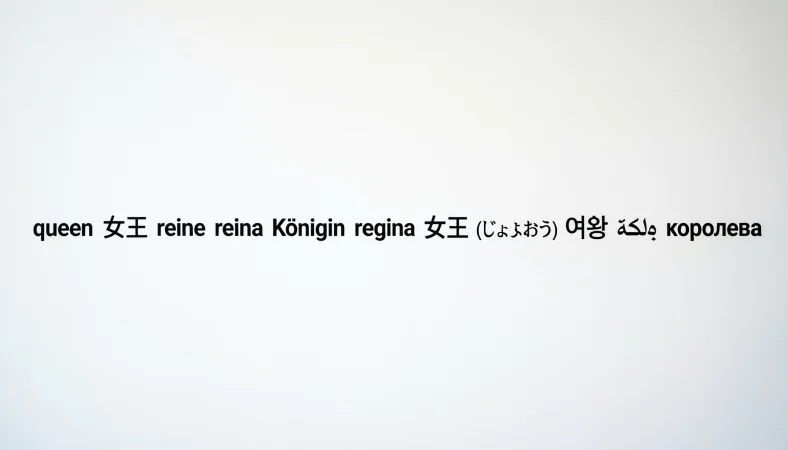
The word “queen” represents royalty, leadership, elegance, strength, and power. Across the world, different languages have their own words for a queen, shaped by their cultures, histories, and traditions.
if you are learning a new language, choosing a meaningful name, writing a story, or exploring royal titles, discovering how to say “queen” in different languages is a fascinating place to start.
From reine in French to regina in Italian and königin in German, these translations offer a glimpse into how people express royalty around the world.
Some languages also distinguish between a reigning queen, a queen consort, and a queen mother, so the most accurate word can depend on the context.
In this guide, you will find translations of “queen” across major world languages, regional languages, and historical traditions, along with pronunciation tips, cultural notes, and related royal vocabulary.
Queen in 15 Popular World Languages
Here are 15 widely recognized translations of the word “queen.”
| Language | Word for Queen | Pronunciation Guide |
|---|---|---|
| French | Reine | Ren |
| Spanish | Reina | RAY-nah |
| Italian | Regina | Reh-JEE-nah |
| German | Königin | KUR-nig-in |
| Portuguese | Rainha | Rah-EEN-yah |
| Dutch | Koningin | Koh-ning-in |
| Russian | Королева (Koroleva) | Kuh-ruh-LYE-vuh |
| Arabic | ملكة (Malika) | MAH-li-kah |
| Hindi | रानी (Rani) | RAH-nee |
| Urdu | ملکہ (Malika) | MAL-kah |
| Chinese (Mandarin) | 女王 (Nǚwáng) | Nyoo-wahng |
| Japanese | 女王 (Joō) | Joh-oh |
| Korean | 여왕 (Yeowang) | Yuh-wahng |
| Turkish | Kraliçe | Krah-lee-cheh |
| Greek | Βασίλισσα (Vasilissa) | Vah-SEE-lee-sah |
Pronunciation guides are approximate. Exact sounds vary by accent and region.
Queen in European Languages
European languages have many distinctive words for queens, reflecting centuries of royal history, monarchies, and cultural traditions.
- English: Queen
- French: Reine
- Spanish: Reina
- Italian: Regina
- German: Königin
- Portuguese: Rainha
- Dutch: Koningin
- Swedish: Drottning
- Norwegian: Dronning
- Danish: Dronning
- Finnish: Kuningatar
- Icelandic: Drottning
- Greek: Βασίλισσα (Vasilissa)
- Polish: Królowa
- Czech: Královna
These words can refer to a queen in a monarchy, although the precise meaning may depend on whether the person rules in her own right or is married to a king.
Queen in Asian Languages
Across Asia, translations of “queen” reflect a wide range of linguistic systems and royal traditions.
- Hindi: रानी (Rani)
- Urdu: ملکہ (Malika)
- Bengali: রানি (Rani)
- Punjabi: ਰਾਣੀ (Rani)
- Gujarati: રાણી (Rani)
- Marathi: राणी (Rani)
- Nepali: रानी (Rani)
- Tamil: ராணி (Rāṇi)
- Telugu: రాణి (Rāṇi)
- Kannada: ರಾಣಿ (Rāṇi)
- Malayalam: റാണി (Rāṇi)
- Chinese (Mandarin): 女王 (Nǚwáng)
- Japanese: 女王 (Joō)
- Korean: 여왕 (Yeowang)
- Thai: ราชินี (Rachini)
Cultural note: Words derived from rani are common in several South Asian languages. Depending on the language and context, the word may refer to a queen, a royal woman, or a traditional title.
Queen in Middle Eastern Languages
Royal vocabulary in the Middle East includes terms with long literary, religious, and historical associations.
- Arabic: ملكة (Malika)
- Hebrew: מַלְכָּה (Malkah)
- Persian (Farsi): ملکه (Malakeh)
- Turkish: Kraliçe
- Kurdish (Kurmanji): Qralîçe
- Azerbaijani: Kraliça
- Armenian: Թագուհի (Taguhi)
- Georgian: დედოფალი (Dedopali)
- Pashto: ملکه (Malika)
- Kurdish (Sorani): شەهزادەی ژن (usage varies by context)
- Kazakh: Патшайым (Patshaiym)
- Uzbek: Qirolicha
- Kyrgyz: Ханыша (Khanysha)
- Tajik: Малика (Malika)
- Mongolian: Хатан (Khatan)
Some entries are general equivalents rather than exact matches for every royal role. For formal writing or historical translation, verify the title in its specific cultural setting.
Queen in African Languages
Africa is home to thousands of languages, many with rich traditions of leadership and royal titles. These examples represent a selection rather than a complete list.
- Swahili: Malkia
- Amharic: ንግሥት (Nəgəśt)
- Yoruba: Ayaba
- Igbo: Eze nwanyị
- Hausa: Sarauniya
- Zulu: Indlovukazi
- Xhosa: Ukumkanikazi
- Somali: Boqorad
- Shona: Mambokadzi
- Kinyarwanda: Umwamikazi
- Kirundi: Umwamikazi
- Sesotho: Mofumahali
- Setswana: Mohumagadi
- Oromo: Mootittii
- Malagasy: Mpanjakavavy
Royal titles can carry meanings beyond the English word “queen.” For example, some may distinguish a ruling monarch from a queen mother or another senior woman in a royal household.
Queen in Southeast Asian Languages
Southeast Asia has diverse languages influenced by local kingdoms, regional traditions, and centuries of cultural exchange.
- Indonesian: Ratu
- Malay: Ratu
- Filipino (Tagalog): Reyna
- Vietnamese: Nữ hoàng
- Thai: ราชินี (Rachini)
- Lao: ພະລາຊິນີ (Pha lasini)
- Khmer: មហាក្សត្រី (Mahaak-satri)
- Burmese: ဘုရင်မ (Bahin-ma)
- Javanese: Ratu
- Sundanese: Ratu
- Cebuano: Reyna
- Ilocano: Reyna
- Tetum: Rainha
- Balinese: Ratu
- Acehnese: Regional terms vary; ratu may be understood in some contexts.
In Indonesian and Malay, ratu can refer to a queen or female sovereign, and it also appears in expressions associated with queenship and royalty.
Queen in Slavic Languages
Slavic languages often have related royal terms, but their spelling, pronunciation, and historical usage differ.
- Russian: Королева (Koroleva)
- Ukrainian: Королева (Koroleva)
- Belarusian: Каралева (Karaleva)
- Polish: Królowa
- Czech: Královna
- Slovak: Kráľovná
- Slovenian: Kraljica
- Croatian: Kraljica
- Serbian: Краљица (Kraljica)
- Bosnian: Kraljica
- Macedonian: Кралица (Kralitsa)
- Bulgarian: Кралица (Kralitsa)
- Montenegrin: Kraljica
- Upper Sorbian: Kralowna
- Lower Sorbian: Kralowna
Several of these words share recognizable roots related to kingship. However, similar-looking terms should not automatically be assumed to have identical pronunciation or historical meaning.
Queen in Nordic and Other Northern European Languages
Northern Europe has its own distinctive royal vocabulary.
- Swedish: Drottning
- Norwegian: Dronning
- Danish: Dronning
- Icelandic: Drottning
- Finnish: Kuningatar
- Estonian: Kuninganna
- Latvian: Karaliene
- Lithuanian: Karalienė
- Northern Sámi: Gonagasdálvi is not the standard word for queen; terminology varies by dialect and context.
- Irish: Banríon
- Scottish Gaelic: Banrigh
- Welsh: Brenhines
- Breton: Rouanez
- Luxembourgish: Kinnigin
- Faroese: Drotning
The Irish banríon and Scottish Gaelic banrigh illustrate how closely related languages can preserve their own forms for royal titles.
Queen in Indigenous and Regional Languages
Many Indigenous and regional languages have terms for queens, female rulers, or women holding traditional authority. Some communities historically used different political systems from European monarchies, so a direct one-word translation may not always fit.
- Māori: Kuini
- Hawaiian: Mōʻī wahine
- Samoan: Masiofo
- Tongan: Kuini
- Fijian: Ranadi
- Quechua: Terminology varies by dialect and historical context.
- Aymara: Terminology depends on the intended royal or leadership role.
- Guarani: Usage varies by regional variety and context.
- Nahuatl: Historical and modern equivalents depend on the type of ruler.
- Inuktitut: Terms vary across dialects and contexts.
- Greenlandic: Queen-related terminology depends on modern or historical usage.
- Cherokee: A context-specific translation is preferable to a generic title.
- Navajo (Diné): A descriptive translation may be needed for a foreign royal title.
- Ojibwe: Wording depends on the intended meaning and community usage.
- Yucatec Maya: Royal titles depend on historical context and the type of leadership described.
For these languages, a reliable translation should be checked with a fluent speaker or a language-specific dictionary, especially when the term will be used publicly or ceremonially.
Queen in Ancient and Historical Languages
Historical languages are useful when exploring mythology, ancient rulers, literature, or historical fiction.
- Latin: Regina
- Ancient Greek: βασίλισσα (basilissa; forms and usage varied historically)
- Biblical Hebrew: מַלְכָּה (malkāh)
- Classical Arabic: ملكة (malika)
- Old English: Cwen
- Old Norse: Dróttning
- Old Irish: Banchuire, in historical royal terminology
- Sanskrit: राज्ञी (Rājñī)
- Classical Persian: Royal terminology varied by period and court.
- Middle Persian: Historical royal titles varied by period.
- Old Church Slavonic: Historical forms depend on the text and title.
- Ancient Egyptian: Royal women held several titles, depending on their role.
- Akkadian: Royal titles depended on period and context.
- Sumerian: Royal terminology differs from modern one-word translations.
- Gothic: Historical evidence for specific royal terms is limited.
Important: Ancient languages often had several words for royal women, queens consort, goddesses, or female rulers. A modern dictionary equivalent may not capture the full historical meaning.
Beautiful Words for Queen in Different Languages
Some translations of “queen” sound especially elegant to people learning languages or looking for inspiration for names, usernames, and creative projects.
- Reine — French
- Reina — Spanish
- Regina — Italian and Latin
- Rainha — Portuguese
- Malika — Arabic and several other languages
- Rani — Hindi and several South Asian languages
- Malkah — Hebrew
- Kuningatar — Finnish
- Königin — German
- Kraljica — Croatian and Slovenian
- Ayaba — Yoruba
- Sarauniya — Hausa
- Malkia — Swahili
- Kuini — Māori
- Masiofo — Samoan
The best choice depends on what you want to express. Regina has a classical feel, Reina is short and recognizable, and Malika has a graceful sound and broad cultural familiarity.
Short and Stylish Words Meaning Queen
If you want a concise word for a profile, nickname, creative project, or design, these options are worth exploring.
- Rani — Hindi and related South Asian usage
- Reina — Spanish
- Reine — French
- Ratu — Indonesian and Malay
- Kuini — Māori
- Regina — Italian and Latin
- Malkia — Swahili
- Malika — Arabic
- Ayaba — Yoruba
- Reyna — A spelling used in some Spanish-language names and Filipino usage
- Raina — A name in various cultures, but not the standard translation in every language
- Raniyah — A personal-name form, not a universal translation of queen
- Reinae — A creative variation rather than a standard translation
- Queenie — English nickname or affectionate form
- Queen — English
Some entries are personal names or creative variations rather than literal translations. If accuracy matters, choose a standard language form and verify its spelling.
Words Related to Queen: Royal Titles and Meanings
Not every royal title means exactly the same thing. These distinctions are useful when translating books, writing character profiles, or studying monarchy.
- Queen regnant: A queen who rules in her own right.
- Queen consort: The wife of a reigning king.
- Queen mother: A queen who is the mother of the reigning monarch.
- Dowager queen: A widow of a king who retains a royal title.
- Crown princess: A female heir or a princess next in line, depending on the monarchy.
- Princess: A female member of a royal family, or a woman holding a princely title.
- Empress: A female ruler of an empire or the consort of an emperor.
- Empress regnant: A woman who rules an empire in her own right.
- Royal consort: A spouse of a monarch.
- Sovereign: The supreme ruler of a state or monarchy.
- Monarch: A king, queen, or another sovereign ruler.
- Royal highness: A style of address used by certain members of royal families.
- Her Majesty: A formal style of address for certain queens.
- Queen dowager: Another term used for a widow of a king who retains a queenly status.
- Female sovereign: A general description of a woman who rules a country or territory.
These distinctions help prevent confusion between a woman who holds power as monarch and a woman who receives a title through marriage or family relationship.
How to Use the Word Queen in Different Languages
Knowing the translation is only the first step. Grammar, formality, and cultural context can affect how you use it.
- Check the gender of the noun. Some languages classify nouns by grammatical gender.
- Learn the correct article. French uses la reine, while Spanish uses la reina.
- Check plural forms. A plural noun may change its ending or spelling.
- Distinguish a person from a chess piece. The translation of “queen” in chess may differ from a royal title.
- Consider the historical period. Ancient titles may not match modern royal vocabulary.
- Use the correct writing system. Learn the native script where possible.
- Check accent marks. Diacritics can affect spelling and sometimes pronunciation.
- Listen to native speakers. Pronunciation guides cannot represent every sound perfectly.
- Avoid mixing languages. A word that looks similar across languages may have a different meaning.
- Check formal titles. Official royal styles can have specific rules.
- Understand local traditions. Some cultures distinguish multiple kinds of royal women.
- Use reliable dictionaries. Prefer language-specific dictionaries and reputable educational resources.
- Ask a fluent speaker. This is especially valuable for ceremonial or public uses.
- Check transliteration. Romanized spelling may differ between systems.
- Match the intended meaning. Decide whether you mean a ruler, consort, queen mother, or metaphorical “queen.”
Image Suggestions
- Image 1: A world map showing translations of “queen” in selected languages.
- Image 2: A comparison graphic featuring Reina, Reine, Regina, Rani, and Malika.
- Image 3: A royal vocabulary infographic explaining queen regnant, queen consort, and queen mother.
Internal Linking Suggestions
If these topics are part of a language or names website, consider linking to related pages such as:
- Names that mean queen
- Princess in different languages
- King in different languages
- Royal names for girls
- Beautiful words from around the world
- Powerful female names
- Royal and elegant usernames
Frequently Asked Questions
1. What is the word for queen in the most languages?
There is no single word used in every language. Common translations include reina in Spanish, reine in French, regina in Italian, rani in Hindi, and malika in Arabic.
2. How do you say queen in French?
The French word for queen is reine. It is pronounced approximately “ren,” with a French nasal vowel.
3. What is queen in Spanish?
The Spanish word for queen is reina, pronounced approximately “RAY-nah.” It is used for a queen in a royal context.
4. What does Malika mean?
Malika means “queen” in Arabic and is also used as a personal name in various cultures. Its precise pronunciation and use may vary by language and region.
5. What is queen in Japanese?
The Japanese word for queen is 女王 (joō). The term is used for a queen or female sovereign, depending on context.
6. What is queen in Hindi?
The Hindi word commonly used for queen is (rani). It can refer to a queen or a royal woman, depending on context.
7. Is Regina another word for queen?
Yes. Regina means “queen” in Italian and Latin. It is also used as a personal name in many countries.
8. Are queen translations the same in every culture?
No. Some languages use one general word, while others distinguish between a reigning queen, a queen consort, and a queen mother. Cultural context matters when choosing the most accurate translation.
Final Thoughts
Learning how to say queen in different languages reveals more than a collection of translations. Words such as Reina, Reine, Regina, Rani, and Malika reflect the diversity of languages and the many ways cultures express royalty, leadership, and elegance.
If you are choosing a word for a name, username, story, or design, consider both its meaning and its cultural context. For formal or historical use, confirm the translation with a trusted dictionary or fluent speaker.
Which word for “queen” is your favorite? Share it with others who enjoy languages, meaningful words, and royal names.

I am Danny James, an Administrator at LingoHives, passionate about languages, communication, and cultural diversity. I enjoy helping people discover languages, understand words, and connect with different cultures through simple, useful, and engaging content.