Family is one of the most universal ideas in the world. Although languages, cultures, and traditions differ, almost every society has a special way to describe the people we love, support, and share life with.
If you are searching for family in different languages, this guide gives you 70 useful translations in a simple, easy-to-read format. You will find the native word or phrase, an easy English pronunciation, a short real-life example, and the English meaning of that sentence.
if you are learning a language, traveling, researching family-related words, choosing a meaningful tattoo or name, or simply curious about family in all languages, this list makes it easy to compare family translations around the world.
Family in All Languages: 70 Translations
The word for family can sometimes have slightly different meanings depending on context. The translations below use the most natural common expression for “family” in each language.
| # | Language | Native phrase | Easy English pronunciation | Real-life example | English meaning |
|---|---|---|---|---|---|
| 1 | English | family | FAM-uh-lee | My family is very close. | My family is very close. |
| 2 | Spanish | familia | fah-MEE-lyah | Mi familia vive aquí. | My family lives here. |
| 3 | French | famille | fah-MEE | Ma famille est grande. | My family is large. |
| 4 | German | Familie | fah-MEE-lee-eh | Meine Familie ist wichtig. | My family is important. |
| 5 | Italian | famiglia | fah-MEE-lyah | La mia famiglia è grande. | My family is large. |
| 6 | Portuguese | família | fah-MEE-lyah | Minha família mora aqui. | My family lives here. |
| 7 | Dutch | familie | fah-MEE-lee | Mijn familie is groot. | My family is large. |
| 8 | Swedish | familj | fah-MEEL-y | Min familj är viktig. | My family is important. |
| 9 | Norwegian | familie | fah-MEE-lee-eh | Familien min er stor. | My family is large. |
| 10 | Danish | familie | fah-MEE-lee-eh | Min familie er vigtig. | My family is important. |
| 11 | Finnish | perhe | PEHR-heh | Perheeni on suuri. | My family is large. |
| 12 | Icelandic | fjölskylda | FYURL-skill-dah | Fjölskyldan mín er stór. | My family is large. |
| 13 | Irish | teaghlach | CHYAKH-lukh | Tá mo theaghlach mór. | My family is large. |
| 14 | Welsh | teulu | TAY-lee | Mae fy nheulu yma. | My family is here. |
| 15 | Scottish Gaelic | teaghlach | CHYAKH-lukh | Tha mo theaghlach mòr. | My family is large. |
| 16 | Polish | rodzina | roh-JEE-nah | Moja rodzina jest duża. | My family is large. |
| 17 | Czech | rodina | ROH-dee-nah | Moje rodina je velká. | My family is large. |
| 18 | Slovak | rodina | ROH-dee-nah | Moja rodina je veľká. | My family is large. |
| 19 | Slovenian | družina | droo-ZHEE-nah | Moja družina je velika. | My family is large. |
| 20 | Croatian | obitelj | oh-BYEH-tyel | Moja obitelj je velika. | My family is large. |
| 21 | Serbian | породица | poh-ROH-dee-tsah | Моја породица је велика. | My family is large. |
| 22 | Bosnian | porodica | poh-ROH-dee-tsah | Moja porodica je velika. | My family is large. |
| 23 | Bulgarian | семейство | seh-MAY-stvo | Моето семейство е голямо. | My family is large. |
| 24 | Macedonian | семејство | seh-MEY-stvo | Моето семејство е големо. | My family is large. |
| 25 | Russian | семья | sem-YA | Моя семья здесь. | My family is here. |
| 26 | Ukrainian | сім’я | sim-YA | Моя сім’я тут. | My family is here. |
| 27 | Belarusian | сям’я | syam-YA | Мая сям’я тут. | My family is here. |
| 28 | Lithuanian | šeima | SHAY-mah | Mano šeima didelė. | My family is large. |
| 29 | Latvian | ģimene | GHEE-meh-neh | Mana ģimene ir liela. | My family is large. |
| 30 | Estonian | perekond | PEH-reh-kond | Minu perekond on suur. | My family is large. |
| 31 | Hungarian | család | CHAH-laad | A családom nagy. | My family is large. |
| 32 | Romanian | familie | fah-MEE-lee-eh | Familia mea este mare. | My family is large. |
| 33 | Greek | οικογένεια | ee-koh-GHEH-nee-ah | Η οικογένειά μου είναι μεγάλη. | My family is large. |
| 34 | Albanian | familje | fah-MEEL-yeh | Familja ime është e madhe. | My family is large. |
| 35 | Armenian | ընտանիք | untah-NEEK | Իմ ընտանիքը մեծ է։ | My family is large. |
| 36 | Georgian | ოჯახი | oh-JAH-khee | ჩემი ოჯახი დიდია. | My family is large. |
| 37 | Turkish | aile | eye-LEH | Ailem burada. | My family is here. |
| 38 | Azerbaijani | ailə | eye-LEH | Mənim ailəm böyükdür. | My family is large. |
| 39 | Persian | خانواده | khah-neh-VAH-deh | خانواده من اینجاست. | My family is here. |
| 40 | Arabic | عائلة | AA-eh-lah | عائلتي كبيرة. | My family is large. |
| 41 | Hebrew | משפחה | mish-pah-KHAH | המשפחה שלי גדולה. | My family is large. |
| 42 | Hindi | परिवार | puh-ree-VAAR | मेरा परिवार बड़ा है। | My family is large. |
| 43 | Urdu | خاندان | khaan-DAAN | میرا خاندان بڑا ہے۔ | My family is large. |
| 44 | Bengali | পরিবার | po-ree-BAAR | আমার পরিবার বড়। | My family is large. |
| 45 | Punjabi | ਪਰਿਵਾਰ | puh-rih-VAAR | ਮੇਰਾ ਪਰਿਵਾਰ ਵੱਡਾ ਹੈ। | My family is large. |
| 46 | Gujarati | પરિવાર | puh-ree-VAAR | મારું પરિવાર મોટું છે. | My family is large. |
| 47 | Marathi | कुटुंब | koo-TOOM-buh | माझे कुटुंब मोठे आहे. | My family is large. |
| 48 | Nepali | परिवार | puh-ree-VAAR | मेरो परिवार ठूलो छ। | My family is large. |
| 49 | Sinhala | පවුල | PAU-lah | මගේ පවුල ලොකුයි. | My family is large. |
| 50 | Tamil | குடும்பம் | koo-doom-bam | என் குடும்பம் பெரியது. | My family is large. |
| 51 | Telugu | కుటుంబం | koo-doom-bam | నా కుటుంబం పెద్దది. | My family is large. |
| 52 | Kannada | ಕುಟುಂಬ | koo-doom-bah | ನನ್ನ ಕುಟುಂಬ ದೊಡ್ಡದು. | My family is large. |
| 53 | Malayalam | കുടുംബം | koo-doom-bam | എന്റെ കുടുംബം വലുതാണ്. | My family is large. |
| 54 | Odia | ପରିବାର | puh-ree-BAAR | ମୋ ପରିବାର ବଡ଼। | My family is large. |
| 55 | Assamese | পৰিয়াল | poh-ree-YAAL | মোৰ পৰিয়াল ডাঙৰ। | My family is large. |
| 56 | Chinese (Mandarin) | 家庭 | jiā tíng | 我的家庭很幸福。 | My family is happy. |
| 57 | Japanese | 家族 | kazoku | 私の家族は仲がいいです。 | My family gets along well. |
| 58 | Korean | 가족 | ga-jok | 우리 가족은 화목해요. | My family is harmonious. |
| 59 | Vietnamese | gia đình | zya dinh | Gia đình tôi rất lớn. | My family is very large. |
| 60 | Thai | ครอบครัว | khrop-khrua | ครอบครัวของฉันใหญ่มาก | My family is very large. |
| 61 | Indonesian | keluarga | kuh-LU-ar-gah | Keluarga saya tinggal di sini. | My family lives here. |
| 62 | Malay | keluarga | kuh-LU-ar-gah | Keluarga saya sangat rapat. | My family is very close. |
| 63 | Filipino | pamilya | pah-MEEL-yah | Malaki ang pamilya ko. | My family is large. |
| 64 | Swahili | familia | fah-MEE-lee-ah | Familia yangu ni kubwa. | My family is large. |
| 65 | Afrikaans | familie | fah-MEE-lee | My familie is groot. | My family is large. |
| 66 | Amharic | ቤተሰብ | bay-teh-SEB | ቤተሰቤ ትልቅ ነው። | My family is large. |
| 67 | Zulu | umndeni | oom-NDEH-nee | Umndeni wami mkhulu. | My family is large. |
| 68 | Xhosa | usapho | oo-SAH-poh | Usapho lwam lukhulu. | My family is large. |
| 69 | Haitian Creole | fanmi | fahn-MEE | Fanmi mwen la. | My family is here. |
| 70 | Latin | familia | fah-MEE-lee-ah | Familia mea magna est. | My family is large. |
How to Say Family in Different Languages
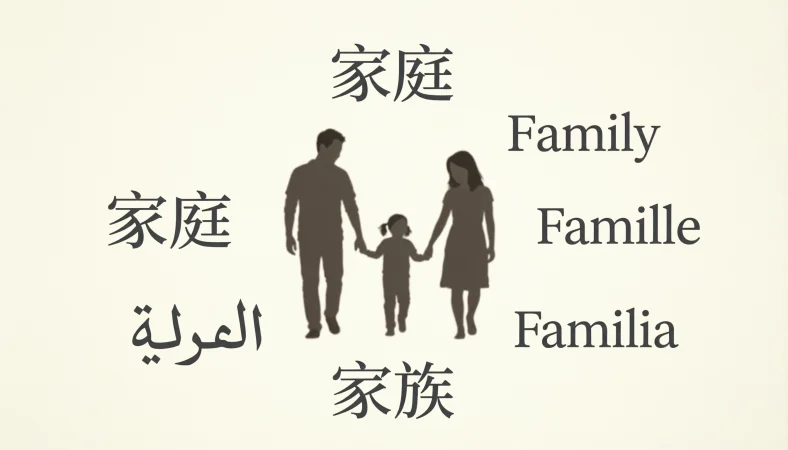
The most common translations of “family” vary considerably in sound and spelling. In many European languages, the word resembles English because the terms share historical or linguistic connections. For example, Spanish familia, Italian famiglia, Portuguese família, French famille, and Romanian familie all have recognizable similarities.
In other languages, the word looks and sounds completely different. Japanese uses 家族, Mandarin commonly uses 家庭, Hindi uses परिवार, Arabic uses عائلة, and Turkish uses aile.
This makes learning how to say family in different languages an interesting way to explore how cultures and languages describe relationships.
Family Around the World: What the Words Tell Us
The concept of family is universal, but the exact meaning of a family can differ between cultures.
In some languages, a family word may focus mainly on people living in the same household. In other contexts, it can refer to a wider group that includes grandparents, cousins, relatives, and extended family.
For everyday conversation, however, the translations in the table provide useful starting points for saying “family” around the world.
Why Learn the Word Family in Different Languages?
Learning one meaningful word in several languages can be useful for many reasons.
- Travel: Knowing a basic family word can help with everyday conversations.
- Language learning: Family vocabulary is common in beginner lessons.
- Cultural understanding: Family relationships are an important part of many cultures.
- Writing and art: Foreign-language family words can inspire names, designs, and creative projects.
- Communication: A familiar word can make conversations with international friends feel more personal.
- Education: Comparing translations helps learners notice differences between languages.
Family Translations for Travel and Conversation
If you are traveling, learning the word “family” is especially useful when talking about your home life, relatives, children, or travel companions.
For example, you may want to explain that your family lives in another country, introduce a family member, or ask someone about their relatives.
Learning the word alone is only the beginning. Once you know it, combine it with simple phrases such as “my family,” “your family,” “large family,” and “small family.” This helps turn vocabulary into practical communication.
Common Family Words to Learn Next
After learning the word for family, several related words can make your vocabulary much more useful:
- Mother
- Father
- Parents
- Brother
- Sister
- Son
- Daughter
- Child
- Husband
- Wife
- Grandmother
- Grandfather
- Relatives
- Home
- Love
Learning these words together creates a useful family vocabulary set instead of memorizing one isolated translation.
Are All Family Translations Exact Equivalents?
Not always. Translation depends on context.
A word may refer to an immediate family, an extended family, a household, or a broader family group depending on the language and sentence. Grammar can also change the form of the word.
For this reason, the table focuses on commonly understood words and natural everyday usage rather than attempting to force every language into exactly the same grammatical structure.
Frequently Asked Questions About Family in Different Languages
1. What is the word for family in different languages?
There are many different words for family around the world. Examples include familia in Spanish, famille in French, Familie in German, famiglia in Italian, 家族 in Japanese, 가족 in Korean, परिवार in Hindi, and عائلة in Arabic.
2. How do you say family in all languages?
There is no single practical list containing every language because thousands of languages are spoken worldwide. However, the table above provides 70 different family translations from languages across Europe, Asia, Africa, and the Americas.
3. What is the most common translation of family?
There is no universal translation, but forms related to familia are common across several Romance languages. Spanish uses familia, Italian uses famiglia, Portuguese uses família, French uses famille, and Romanian uses familie.
4. How do you say “my family” in different languages?
“My family” changes according to the language. Examples include mi familia in Spanish, ma famille in French, meine Familie in German, la mia famiglia in Italian, min familj in Swedish, and moja rodzina in Polish.
5. Why is learning family vocabulary useful?
Family vocabulary is useful because it appears frequently in everyday conversations. It can help you introduce yourself, describe your relatives, discuss your home life, and build a foundation for learning a new language.
Conclusion
Family may be expressed differently in every language, but the idea remains one of the most familiar and meaningful parts of human life
From familia in Spanish to 家族 in Japanese and परिवार in Hindi, these 70 translations show how languages around the world give a name to the people closest to us.
if you are studying languages, traveling, researching family in different languages, or simply exploring words from around the world, learning these translations is a simple way to connect language with culture and everyday life.

I am Johnny Thomas, a passionate language enthusiast and writer. I enjoy exploring different languages, cultures, words, and expressions. I create helpful, easy-to-understand content to help readers discover languages and communicate confidently.