Looking for cool in different languages? The word “cool” can describe something stylish, impressive, enjoyable, fashionable, or simply great. Because languages express these ideas differently, there is not always one exact translation.
This guide shows how to say cool in different languages using natural, everyday expressions. The examples focus mainly on the informal meaning of “cool” as in “That’s cool!” or “That’s awesome!” rather than the literal meaning of low temperature.
if you are learning a language, traveling, writing a multilingual message, or exploring cool translations around the world, this list gives you 70 useful expressions with easy pronunciation and practical examples.
Cool in All Languages: 70 Useful Translations
The phrases below represent common conversational ways to express “cool,” “great,” “awesome,” or a similar positive reaction. Exact usage can vary by region, age, and context.
| # | Language | Native phrase | Easy English pronunciation | Real-life example | English meaning |
|---|---|---|---|---|---|
| 1 | Spanish | ¡Qué guay! | kay gweye | ¡Qué guay tu coche! | Your car is so cool! |
| 2 | French | C’est cool ! | say kool | C’est cool, ton idée ! | Your idea is cool! |
| 3 | German | Cool! | kool | Das ist cool! | That is cool! |
| 4 | Italian | Forte! | FOR-teh | La tua idea è forte! | Your idea is cool! |
| 5 | Portuguese | Legal! | leh-GAHL | Isso é legal! | That is cool! |
| 6 | Dutch | Cool! | kool | Dat is cool! | That is cool! |
| 7 | Swedish | Coolt! | koolt | Det är coolt! | That is cool! |
| 8 | Norwegian | Kult! | koolt | Det er kult! | That is cool! |
| 9 | Danish | Fedt! | fet | Det er fedt! | That is cool! |
| 10 | Finnish | Siistiä! | SEE-stee-ah | Tuo on siistiä! | That is cool! |
| 11 | Icelandic | Flott! | floht | Þetta er flott! | This is cool! |
| 12 | Irish | Fionnuar! | FIN-oo-ar | Tá sé fionnuar! | It is cool! |
| 13 | Welsh | Cŵl! | kool | Mae hynny’n cŵl! | That is cool! |
| 14 | Scottish Gaelic | Fionnar! | FYUN-ar | Tha sin fionnar! | That is cool! |
| 15 | Polish | Fajnie! | FAI-nyeh | Fajnie! | Cool! |
| 16 | Czech | Super! | SOO-per | To je super! | That is cool! |
| 17 | Slovak | Super! | SOO-per | To je super! | That is cool! |
| 18 | Slovenian | Kul! | kool | To je kul! | That is cool! |
| 19 | Croatian | Super! | SOO-per | To je super! | That is cool! |
| 20 | Serbian | Супер! | SOO-per | Ово је супер! | This is cool! |
| 21 | Bosnian | Super! | SOO-per | Ovo je super! | This is cool! |
| 22 | Macedonian | Супер! | SOO-per | Ова е супер! | This is cool! |
| 23 | Bulgarian | Супер! | SOO-per | Това е супер! | This is cool! |
| 24 | Romanian | Mișto! | MISH-toh | E mișto! | It is cool! |
| 25 | Hungarian | Király! | kee-RAI | Ez király! | This is cool! |
| 26 | Greek | Κουλ! | kool | Αυτό είναι κουλ! | This is cool! |
| 27 | Albanian | Bukur! | BOO-koor | Kjo është bukur! | This is cool! |
| 28 | Russian | Круто! | KROO-toh | Это круто! | That is cool! |
| 29 | Ukrainian | Круто! | KROO-toh | Це круто! | That is cool! |
| 30 | Belarusian | Крута! | KROO-tah | Гэта крута! | That is cool! |
| 31 | Lithuanian | Faina! | FAI-nah | Tai faina! | That is cool! |
| 32 | Latvian | Forši! | FOR-shee | Tas ir forši! | That is cool! |
| 33 | Estonian | Lahe! | LAH-heh | See on lahe! | This is cool! |
| 34 | Armenian | Հավես! | hah-VESS | Սա հավես է! | This is cool! |
| 35 | Georgian | მაგარია! | mah-GAH-ree-ah | ეს მაგარია! | This is awesome! |
| 36 | Turkish | Harika! | hah-ree-KAH | Bu harika! | This is cool! |
| 37 | Azerbaijani | Əladır! | ah-LAH-dur | Bu əladır! | This is great! |
| 38 | Persian | باحال! | baa-HAAL | این خیلی باحاله! | This is really cool! |
| 39 | Arabic | رائع! | RAA-eh | هذا رائع! | This is awesome! |
| 40 | Hebrew | מגניב! | mag-NEEV | זה מגניב! | That is cool! |
| 41 | Hindi | बढ़िया! | BURR-hee-yah | यह बढ़िया है! | This is cool! |
| 42 | Urdu | زبردست! | zab-ar-DUST | یہ زبردست ہے! | This is awesome! |
| 43 | Bengali | দারুণ! | dah-ROON | এটা দারুণ! | This is awesome! |
| 44 | Punjabi | ਵਧੀਆ! | vad-HEE-ah | ਇਹ ਵਧੀਆ ਹੈ! | This is great! |
| 45 | Gujarati | સરસ! | suh-RUSS | આ સરસ છે! | This is great! |
| 46 | Marathi | मस्त! | MUST | हे मस्त आहे! | This is cool! |
| 47 | Nepali | राम्रो! | RAHM-roh | यो राम्रो छ! | This is cool/good! |
| 48 | Sinhala | මරු! | mah-ROO | ඒක මරු! | That is cool! |
| 49 | Tamil | சூப்பர்! | SOO-per | இது சூப்பர்! | This is super! |
| 50 | Telugu | అదిరింది! | ah-dee-RIN-dee | ఇది అదిరింది! | This is awesome! |
| 51 | Kannada | ಸೂಪರ್! | SOO-per | ಇದು ಸೂಪರ್! | This is super! |
| 52 | Malayalam | പൊളി! | poh-LEE | ഇത് പൊളിയാണ്! | This is awesome! |
| 53 | Thai | เจ๋ง! | JENG | นี่เจ๋งมาก! | This is really cool! |
| 54 | Vietnamese | Tuyệt! | twhy-et | Cái này tuyệt! | This is great! |
| 55 | Indonesian | Keren! | KEH-ren | Mobilmu keren! | Your car is cool! |
| 56 | Malay | Hebat! | HEH-baht | Itu hebat! | That is great! |
| 57 | Filipino | Astig! | ah-STIG | Astig ng kotse mo! | Your car is cool! |
| 58 | Chinese (Mandarin) | 酷! | koo | 这个很酷! | This is cool! |
| 59 | Cantonese | 型! | yeng | 呢個好型! | This is really cool! |
| 60 | Japanese | かっこいい! | kakkoii | その車、かっこいい! | That car is cool! |
| 61 | Korean | 멋져요! | meot-juh-yo | 이거 멋져요! | This is cool! |
| 62 | Mongolian | Гоё! | GO-yoh | Энэ гоё! | This is cool! |
| 63 | Swahili | Poa! | POH-ah | Hiyo ni poa! | That is cool! |
| 64 | Zulu | Kuhle! | KOO-leh | Lokho kuhle! | That is cool/good! |
| 65 | Xhosa | Kuhle! | KOO-leh | Kulungile, kuhle! | It is cool/good! |
| 66 | Afrikaans | Cool! | kool | Dit is cool! | That is cool! |
| 67 | Amharic | አሪፍ! | ah-RIF | ይህ አሪፍ ነው! | This is cool! |
| 68 | Yoruba | Dáa! | dah | Ó dáa! | That is cool/good! |
| 69 | Haitian Creole | Kwòl! | kwol | Sa kwòl! | That is cool! |
| 70 | Esperanto | Bonege! | boh-neh-GEH | Tio estas bonege! | That is awesome! |
What Does “Cool” Mean in Different Languages?
The English word cool has several meanings, and this matters when looking at translations.
In casual conversation, “cool” can mean “great,” “awesome,” “stylish,” “interesting,” or “I like that.” Many languages use a word with one of these meanings rather than translating the English word literally.
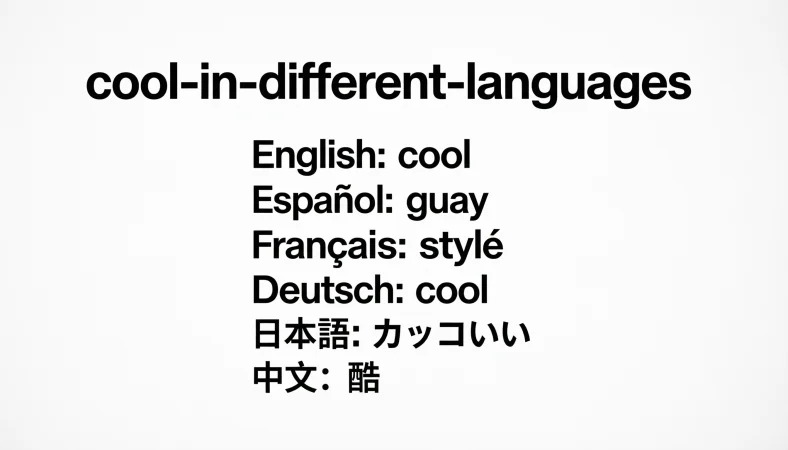
For example, Spanish speakers commonly use “¡Qué guay!” for something impressive or enjoyable, while Japanese speakers may use “かっこいい” when describing someone or something stylish or good-looking.
There is also a literal meaning of “cool” related to temperature. Expressions such as “cool water” or “a cool evening” require different translations in many languages.
How to Say “Cool” in Different Languages Naturally
Learning a direct translation is useful, but context is just as important. A word that means “cool” among friends may sound unnatural in a formal conversation.
For casual situations, expressions equivalent to “awesome,” “great,” or “nice” are often more natural than a literal translation. If you are speaking with native speakers, pay attention to how younger and older speakers use informal vocabulary.
Slang can also change quickly. A phrase that is popular in one country or generation may be uncommon somewhere else.
Cool Translations Around the World
One interesting feature of cool translations is that many languages have borrowed the English word directly. French, German, Dutch, Greek, Welsh, Afrikaans, and several other languages can use a form of “cool” in informal speech.
These differences show why translating individual words is not always enough. A natural expression should fit the situation as well as the dictionary meaning.
Tips for Using “Cool” in Another Language
When using one of these expressions in conversation, consider the setting first.
- For friends: Informal words such as “Keren!” in Indonesian or “Poa!” in Swahili can work naturally in casual contexts.
- For compliments: Some languages use expressions closer to “great,” “beautiful,” or “stylish” than the English word “cool.”
- For formal situations: Choose a neutral expression rather than slang.
- For temperature: Do not automatically use the informal expression for “cool” when describing weather, drinks, or physical temperature.
- For regional speech: Remember that vocabulary can differ between countries where the same language is spoken.
Why Learn “Cool” in All Languages?
A simple word such as “cool” can be a useful starting point for language learning. It introduces you to informal vocabulary, pronunciation, cultural differences, and everyday conversation.
Knowing cool in all languages is also useful for travelers, multilingual content creators, students, and anyone interested in communicating naturally with people from different cultures.
Frequently Asked Questions
1. How do you say “cool” in different languages?
There are many ways to express “cool” depending on the language and context. Examples include “¡Qué guay!” in Spanish, “Cool!” in French, “Круто!” in Russian, “Keren!” in Indonesian, “かっこいい!” in Japanese, and “멋져요!” in Korean.
2. What is the most common translation of “cool”?
There is no single translation that is most common worldwide. Many languages use words meaning “great,” “awesome,” “stylish,” or “nice,” while others have adopted the English word “cool.”
3. Is “cool” the same in every language?
No. The English word has several meanings, and another language may use different expressions for style, approval, admiration, or temperature.
4. Can I use these “cool” translations with native speakers?
Many of the expressions in the table are intended for everyday or informal communication. However, slang and casual vocabulary can vary by region, age group, and social setting, so context matters.
5. Which languages use the English word “cool”?
Several languages use “cool” directly or in a closely adapted form in informal speech. Examples include French, German, Dutch, Swedish, Welsh, Greek, Afrikaans, and others.
Conclusion
Learning how to say cool in different languages is a simple way to explore everyday vocabulary and cultural expression.
While some languages borrow “cool” directly, others use words meaning awesome, great, stylish, or impressive. Use the expression that fits both the language and the situation, and remember that natural communication matters more than a word-for-word translation.

I am Danny James, an Administrator at LingoHives, passionate about languages, communication, and cultural diversity. I enjoy helping people discover languages, understand words, and connect with different cultures through simple, useful, and engaging content.