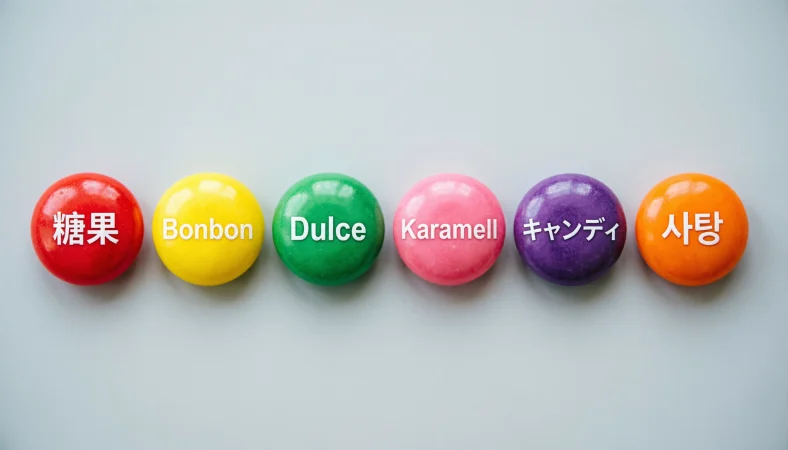
Candy is a sweet treat enjoyed in almost every part of the world, but the word used to describe it changes from language to language.
Learning how to say candy in different languages is useful for travelers, language learners, writers, teachers, multilingual families, and anyone curious about international vocabulary.
This guide provides 70 candy translations with the native word or phrase, an easy English pronunciation, a practical example sentence, and the English of that sentence.
if you want to know how to say candy in Spanish, Japanese, Arabic, French, or less commonly studied languages, this list makes the differences easy to understand.
Candy in All Languages: 70 Translations
The table below focuses on commonly used words or expressions for candy, sweets, confectionery, or similar sweet treats. In some languages, the exact word can vary depending on the type of candy or regional usage.
| # | Language | Native phrase | Easy English pronunciation | Real-life example | English meaning |
|---|---|---|---|---|---|
| 1 | English | candy | KAN-dee | I bought some candy. | I bought some candy. |
| 2 | Spanish | caramelo | kah-rah-MEH-loh | Quiero un caramelo. | I want a piece of candy. |
| 3 | French | bonbon | bohn-BOHN | J’aime les bonbons. | I like candy. |
| 4 | German | Süßigkeit | ZOOS-ig-kite | Ich esse eine Süßigkeit. | I am eating a sweet. |
| 5 | Italian | caramella | kah-rah-MEL-lah | Vorrei una caramella. | I would like a piece of candy. |
| 6 | Portuguese | doce | DOH-see | Eu quero um doce. | I want a sweet. |
| 7 | Dutch | snoep | snoop | Ik eet snoep. | I am eating candy. |
| 8 | Swedish | godis | GOO-dis | Jag köper godis. | I am buying candy. |
| 9 | Norwegian | godteri | GOO-teh-ree | Jeg liker godteri. | I like candy. |
| 10 | Danish | slik | sleek | Jeg spiser slik. | I am eating candy. |
| 11 | Finnish | karkki | KAR-kee | Ostan karkkia. | I am buying candy. |
| 12 | Icelandic | sælgæti | SAI-lai-gai-ti | Ég elska sælgæti. | I love candy. |
| 13 | Irish | milseán | MIL-shawn | Is maith liom milseáin. | I like sweets. |
| 14 | Welsh | melysion | meh-LUSS-yon | Rwy’n hoffi melysion. | I like sweets. |
| 15 | Scottish Gaelic | siùcairean | SHOO-ki-rah-n | Tha mi dèidheil air siùcairean. | I love sweets. |
| 16 | Polish | cukierek | tsoo-KYEH-rek | Chcę cukierka. | I want a piece of candy. |
| 17 | Czech | bonbón | BOM-bohn | Mám rád bonbóny. | I like candies. |
| 18 | Slovak | cukrík | TSOO-kreek | Mám rád cukríky. | I like candy. |
| 19 | Slovenian | bonbon | bon-BON | Rad imam bonbone. | I like candies. |
| 20 | Croatian | bombon | BOM-bon | Volim bombone. | I like candies. |
| 21 | Serbian | бомбона | BOM-boh-nah | Волим бомбоне. | I like candies. |
| 22 | Bulgarian | бонбон | bon-BON | Обичам бонбони. | I love candies. |
| 23 | Macedonian | бонбона | bon-BOH-nah | Сакам бонбони. | I like candy. |
| 24 | Romanian | bomboană | bom-BWAH-nuh | Îmi place bomboana. | I like candy. |
| 25 | Hungarian | cukorka | TSOO-kor-kah | Szeretem a cukorkát. | I like candy. |
| 26 | Greek | καραμέλα | kah-rah-MEH-lah | Μου αρέσει η καραμέλα. | I like candy. |
| 27 | Russian | конфета | kahn-FYEH-tah | Я люблю конфеты. | I love candy. |
| 28 | Ukrainian | цукерка | tsoo-KER-kah | Я люблю цукерки. | I love candy. |
| 29 | Belarusian | цукерка | tsoo-KYER-kah | Я люблю цукеркі. | I love candy. |
| 30 | Lithuanian | saldainis | sal-DAI-nis | Aš mėgstu saldainius. | I like candy. |
| 31 | Latvian | konfekte | kon-FEK-teh | Man garšo konfektes. | I like candy. |
| 32 | Estonian | komm | komm | Mulle meeldivad kommid. | I like candies. |
| 33 | Albanian | karamele | kah-rah-MEH-leh | Më pëlqen karamelja. | I like caramel candy. |
| 34 | Turkish | şekerleme | sheh-kehr-LEH-meh | Şekerleme yemeyi seviyorum. | I like eating candy. |
| 35 | Azerbaijani | konfet | kon-FET | Mən konfet sevirəm. | I like candy. |
| 36 | Armenian | կոնֆետ | kon-FET | Ես կոնֆետ եմ սիրում։ | I like candy. |
| 37 | Georgian | კანფეტი | kan-FEH-tee | მე კანფეტი მიყვარს. | I like candy. |
| 38 | Arabic | حلوى | HAL-wa | أحب الحلوى. | I love candy. |
| 39 | Hebrew | ממתק | mam-TAHK | אני אוהב ממתקים. | I like sweets. |
| 40 | Persian | آبنبات | aab-na-BAAT | من آبنبات دوست دارم. | I like candy. |
| 41 | Urdu | ٹافی | TAA-fee | مجھے ٹافی پسند ہے۔ | I like toffee/candy. |
| 42 | Hindi | टॉफ़ी | TAW-fee | मुझे टॉफ़ी पसंद है। | I like candy/toffee. |
| 43 | Bengali | মিষ্টি | MISH-tee | আমি মিষ্টি পছন্দ করি। | I like sweets. |
| 44 | Punjabi | ਟਾਫ਼ੀ | TAA-fee | ਮੈਨੂੰ ਟਾਫ਼ੀ ਪਸੰਦ ਹੈ। | I like candy/toffee. |
| 45 | Gujarati | ટૉફી | TAW-fee | મને ટૉફી ગમે છે. | I like candy/toffee. |
| 46 | Marathi | गोळी | GOH-lee | मला गोळी आवडते. | I like candy. |
| 47 | Nepali | मिठाई | mi-THAI | मलाई मिठाई मन पर्छ। | I like sweets. |
| 48 | Sinhala | ටොෆි | TOH-fee | මම ටොෆි වලට කැමතියි. | I like candy/toffee. |
| 49 | Tamil | மிட்டாய் | MIT-taai | எனக்கு மிட்டாய் பிடிக்கும். | I like candy. |
| 50 | Telugu | మిఠాయి | mi-THAA-yi | నాకు మిఠాయి ఇష్టం. | I like sweets. |
| 51 | Kannada | ಸಿಹಿತಿಂಡಿ | si-hee-TIN-dee | ನನಗೆ ಸಿಹಿತಿಂಡಿ ಇಷ್ಟ. | I like sweets. |
| 52 | Malayalam | മിഠായി | mi-THAA-yi | എനിക്ക് മിഠായി ഇഷ്ടമാണ്. | I like candy. |
| 53 | Odia | ମିଠା | MI-tha | ମୋତେ ମିଠା ପସନ୍ଦ। | I like sweets. |
| 54 | Assamese | মিঠাই | mi-THAI | মই মিঠাই ভাল পাওঁ। | I like sweets. |
| 55 | Chinese (Mandarin) | 糖果 | tángguǒ | 我喜欢糖果。 | I like candy. |
| 56 | Cantonese | 糖果 | tòhng gwó | 我鍾意食糖果。 | I like eating candy. |
| 57 | Japanese | キャンディー | KYAN-dee | キャンディーが好きです。 | I like candy. |
| 58 | Korean | 사탕 | sa-tang | 저는 사탕을 좋아해요. | I like candy. |
| 59 | Vietnamese | kẹo | keh-oh | Tôi thích kẹo. | I like candy. |
| 60 | Thai | ลูกอม | look-om | ฉันชอบลูกอม | I like candy. |
| 61 | Indonesian | permen | PER-men | Saya suka permen. | I like candy. |
| 62 | Malay | gula-gula | GOO-lah GOO-lah | Saya suka gula-gula. | I like candy. |
| 63 | Filipino | kendi | KEN-dee | Gusto ko ang kendi. | I like candy. |
| 64 | Mongolian | чихэр | CHEE-kher | Би чихэрт дуртай. | I like candy. |
| 65 | Swahili | pipi | PEE-pee | Ninapenda pipi. | I like candy. |
| 66 | Zulu | uswidi | oo-SWEE-dee | Ngiyawuthanda uswidi. | I like candy. |
| 67 | Afrikaans | lekkergoed | LEK-er-khoot | Ek hou van lekkergoed. | I like candy. |
| 68 | Haitian Creole | sirèt | see-RET | Mwen renmen sirèt. | I like candy. |
| 69 | Esperanto | bombono | bom-BOH-no | Mi ŝatas bombonojn. | I like candies. |
| 70 | Latin | dulciarium | dool-kee-AH-ree-um | Dulciarium amo. | I love candy. |
How to Say Candy in Different Languages
The most interesting part of learning candy in different languages is seeing how languages categorize sweet foods differently.
For example, Spanish commonly uses caramelo, while French uses bonbon. German uses the broader term Süßigkeit, which refers to a sweet or confection. Japanese commonly uses the borrowed term キャンディー, while Korean uses 사탕.
South Asian languages can also distinguish between traditional sweets and packaged candy. Words such as Hindi मिठाई and Nepali मिठाई can refer broadly to sweets, while words such as टॉफ़ी are more specifically associated with toffee or candy.
This means that a direct dictionary translation is not always identical to the everyday word a native speaker would choose.
Candy Translations Around the World
Candy vocabulary reflects local food traditions and language history.
In many European languages, candy-related words have developed from terms associated with sugar, sweetness, or specific confectionery products. Other languages use words borrowed from English or neighboring languages, especially for modern packaged sweets.
In Asia, the distinction between candy and traditional sweets can be particularly important. A word translated as “sweet” may describe everything from a small confection to a traditional dessert.
That is why candy in all languages should be understood as a useful vocabulary guide rather than a claim that every language has one exact equivalent for every kind of candy.
Why Candy Has Different Names
Languages develop vocabulary according to culture, history, trade, and everyday usage.
Some languages have a general word for sweets. Others have separate terms for hard candy, chocolate, caramel, toffee, chewing gum, or traditional desserts.
Loanwords are another important factor. Japanese, for example, uses キャンディー, a word derived from the English “candy.” Other languages have developed their own long-established vocabulary.
Regional differences can matter too. A word that is natural in one country may sound unusual or have a narrower meaning in another.
Common Types of Candy Vocabulary
When learning candy translations, it helps to recognize several related concepts:
- Candy: A general term for sweet confectionery.
- Sweet: A broad word that can include candy and other sugary foods.
- Toffee: A specific confection made primarily with sugar and butter.
- Caramel: A confection or flavor produced by heating sugar.
- Chocolate: A cocoa-based confection that is often grouped with candy.
- Sweets: A common broader term, particularly in British English.
Because these categories overlap, the most natural translation depends on the context.
How to Use Candy Words in Everyday Conversation
Learning a word becomes easier when you use it in a complete sentence. Instead of memorizing only the translation, practice simple expressions such as “I like candy,” “I bought candy,” or “Do you want some candy?”
For travelers, this approach can be especially useful in shops and markets. You can also combine the word for candy with terms for flavors, quantities, colors, and prices.
For language learners, writing three or four short sentences with a new word is often more useful than memorizing a vocabulary list without context.
Candy Vocabulary for Travel and Language Learning
If you are traveling internationally, knowing the local word for candy can make simple shopping conversations easier. However, remember that packaging often uses brand names and international terminology, so the word you hear may not always match the dictionary form.
For students, this list is also useful for vocabulary projects, multilingual presentations, classroom activities, and cultural comparisons.
The pronunciation column provides an easy English approximation rather than a precise phonetic transcription. Pronunciation can vary by country, region, accent, and individual speaker.
Frequently Asked Questions
1. How do you say candy in different languages?
The word for candy varies widely. Examples include caramelo in Spanish, bonbon in French, Süßigkeit in German, конфета in Russian, 糖果 in Mandarin Chinese, 사탕 in Korean, and pipi in Swahili.
2. What is candy called in the most spoken languages?
Common examples include candy in English, caramelo in Spanish, bonbon in French, doce in Portuguese, 糖果 in Mandarin Chinese, キャンディー in Japanese, 사탕 in Korean, kẹo in Vietnamese, and حلوى in Arabic.
3. Is the word for candy the same as “sweet” in other languages?
Not always. Some languages use a broad word meaning “sweet” or “sweets,” while others have a more specific word for candy or confectionery. The appropriate translation depends on the language and the type of sweet being discussed.
4. What is the easiest way to learn candy in different languages?
Start with the native word, learn its pronunciation, and practice it in a short everyday sentence. Associating the word with an actual food or shopping situation can make it easier to remember.
5. Why are there different translations for candy?
Languages have different histories and food traditions. Some distinguish between candy, sweets, and traditional desserts, while others use one broader term. Borrowed words and regional usage also contribute to differences in candy translations.
Conclusion
Learning candy in different languages is a simple way to explore vocabulary, culture, and everyday communication around the world. From caramelo and bonbon to 糖果, 사탕, and pipi, each language offers its own way of describing sweet treats.
Use the 70-language table as a quick reference for language learning, travel, writing, teaching, or discovering how people talk about candy around the world.

I am Johnny Thomas, a passionate language enthusiast and writer. I enjoy exploring different languages, cultures, words, and expressions. I create helpful, easy-to-understand content to help readers discover languages and communicate confidently.