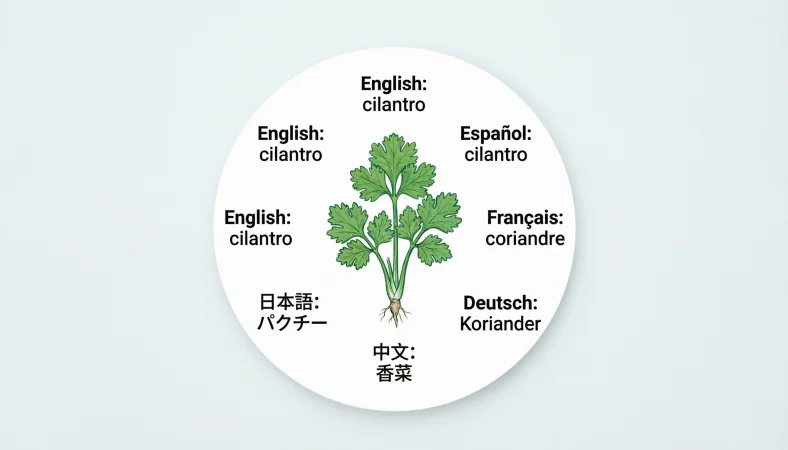
Cilantro is one of the world’s most recognizable culinary herbs, but its name changes significantly from one language to another.
if you are traveling, reading international recipes, shopping for ingredients, or learning a new language, knowing how to say cilantro in different languages can be surprisingly useful.
In some countries, the word refers specifically to the fresh green leaves, while related terms may also be used for coriander as a whole plant or for its seeds.
The table below gives you 70 cilantro translations, including the native phrase, an easy English pronunciation, and a practical example sentence.
If you have been searching for cilantro in all languages, wondering how to say cilantro in different languages, or looking for cilantro translations around the world, this guide provides a quick reference.
Cilantro in Different Languages: 70 Translations
| # | Language | Native phrase | Easy English pronunciation | Example sentence | English meaning |
|---|---|---|---|---|---|
| 1 | English | cilantro | sih-LAHN-troh | I added fresh cilantro to the salsa. | I added fresh cilantro to the salsa. |
| 2 | Spanish | cilantro | see-LAHN-troh | Añadí cilantro fresco a la salsa. | I added fresh cilantro to the salsa. |
| 3 | French | coriandre | koh-ree-AHN-druh | J’ai ajouté de la coriandre fraîche. | I added fresh cilantro. |
| 4 | German | Koriander | koh-ree-AHN-der | Ich habe frischen Koriander hinzugefügt. | I added fresh cilantro. |
| 5 | Italian | coriandolo | koh-ree-ahn-DOH-loh | Ho aggiunto coriandolo fresco. | I added fresh cilantro. |
| 6 | Portuguese | coentro | koh-EN-troh | Adicionei coentro fresco à sopa. | I added fresh cilantro to the soup. |
| 7 | Dutch | koriander | koh-ree-AHN-der | Ik heb verse koriander toegevoegd. | I added fresh cilantro. |
| 8 | Swedish | koriander | koh-ree-AHN-der | Jag tillsatte färsk koriander. | I added fresh cilantro. |
| 9 | Norwegian | koriander | koh-ree-AHN-der | Jeg tilsatte frisk koriander. | I added fresh cilantro. |
| 10 | Danish | koriander | koh-ree-AHN-er | Jeg tilsatte frisk koriander. | I added fresh cilantro. |
| 11 | Finnish | korianteri | koh-ree-AHN-teh-ree | Lisäsin tuoretta korianteria. | I added fresh cilantro. |
| 12 | Icelandic | kóríander | KOH-ree-ahn-der | Ég bætti ferskum kóríander við. | I added fresh cilantro. |
| 13 | Irish | lus an choire | luss un KHIR-eh | Chuir mé lus an choire sa sailéad. | I put cilantro in the salad. |
| 14 | Welsh | coriander | koh-ree-AHN-der | Ychwanegais coriander ffres. | I added fresh cilantro. |
| 15 | Scottish Gaelic | coriander | koh-ree-AHN-der | Chuir mi coriander ùr ris. | I added fresh cilantro. |
| 16 | Polish | kolendra | koh-LEN-drah | Dodałem świeżą kolendrę. | I added fresh cilantro. |
| 17 | Czech | koriandr | koh-ree-AHN-dur | Přidal jsem čerstvý koriandr. | I added fresh cilantro. |
| 18 | Slovak | koriander | koh-ree-AHN-der | Pridal som čerstvý koriander. | I added fresh cilantro. |
| 19 | Slovenian | koriander | koh-ree-AHN-der | Dodal sem svež koriander. | I added fresh cilantro. |
| 20 | Croatian | korijander | koh-ree-YAHN-der | Dodao sam svježi korijander. | I added fresh cilantro. |
| 21 | Serbian | korijander | koh-ree-YAHN-der | Dodao sam svež korijander. | I added fresh cilantro. |
| 22 | Bosnian | korijander | koh-ree-YAHN-der | Dodao sam svježi korijander. | I added fresh cilantro. |
| 23 | Bulgarian | кориандър | koh-ree-AHN-dur | Добавих пресен кориандър. | I added fresh cilantro. |
| 24 | Macedonian | коријандер | koh-ree-YAHN-der | Додадов свеж коријандер. | I added fresh cilantro. |
| 25 | Russian | кинза | KEEN-zah | Я добавил свежую кинзу. | I added fresh cilantro. |
| 26 | Ukrainian | кінза | KEEN-zah | Я додав свіжу кінзу. | I added fresh cilantro. |
| 27 | Belarusian | кінза | KEEN-zah | Я дадаў свежую кінзу. | I added fresh cilantro. |
| 28 | Lithuanian | kalendra | kah-LEN-drah | Įdėjau šviežios kalendros. | I added fresh cilantro. |
| 29 | Latvian | koriandrs | koh-ree-AHN-drs | Es pievienoju svaigu koriandru. | I added fresh cilantro. |
| 30 | Estonian | koriander | koh-ree-AHN-der | Lisasin värsket koriandrit. | I added fresh cilantro. |
| 31 | Romanian | coriandru | koh-ree-AHN-droo | Am adăugat coriandru proaspăt. | I added fresh cilantro. |
| 32 | Hungarian | koriander | KOH-ree-ahn-der | Friss koriandert adtam hozzá. | I added fresh cilantro. |
| 33 | Greek | κόλιανδρος | KOH-lee-ahn-dros | Πρόσθεσα φρέσκο κόλιανδρο. | I added fresh cilantro. |
| 34 | Albanian | koriandër | koh-ree-AHN-der | Shtova koriandër të freskët. | I added fresh cilantro. |
| 35 | Armenian | համեմ | hah-MEM | Ես թարմ համեմ ավելացրեցի. | I added fresh cilantro. |
| 36 | Georgian | ქინძი | KEEN-dzee | სალათას ახალი ქინძი დავამატე. | I added fresh cilantro to the salad. |
| 37 | Turkish | kişniş | kish-NEESH | Taze kişniş ekledim. | I added fresh cilantro. |
| 38 | Azerbaijani | keşniş | kesh-NEESH | Təzə keşniş əlavə etdim. | I added fresh cilantro. |
| 39 | Persian | گشنیز | gosh-NEEZ | گشنیز تازه اضافه کردم. | I added fresh cilantro. |
| 40 | Arabic | كزبرة | kuz-BAH-rah | أضفت الكزبرة الطازجة. | I added fresh cilantro. |
| 41 | Hebrew | כוסברה | koos-BAH-rah | הוספתי כוסברה טרייה. | I added fresh cilantro. |
| 42 | Hindi | धनिया | dhuh-NEE-yah | मैंने ताज़ा धनिया डाला। | I added fresh cilantro. |
| 43 | Urdu | دھنیا | dhuh-NEE-yah | میں نے تازہ دھنیا ڈالا۔ | I added fresh cilantro. |
| 44 | Bengali | ধনেপাতা | dhaw-nay-PAH-tah | আমি তরকারিতে ধনেপাতা দিয়েছি। | I added cilantro leaves to the curry. |
| 45 | Punjabi | ਧਨੀਆ | dhuh-NEE-yah | ਮੈਂ ਤਾਜ਼ਾ ਧਨੀਆ ਪਾਇਆ। | I added fresh cilantro. |
| 46 | Gujarati | કોથમીર | koth-MEER | મેં તાજી કોથમીર ઉમેરી. | I added fresh cilantro. |
| 47 | Marathi | कोथिंबीर | koh-THIM-beer | मी ताजी कोथिंबीर घातली. | I added fresh cilantro. |
| 48 | Nepali | धनियाँ | dhuh-NEE-yah | मैले ताजा धनियाँ थपें। | I added fresh cilantro. |
| 49 | Tamil | கொத்தமல்லி | koth-thuh-MAHL-lee | நான் புதிய கொத்தமல்லி சேர்த்தேன். | I added fresh cilantro. |
| 50 | Telugu | కొత్తిమీర | koth-thuh-MEE-rah | నేను తాజా కొత్తిమీర వేశాను. | I added fresh cilantro. |
| 51 | Kannada | ಕೊತ್ತಂಬರಿ ಸೊಪ್ಪು | koth-uhm-buh-REE sop-poo | ನಾನು ತಾಜಾ ಕೊತ್ತಂಬರಿ ಸೊಪ್ಪು ಹಾಕಿದೆ. | I added fresh cilantro leaves. |
| 52 | Malayalam | മല്ലിയില | mal-lee-YIL | ഞാൻ പുതിയ മല്ലിയില ചേർത്തു. | I added fresh cilantro leaves. |
| 53 | Sinhala | කොත්තමල්ලි කොළ | koth-thuh-MAHL-lee kola | මම නැවුම් කොත්තමල්ලි කොළ දැම්මා. | I added fresh cilantro leaves. |
| 54 | Thai | ผักชี | pak-CHEE | ฉันใส่ผักชีสดลงในซุป | I added fresh cilantro to the soup. |
| 55 | Lao | ຜັກຊີ | pak-SEE | ຂ້ອຍໃສ່ຜັກຊີສົດ. | I added fresh cilantro. |
| 56 | Khmer | ជីវ៉ាន់ស៊ុយ | jee-VAN-sooy | ខ្ញុំបានដាក់ជីវ៉ាន់ស៊ុយស្រស់។ | I added fresh cilantro. |
| 57 | Vietnamese | rau mùi | zow MOY | Tôi thêm rau mùi tươi vào món ăn. | I added fresh cilantro to the dish. |
| 58 | Mandarin Chinese | 香菜 | xiāng cài | 我在汤里加了香菜。 | I added cilantro to the soup. |
| 59 | Cantonese | 芫荽 | jyun4 seoi1 | 我喺湯入面加咗芫荽。 | I added cilantro to the soup. |
| 60 | Japanese | パクチー | pakuchī | スープにパクチーを入れました。 | I added cilantro to the soup. |
| 61 | Korean | 고수 | gosu | 국에 고수를 넣었어요. | I added cilantro to the soup. |
| 62 | Indonesian | daun ketumbar | dah-oon kuh-TOOM-bar | Saya menambahkan daun ketumbar segar. | I added fresh cilantro leaves. |
| 63 | Malay | daun ketumbar | dah-oon kuh-TOOM-bar | Saya menambah daun ketumbar segar. | I added fresh cilantro leaves. |
| 64 | Filipino | kulantro | koo-LAHN-troh | Naglagay ako ng sariwang kulantro. | I added fresh cilantro. |
| 65 | Swahili | giligilani | gee-lee-gee-LAH-nee | Niliongeza giligilani mbichi. | I added fresh cilantro. |
| 66 | Afrikaans | koljander | koh-LYAHN-der | Ek het vars koljander bygevoeg. | I added fresh cilantro. |
| 67 | Zulu | coriander | koh-ree-AHN-der | Ngifake i-coriander entsha. | I added fresh cilantro. |
| 68 | Xhosa | coriander | koh-ree-AHN-der | Ndongeze i-coriander entsha. | I added fresh cilantro. |
| 69 | Malagasy | koriandra | koh-ree-AHN-drah | Nampiana koriandra vaovao aho. | I added fresh cilantro. |
| 70 | Esperanto | koriandro | koh-ree-AHN-droh | Mi aldonis freŝan koriandron. | I added fresh cilantro. |
Why Is Cilantro Called Different Names?
Cilantro belongs to the coriander plant, and language differences often reflect how different cultures use the plant.
In American English, cilantro usually means the fresh leaves and stems, while coriander commonly refers to the dried seeds. In British English and several other varieties of English, however, coriander can refer to the fresh herb as well.
Other languages make similar distinctions. Some use a general word for coriander, while others have a term specifically associated with the leaves.
This is important when reading recipes because a direct translation does not always tell you whether a recipe means fresh leaves, dried seeds, or the entire plant.
Cilantro vs. Coriander: Are They the Same?
Yes, cilantro and coriander come from the same plant, Coriandrum sativum.
In Mexican cooking, fresh cilantro is frequently used in salsa, tacos, guacamole, soups, and rice dishes. In South Asian cuisine, fresh coriander leaves are commonly used as a garnish and flavoring in curries, chutneys, dals, and snacks.
Across Southeast Asia, cilantro can be added to soups, noodle dishes, salads, sauces, and fresh herb combinations. In Chinese and other East Asian cuisines, it is also used to add a fresh, aromatic note to many dishes.
The herb’s strong aroma makes it especially useful as a finishing ingredient. A small amount can noticeably change the flavor and fragrance of a meal.
Useful Tips for Using Cilantro Translations
When using a cilantro translation in another country, keep these points in mind:
- Check whether the term means fresh leaves or seeds. This distinction varies between languages and regions.
- Look at the recipe context. A garnish usually indicates the fresh herb, while a spice mixture may contain coriander seeds.
- Listen for regional differences. A language can have more than one common word depending on the country.
- Use the native script when shopping. It can make labels and ingredient lists easier to recognize.
- Ask for fresh leaves when necessary. This avoids confusion in places where the general word for coriander covers several parts of the plant.
Cilantro Translations for Travel and Cooking
Knowing the local word for cilantro can be particularly useful when traveling.
At a restaurant, it can help you understand menu descriptions and communicate ingredient preferences. At a grocery store or market, the native term can help you identify the herb more quickly.
It is also useful when searching for international recipes. A recipe written in another language may not use the English word “cilantro” at all. Searching for the local translation can reveal additional recipes and traditional ways of using the herb.
Common Questions About Cilantro in Different Languages
1. What is cilantro called in Spanish?
Cilantro is called cilantro in Spanish. The word is widely used in Spanish-speaking countries for the fresh herb.
2. What is cilantro called in Hindi?
Cilantro is commonly called धनिया (dhania) in Hindi. The term is widely used for coriander, including the fresh leaves used in Indian cooking.
3. What is cilantro called in Chinese?
In Mandarin Chinese, cilantro is commonly called 香菜 (xiāng cài). The literal sense of the term is associated with fragrant vegetables or herbs.
4. What is cilantro called in Japanese?
Cilantro is commonly called パクチー (pakuchī) in Japanese, particularly when referring to the fresh herb used in Southeast Asian-style cuisine.
5. What is cilantro called in Arabic?
Cilantro is commonly called كزبرة (kuzbara) in Arabic. Regional pronunciation and usage can vary across Arabic-speaking countries.
Conclusion
Cilantro may have one familiar name in English, but it has dozens of names around the world. Learning these cilantro translations can make international recipes easier to understand, simplify grocery shopping abroad, and help you communicate about food in different languages.
From cilantro in Spanish to 香菜 in Chinese and パクチー in Japanese, these 70 translations show how a single everyday herb can have a rich vocabulary across cultures. Whether you are cooking, traveling, studying languages, or exploring food from around the world, this list gives you a practical starting point.
FAQs
1. How do you say cilantro in different languages?
The word varies by language. Common examples include cilantro in Spanish, coriandre in French, coentro in Portuguese, кинза in Russian, धनिया in Hindi, 香菜 in Mandarin Chinese, and 고수 in Korean.
2. Is cilantro the same as coriander?
Cilantro and coriander come from the same plant. In American English, cilantro usually means the fresh leaves, while coriander often means the seeds. In British English and many other varieties of English, “coriander” can refer to the fresh herb as well.
3. What is the most common word for cilantro around the world?
There is no single worldwide word. Many languages use a form related to “coriander,” while others have distinct everyday terms. Regional language and culinary traditions influence the name.
4. Why does cilantro have different names in different languages?
Different languages developed their own names for the herb based on local history, food traditions, pronunciation, and contact with other languages. Some languages also distinguish between the fresh leaves and coriander seeds.
5. Where is cilantro commonly used?
Cilantro is widely used in Mexican, South Asian, Southeast Asian, Middle Eastern, Chinese, and other cuisines. It can be used in sauces, curries, soups, salads, rice dishes, noodles, garnishes, and fresh herb mixtures.

I am Jimmy Michael, a language enthusiast and writer passionate about exploring different languages, words, and cultures. I create simple, useful content that helps readers understand languages better and discover new ways to communicate globally.