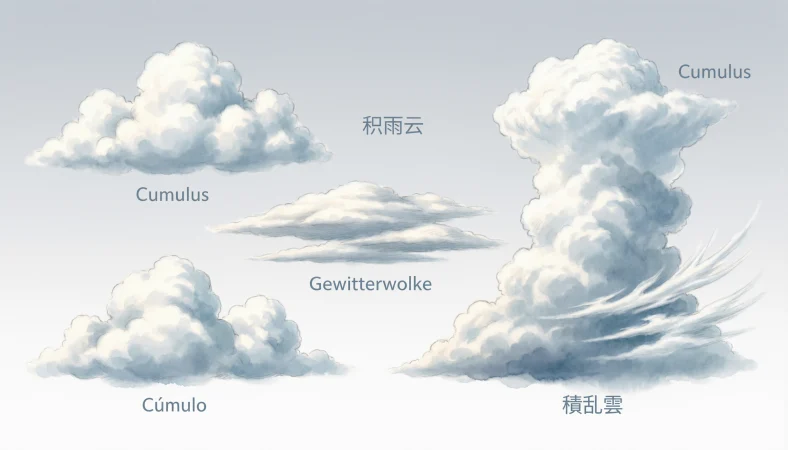
Clouds are one of the most familiar sights in nature, but the word used to describe them changes from language to language.
If you are learning vocabulary, writing multilingual content, traveling, or simply curious about how people around the world describe the sky, learning clouds in different languages is a simple and useful place to start.
This guide shows how to say clouds in different languages using 70 languages from Europe, Asia, Africa, and other parts of the world. Each entry includes the native phrase, an easy English pronunciation, a short everyday example, and the English meaning of that example.
Because some languages express plural nouns differently, the forms below focus on the natural word or plural form used for “clouds” in everyday contexts.
Pronunciations are simplified English-friendly guides rather than formal phonetic transcriptions.
Clouds in Different Languages: 70 Translations
| # | Language | Native phrase | Easy English pronunciation | Real-life example | English meaning |
|---|---|---|---|---|---|
| 1 | English | Clouds | KLOWDZ | The clouds are dark today. | The clouds look dark today. |
| 2 | Spanish | Nubes | NOO-bes | Las nubes son grises. | The clouds are gray. |
| 3 | French | Nuages | NWAAZH | Les nuages sont blancs. | The clouds are white. |
| 4 | German | Wolken | VOL-ken | Die Wolken ziehen vorbei. | The clouds are passing by. |
| 5 | Italian | Nuvole | NOO-voh-leh | Le nuvole sono belle. | The clouds are beautiful. |
| 6 | Portuguese | Nuvens | NOO-vens | As nuvens estão escuras. | The clouds are dark. |
| 7 | Dutch | Wolken | VOL-ken | De wolken bewegen snel. | The clouds are moving quickly. |
| 8 | Afrikaans | Wolke | VOL-keh | Die wolke beweeg stadig. | The clouds move slowly. |
| 9 | Swedish | Moln | MOHLN | Molnen rör sig snabbt. | The clouds are moving quickly. |
| 10 | Norwegian | Skyer | SHY-er | Skyene samler seg. | The clouds are gathering. |
| 11 | Danish | Skyer | SKOO-er | Skyerne bevæger sig. | The clouds are moving. |
| 12 | Icelandic | Ský | SKEE | Skýin eru dökk. | The clouds are dark. |
| 13 | Finnish | Pilvet | PEEL-vet | Pilvet liikkuvat nopeasti. | The clouds are moving quickly. |
| 14 | Estonian | Pilved | PEEL-ved | Pilved liiguvad. | The clouds are moving. |
| 15 | Latvian | Mākoņi | MAA-koh-nyee | Mākoņi ir tumši. | The clouds are dark. |
| 16 | Lithuanian | Debesys | deh-BEH-sis | Debesys juda greitai. | The clouds are moving quickly. |
| 17 | Polish | Chmury | KHMOO-ri | Chmury są niskie. | The clouds are low. |
| 18 | Czech | Mraky | MRAH-kee | Mraky jsou tmavé. | The clouds are dark. |
| 19 | Slovak | Oblaky | OB-la-kee | Oblaky sa pohybujú. | The clouds are moving. |
| 20 | Slovenian | Oblaki | oh-BLAH-kee | Oblaki so temni. | The clouds are dark. |
| 21 | Croatian | Oblaci | oh-BLAH-tsee | Oblaci dolaze. | The clouds are coming. |
| 22 | Serbian | Облаци | oh-BLAH-tsee | Облаци су тамни. | The clouds are dark. |
| 23 | Bulgarian | Облаци | oh-BLAH-tsee | Облаците идват. | The clouds are coming. |
| 24 | Macedonian | Облаци | oh-BLAH-tsee | Облаците се движат. | The clouds are moving. |
| 25 | Russian | Облака | ab-la-KA | Облака тёмные. | The clouds are dark. |
| 26 | Ukrainian | Хмари | KHMAH-ree | Хмари насуваються. | The clouds are approaching. |
| 27 | Belarusian | Аблокі | ab-loh-KEE | Аблокі рухаюцца. | The clouds are moving. |
| 28 | Romanian | Nori | NOR-ee | Norii sunt groși. | The clouds are thick. |
| 29 | Hungarian | Felhők | FEL-hurk | Felhők gyűlnek az égen. | Clouds are gathering in the sky. |
| 30 | Greek | Σύννεφα | SEE-ne-fa | Τα σύννεφα είναι χαμηλά. | The clouds are low. |
| 31 | Albanian | Retë | REH-tuh | Retë janë të errëta. | The clouds are dark. |
| 32 | Armenian | Ամպեր | AM-per | Ամպերը մուգ են։ | The clouds are dark. |
| 33 | Georgian | ღრუბლები | GHRUB-leh-bee | ღრუბლები ცას ფარავს. | The clouds cover the sky. |
| 34 | Turkish | Bulutlar | BOO-loot-lar | Bulutlar geliyor. | The clouds are coming. |
| 35 | Azerbaijani | Buludlar | BOO-lud-lar | Buludlar göyü örtür. | The clouds cover the sky. |
| 36 | Persian | ابرها | ab-RAA | ابرها زیاد هستند. | There are many clouds. |
| 37 | Arabic | السحب | as-SUH-hub | السحب كثيفة اليوم. | The clouds are thick today. |
| 38 | Hebrew | עננים | a-na-NEEM | העננים כהים היום. | The clouds are dark today. |
| 39 | Urdu | بادل | BAA-dal | بادل چھائے ہوئے ہیں۔ | Clouds cover the sky. |
| 40 | Hindi | बादल | BAA-dal | बादल आ रहे हैं। | The clouds are coming. |
| 41 | Bengali | মেঘ | MEGH | মেঘ জমেছে। | Clouds have gathered. |
| 42 | Punjabi | ਬੱਦਲ | BAD-dal | ਬੱਦਲ ਛਾਏ ਹੋਏ ਹਨ। | Clouds cover the sky. |
| 43 | Gujarati | વાદળો | VAA-dal-o | વાદળો આકાશમાં છે. | The clouds are in the sky. |
| 44 | Marathi | ढग | DHAG | ढग जमले आहेत. | Clouds have gathered. |
| 45 | Nepali | बादलहरू | BAA-dal-ha-roo | बादलहरू बाक्ला छन्। | The clouds are thick. |
| 46 | Sinhala | වලාකුළු | wa-LAA-koo-loo | වලාකුළු අහසේ ඇත. | There are clouds in the sky. |
| 47 | Tamil | மேகங்கள் | MAY-gan-gal | மேகங்கள் நகர்கின்றன. | The clouds are moving. |
| 48 | Telugu | మేఘాలు | MAY-ghaa-loo | మేఘాలు వస్తున్నాయి. | The clouds are coming. |
| 49 | Kannada | ಮೋಡಗಳು | MOH-da-ga-loo | ಮೋಡಗಳು ಸಾಗುತ್ತಿವೆ. | The clouds are moving. |
| 50 | Malayalam | മേഘങ്ങൾ | MAY-ghan-gal | മേഘങ്ങൾ കൂടുന്നു. | The clouds are gathering. |
| 51 | Odia | ମେଘ | MEGH | ମେଘ ଜମିଛି। | Clouds have gathered. |
| 52 | Assamese | মেঘ | MEGH | মেঘ গোট খাইছে। | Clouds have gathered. |
| 53 | Thai | เมฆ | MEK | เมฆกำลังเคลื่อนตัว | The clouds are moving. |
| 54 | Lao | ເມກ | MEK | ເມກກຳລັງມາ. | The clouds are coming. |
| 55 | Khmer | ពពក | POH-pok | ពពកមានច្រើន។ | There are many clouds. |
| 56 | Vietnamese | Mây | MAY | Mây đang kéo đến. | The clouds are approaching. |
| 57 | Indonesian | Awan | AH-wan | Awan menutupi langit. | The clouds cover the sky. |
| 58 | Malay | Awan | AH-wan | Awan bergerak perlahan. | The clouds are moving slowly. |
| 59 | Filipino | Mga ulap | mga OO-lap | Makapal ang mga ulap. | The clouds are thick. |
| 60 | Burmese | တိမ်များ | TEIM-myar | တိမ်များလာနေသည်။ | The clouds are coming. |
| 61 | Chinese (Mandarin) | 云 | Yún | 天上有很多云。 | There are many clouds in the sky. |
| 62 | Japanese | 雲 | Kumo | 空に雲が多いです。 | There are many clouds in the sky. |
| 63 | Korean | 구름 | Gureum | 하늘에 구름이 많아요. | There are many clouds in the sky. |
| 64 | Mongolian | Үүлс | OOL-s | Үүлс их байна. | There are many clouds. |
| 65 | Kazakh | Бұлттар | BOOLT-tar | Бұлттар аспанды жапты. | The clouds covered the sky. |
| 66 | Uzbek | Bulutlar | boo-LOOT-lar | Bulutlar osmonni qoplagan. | The clouds cover the sky. |
| 67 | Kyrgyz | Булуттар | boo-LOOT-tar | Булуттар көбөйдү. | The clouds have increased. |
| 68 | Tajik | Абрҳо | ab-RHO | Абрҳо зиёданд. | There are many clouds. |
| 69 | Swahili | Mawingu | ma-WEEN-goo | Mawingu yanaongezeka. | The clouds are increasing. |
| 70 | Zulu | Amafu | a-ma-FOO | Amafu amnyama. | The clouds are dark. |
How to Say “Clouds” in Different Languages Correctly
The easiest way to learn clouds in different languages is to connect the word with a simple image or weather situation.
For example, imagine a gray sky and associate it with Spanish nubes, French nuages, German Wolken, or Italian nuvole. Using the vocabulary in a sentence makes it much easier to remember than memorizing isolated translations.
It is also important to remember that a direct English-to-foreign-language translation does not always behave exactly the same way grammatically. Some languages have a distinct plural form for “clouds,” while others use a word that can be understood according to context.
The pronunciation guides in this article are deliberately simple. They are intended to help English speakers get close to the natural sound without requiring knowledge of the International Phonetic Alphabet.
Clouds Translations Across Europe
European languages show several interesting patterns in their words for clouds.
Romance languages such as Spanish, French, Italian, and Portuguese use forms that are historically related but have developed differently. Spanish uses nubes, French uses nuages, Italian uses nuvole, and Portuguese uses nuvens.
Germanic languages also have their own distinctive vocabulary. German uses Wolken, Dutch uses wolken, Swedish uses moln, Norwegian uses skyer, and Danish uses skyer.
Slavic languages frequently use related forms. Russian uses облака, Serbian uses облаци, Croatian uses oblaci, Bulgarian uses облаци, and Slovak uses oblaky.
These similarities can be helpful for language learners because recognizing a familiar word pattern can sometimes make new vocabulary easier to remember.
Clouds in Asian Languages
Asia contains thousands of languages and a huge range of writing systems, making clouds in different languages particularly interesting.
In South Asia, Hindi and Urdu use the familiar word बादल / بادل, while Bengali uses মেঘ. Punjabi uses ਬੱਦਲ, Gujarati uses વાદળો, and Marathi uses ढग.
Further east, Chinese uses 云, Japanese uses 雲, and Korean uses 구름. These words look completely different in their respective writing systems, demonstrating how the same natural object can have very different linguistic identities.
Southeast Asian languages also provide distinctive forms. Vietnamese uses mây, Indonesian and Malay use awan, Thai uses เมฆ, Khmer uses ពពក, and Filipino uses mga ulap.
Clouds Around the World: Language and Everyday Weather
Clouds are closely connected with everyday conversations about weather.
People use cloud vocabulary when discussing rain, storms, sunshine, temperature, travel conditions, photography, and outdoor activities. A phrase such as “the clouds are dark” can naturally lead to a conversation about whether rain is coming.
This makes cloud vocabulary particularly useful for beginners. You do not need advanced grammar to begin using it. Learning one word and one simple sentence can give you a practical piece of vocabulary immediately.
Clouds also appear frequently in literature, songs, poetry, photography captions, children’s books, and descriptions of nature. As a result, knowing the word for clouds can be useful beyond basic weather conversations.
Why Learn “Clouds” in 70 Languages?
Learning clouds in all languages is not only an interesting vocabulary exercise. It can also be useful in several practical situations.
- Language learning: Build vocabulary around nature and weather.
- Travel: Understand simple weather conversations in other countries.
- Writing: Add accurate multilingual words to creative or educational content.
- Education: Compare vocabulary and writing systems across cultures.
- Photography: Create multilingual captions about skies, weather, and landscapes.
- Cultural learning: Discover how different languages describe the natural world.
- Multilingual content: Find useful vocabulary for international audiences.
A single word can also introduce learners to grammar. For example, you can compare singular and plural forms, articles, cases, noun endings, and sentence structure while studying translations for clouds.
Tips for Remembering Clouds Translations
The best approach is to learn each word in context rather than memorizing a long list.
Start with five languages that interest you. Read the native word, say it aloud, and then use it in a short sentence. Once those words become familiar, add another five.
Visual memory can help too. Look at a photograph of a cloudy sky while reviewing the vocabulary. The connection between the image, sound, spelling, and meaning creates several memory cues at once.
Another useful technique is comparison. Notice related words in languages from the same family. Seeing similarities between words can make vocabulary acquisition more efficient.
Finally, revisit the words regularly. Short, repeated practice is generally more effective than trying to memorize all 70 translations in one sitting.
Frequently Asked Questions About Clouds in Different Languages
1. How do you say “clouds” in different languages?
The word for clouds varies by language. Examples include nubes in Spanish, nuages in French, Wolken in German, nuvole in Italian, облака in Russian, 雲 in Japanese, and 구름 in Korean.
2. What is the word for clouds in the most commonly spoken languages?
Common examples include nubes in Spanish, nuages in French, Wolken in German, 云 in Mandarin Chinese, 雲 in Japanese, 구름 in Korean, بادل in Urdu, and बादल in Hindi.
3. Are “cloud” and “clouds” the same in every language?
No. Some languages have different singular and plural forms, while others may use a form whose meaning depends on grammatical context. The natural form for “clouds” therefore varies from language to language.
4. Why are clouds translations useful for language learners?
Clouds are common vocabulary in conversations about weather, nature, travel, photography, and outdoor activities. Learning the word together with a short sentence also helps learners understand how the vocabulary works in real communication.
5. Which languages have unique writing systems for the word “clouds”?
Several languages use writing systems that look very different from the Latin alphabet. Chinese uses 云, Japanese uses 雲, Korean uses 구름, Arabic uses السحب, Hebrew uses עננים, and Hindi uses बादल. Learning these forms can be an interesting introduction to different writing systems.
Conclusion
Learning clouds in different languages is a simple way to expand vocabulary while exploring how cultures and languages describe the natural world. From Spanish nubes and French nuages to Japanese 雲, Mandarin 云, Hindi बादल, and Swahili mawingu, each language offers its own expression.
if you are a language learner, traveler, teacher, writer, or simply curious about clouds around the world, these 70 translations provide a practical starting point.
Practice the words in short sentences, listen to native speakers when possible, and gradually build your multilingual vocabulary through everyday topics.

I am Johnny Thomas, a passionate language enthusiast and writer. I enjoy exploring different languages, cultures, words, and expressions. I create helpful, easy-to-understand content to help readers discover languages and communicate confidently.