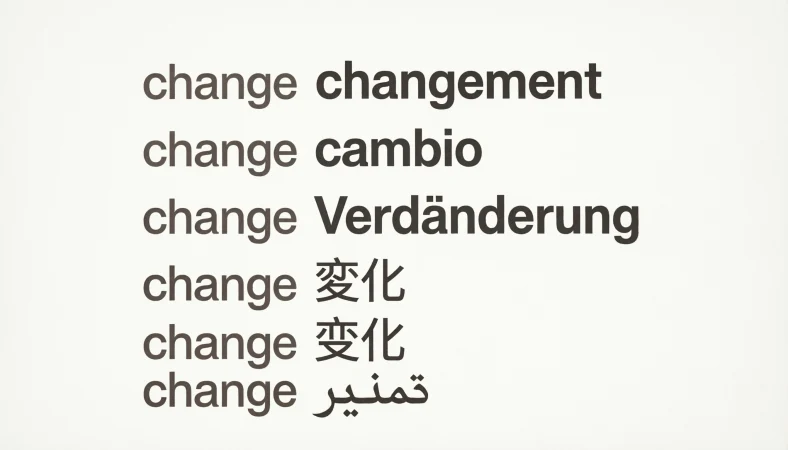
The word “change” is simple in English, but its translation can vary depending on if you mean changing something, becoming different, exchanging something, or money change.
If you are looking for change in different languages, this guide gives you 70 useful translations with native phrases, easy pronunciation, and practical examples.
if you are learning a language, writing a multilingual message, traveling, or researching how to say change in different languages, the table below provides a quick reference.
The examples focus mainly on the everyday meaning of changing or making something different.
Change in All Languages: 70 Translations
The following list covers 70 widely spoken or culturally significant languages. Pronunciations are simplified English-friendly guides rather than formal phonetic transcriptions.
| # | Language | Native phrase | Easy English pronunciation | Real-life example | English meaning |
|---|---|---|---|---|---|
| 1 | Spanish | cambiar | kam-BYAR | Necesito cambiar de trabajo. | I need to change jobs. |
| 2 | French | changer | shahn-ZHAY | Je veux changer de travail. | I want to change jobs. |
| 3 | German | ändern | EN-dairn | Ich möchte etwas ändern. | I want to change something. |
| 4 | Italian | cambiare | kam-BYAH-reh | Voglio cambiare idea. | I want to change my mind. |
| 5 | Portuguese | mudar | moo-DAR | Preciso mudar de casa. | I need to change houses. |
| 6 | Dutch | veranderen | ver-AN-der-un | Ik wil mijn plan veranderen. | I want to change my plan. |
| 7 | Swedish | förändra | fur-EN-drah | Vi måste förändra planen. | We must change the plan. |
| 8 | Norwegian | endre | EN-dreh | Jeg vil endre planen. | I want to change the plan. |
| 9 | Danish | ændre | EN-druh | Jeg vil ændre planen. | I want to change the plan. |
| 10 | Finnish | muuttaa | MOO-ta | Haluan muuttaa suunnitelmaa. | I want to change the plan. |
| 11 | Icelandic | breyta | BRAY-ta | Ég vil breyta áætluninni. | I want to change the plan. |
| 12 | Irish | athraigh | AH-ree | Caithfidh mé athrú. | I need to change. |
| 13 | Welsh | newid | NAY-wid | Mae angen newid y cynllun. | The plan needs to change. |
| 14 | Polish | zmieniać | ZMYEH-nyach | Chcę zmienić plan. | I want to change the plan. |
| 15 | Czech | změnit | ZHMEH-nit | Chci změnit plán. | I want to change the plan. |
| 16 | Slovak | zmeniť | ZMEH-nitch | Chcem zmeniť plán. | I want to change the plan. |
| 17 | Slovenian | spremeniti | spreh-MEH-nee-tee | Želim spremeniti načrt. | I want to change the plan. |
| 18 | Croatian | promijeniti | proh-MYEH-nee-tee | Želim promijeniti plan. | I want to change the plan. |
| 19 | Serbian | променити | proh-MEH-nee-tee | Желим да променим план. | I want to change the plan. |
| 20 | Bulgarian | променям | proh-meh-NYAM | Искам да променя плана. | I want to change the plan. |
| 21 | Macedonian | промени | proh-MEH-nee | Сакам да го променам планот. | I want to change the plan. |
| 22 | Russian | менять | meh-NYAT | Я хочу изменить план. | I want to change the plan. |
| 23 | Ukrainian | змінювати | zmee-NYOO-vah-tee | Я хочу змінити план. | I want to change the plan. |
| 24 | Belarusian | мяняць | mya-NYATS | Я хачу змяніць план. | I want to change the plan. |
| 25 | Lithuanian | keisti | KAY-stee | Noriu pakeisti planą. | I want to change the plan. |
| 26 | Latvian | mainīt | MY-nit | Es gribu mainīt plānu. | I want to change the plan. |
| 27 | Estonian | muutma | MOOT-ma | Ma tahan plaani muuta. | I want to change the plan. |
| 28 | Hungarian | változtatni | VAHL-toz-tat-nee | Meg akarom változtatni a tervet. | I want to change the plan. |
| 29 | Romanian | schimba | SKEEM-bah | Vreau să schimb planul. | I want to change the plan. |
| 30 | Greek | αλλάζω | ah-LAH-zoh | Θέλω να αλλάξω το σχέδιο. | I want to change the plan. |
| 31 | Albanian | ndryshoj | ndree-SHOY | Dua të ndryshoj planin. | I want to change the plan. |
| 32 | Turkish | değiştirmek | day-eezh-TEER-mek | Planı değiştirmek istiyorum. | I want to change the plan. |
| 33 | Azerbaijani | dəyişmək | day-ish-MEK | Planı dəyişmək istəyirəm. | I want to change the plan. |
| 34 | Georgian | შეცვლა | shets-VLA | გეგმის შეცვლა მინდა. | I want to change the plan. |
| 35 | Armenian | փոխել | po-KHEL | Ես ուզում եմ փոխել ծրագիրը։ | I want to change the plan. |
| 36 | Arabic | يغيّر | yoo-GHAIR | أريد أن أغير الخطة. | I want to change the plan. |
| 37 | Hebrew | לשנות | le-sha-NOT | אני רוצה לשנות את התוכנית. | I want to change the plan. |
| 38 | Persian | تغییر دادن | tagh-YEER dâ-dan | میخواهم برنامه را تغییر بدهم. | I want to change the plan. |
| 39 | Urdu | بدلنا | bad-LNA | میں منصوبہ بدلنا چاہتا ہوں۔ | I want to change the plan. |
| 40 | Hindi | बदलना | bad-LNA | मैं योजना बदलना चाहता हूँ। | I want to change the plan. |
| 41 | Bengali | পরিবর্তন করা | por-i-BOR-ton kora | আমি পরিকল্পনা পরিবর্তন করতে চাই। | I want to change the plan. |
| 42 | Punjabi | ਬਦਲਣਾ | bad-LNA | ਮੈਂ ਯੋਜਨਾ ਬਦਲਣਾ ਚਾਹੁੰਦਾ ਹਾਂ। | I want to change the plan. |
| 43 | Gujarati | બદલવું | bad-LVOO | મારે યોજના બદલવી છે. | I want to change the plan. |
| 44 | Marathi | बदलणे | ba-DAL-nay | मला योजना बदलायची आहे. | I want to change the plan. |
| 45 | Nepali | परिवर्तन गर्नु | par-ee-VAR-tan gar-NU | म योजना परिवर्तन गर्न चाहन्छु। | I want to change the plan. |
| 46 | Sinhala | වෙනස් කරනවා | VEH-nas ka-ra-NA-wa | මට සැලැස්ම වෙනස් කරන්න ඕනේ. | I want to change the plan. |
| 47 | Tamil | மாற்று | MAAT-roo | நான் திட்டத்தை மாற்ற விரும்புகிறேன். | I want to change the plan. |
| 48 | Telugu | మార్చడం | maar-CHA-dam | నేను ప్రణాళికను మార్చాలనుకుంటున్నాను. | I want to change the plan. |
| 49 | Kannada | ಬದಲಾಯಿಸು | ba-da-LA-yi-soo | ನಾನು ಯೋಜನೆಯನ್ನು ಬದಲಾಯಿಸಲು ಬಯಸುತ್ತೇನೆ. | I want to change the plan. |
| 50 | Malayalam | മാറ്റുക | MAA-tuh-ka | എനിക്ക് പദ്ധതി മാറ്റണം. | I need to change the plan. |
| 51 | Odia | ପରିବର୍ତ୍ତନ କରିବା | por-ee-BOR-ton ko-ree-BA | ମୁଁ ଯୋଜନା ପରିବର୍ତ୍ତନ କରିବି। | I will change the plan. |
| 52 | Assamese | সলনি কৰা | sol-NEE ko-RA | মই পৰিকল্পনা সলনি কৰিব বিচাৰোঁ। | I want to change the plan. |
| 53 | Mandarin Chinese | 改变 | gǎi biàn | 我想改变计划。 | I want to change the plan. |
| 54 | Cantonese | 改變 | goi bin | 我想改變計劃。 | I want to change the plan. |
| 55 | Japanese | 変える | ka-eru | 計画を変えたいです。 | I want to change the plan. |
| 56 | Korean | 바꾸다 | ba-kku-da | 계획을 바꾸고 싶어요. | I want to change the plan. |
| 57 | Vietnamese | thay đổi | tie DOW-ee | Tôi muốn thay đổi kế hoạch. | I want to change the plan. |
| 58 | Thai | เปลี่ยน | bplìan | ฉันต้องการเปลี่ยนแผน | I want to change the plan. |
| 59 | Lao | ປ່ຽນ | pìan | ຂ້ອຍຢາກປ່ຽນແຜນ. | I want to change the plan. |
| 60 | Khmer | ផ្លាស់ប្តូរ | plah-BDOH | ខ្ញុំចង់ផ្លាស់ប្តូរផែនការ។ | I want to change the plan. |
| 61 | Burmese | ပြောင်းလဲသည် | pyaung-LAE-thee | အစီအစဉ်ကို ပြောင်းလဲချင်တယ်။ | I want to change the plan. |
| 62 | Indonesian | mengubah | meng-OO-bah | Saya ingin mengubah rencana. | I want to change the plan. |
| 63 | Malay | mengubah | meng-OO-bah | Saya mahu mengubah rancangan. | I want to change the plan. |
| 64 | Tagalog | baguhin | ba-GOO-hin | Gusto kong baguhin ang plano. | I want to change the plan. |
| 65 | Javanese | ngowahi | ngo-WA-hee | Aku arep ngowahi rencana. | I want to change the plan. |
| 66 | Swahili | kubadilisha | koo-ba-dee-LEE-sha | Ninataka kubadilisha mpango. | I want to change the plan. |
| 67 | Zulu | shintsha | SHINT-sha | Ngifuna ukushintsha uhlelo. | I want to change the plan. |
| 68 | Xhosa | tshintsha | TSHINT-sha | Ndifuna ukutshintsha icebo. | I want to change the plan. |
| 69 | Afrikaans | verander | fer-AN-der | Ek wil die plan verander. | I want to change the plan. |
| 70 | Esperanto | ŝanĝi | SHAN-jee | Mi volas ŝanĝi la planon. | I want to change the plan. |
How to Say “Change” in Different Languages
There is no single universal translation for change. Languages often distinguish between changing an object, changing an opinion, becoming different, replacing something, and exchanging one thing for another.
For example, English uses “change” in several situations:
- Change a plan: modify an existing plan.
- Change clothes: put on different clothes.
- Change your mind: adopt a different opinion.
- Change money: exchange one currency for another.
- Change over time: become different gradually.
The appropriate translation can therefore depend on the sentence rather than the English word alone.
Change Translations for Everyday Conversation
For everyday conversation, the translations above are useful starting points, but context remains important.
A dictionary entry may provide several words for “change,” while native speakers select one according to grammar and meaning.
If you are writing a sentence for a native speaker, translating the complete sentence is generally more accurate than translating the word in isolation.
“Change” Around the World
The idea of change is expressed in every culture, but languages organize the concept differently.
Some languages use one common verb for several meanings, while others use different words depending on whether something is modified, replaced, exchanged, or transformed.
This is why “change in all languages” is best understood as a collection of practical equivalents rather than a word-for-word universal formula.
Common Meanings of the Word “Change”
Before choosing a translation, identify which meaning you need.
Change as a verb
This means to make something different.
Example: “I want to change my plan.”
Change as becoming different
This describes something that becomes different over time.
Example: “People change as they grow older.”
Change as replacement
This can mean replacing one thing with another.
Example: “I need to change my shirt.”
Change as an exchange
In financial or shopping contexts, “change” can refer to exchanging money or receiving money back after a purchase.
Example: “Do you have change for a twenty-dollar bill?”
These meanings may require different words in another language.
Why Context Matters in Change Translations
A common translation mistake is assuming that every English word has exactly one equivalent in another language.
Words such as change, get, make, and take are particularly dependent on context. A natural translation may require a different verb, noun, grammatical construction, or phrase.
For language learners, the safest approach is to learn the translation together with a practical sentence. That is why this guide includes a real-life example for every language.
Tips for Using “Change” Correctly in Another Language
When using one of these translations, consider the following:
- Check whether you mean changing, replacing, exchanging, or transforming something.
- Pay attention to verb forms and sentence structure.
- Learn the phrase in context rather than memorizing a single word.
- Use the native script when communicating with fluent speakers.
- Treat the English-friendly pronunciation as a starting aid, not a substitute for native pronunciation.
- When accuracy matters, have the complete sentence checked by a fluent speaker.
Frequently Asked Questions
1. How do you say “change” in different languages?
“Change” has different translations depending on the language and context. Examples include cambiar in Spanish, changer in French, ändern in German, mudar in Portuguese, 改变 in Mandarin Chinese, 変える in Japanese, 바꾸다 in Korean, بدلنا in Urdu, and बदलना in Hindi.
2. What is “change” in the most commonly spoken languages?
Common translations include cambiar in Spanish, changer in French, cambiare in Italian, mudar in Portuguese, ändern in German, 改变 in Mandarin Chinese, बदलना in Hindi, بدلنا in Urdu, and تغيير or related forms in Arabic depending on grammatical context.
3. Is “change” translated the same way in every language?
No. The best translation depends on what “change” means in a particular sentence. Changing a plan, changing clothes, exchanging money, and becoming different can require different words or grammatical constructions.
4. What is the easiest way to learn “change” in another language?
Learn the word together with a short everyday sentence. This helps you understand how the word behaves grammatically and makes it easier to remember when speaking or writing.
5. Why can one language have several translations for “change”?
English uses “change” for several related concepts, including modification, replacement, transformation, and exchange. Other languages may use separate words for these meanings, so context determines the most natural translation.
Conclusion
Learning how to say change in different languages is more useful when you understand the context behind each translation.
The 70 languages in this guide provide a practical starting point for travelers, students, writers, and anyone interested in change translations around the world.
For the most natural result, remember the phrase with its example sentence instead of treating the English word “change” as having only one fixed equivalent.

I am Johnny Thomas, a passionate language enthusiast and writer. I enjoy exploring different languages, cultures, words, and expressions. I create helpful, easy-to-understand content to help readers discover languages and communicate confidently.