Wondering how to say China in different languages? The country has many different names around the world, and some are surprisingly from the English word “China.”
Learning these translations is useful for travelers, language learners, students, writers, and anyone interested in how countries are named across cultures.
In this guide, you’ll find China in all languages covered below, including the native phrase, an easy English pronunciation, and a short real-life example.
If you’re searching for how to say China in different languages, this table gives you 70 commonly used forms in one place.
The Chinese name for China is 中国 in Simplified Chinese and 中國 in Traditional Chinese, pronounced Zhōngguó.
China in Different Languages: 70 Translations
The following table provides 70 ways to say China around the world. Pronunciations are simplified for English speakers rather than being formal IPA transcriptions.
| # | Language | Native phrase | Easy English pronunciation | Example sentence | English meaning |
|---|---|---|---|---|---|
| 1 | English | China | CHY-nuh | China is in Asia. | China is in Asia. |
| 2 | Mandarin Chinese | 中国 | JONG-gwoh | 中国在亚洲。 | China is in Asia. |
| 3 | Cantonese | 中國 | JUNG-gwok | 中國喺亞洲。 | China is in Asia. |
| 4 | Spanish | China | CHEE-nah | China está en Asia. | China is in Asia. |
| 5 | French | Chine | SHEEN | La Chine est en Asie. | China is in Asia. |
| 6 | German | China | KHEE-nah | China liegt in Asien. | China is in Asia. |
| 7 | Italian | Cina | CHEE-nah | La Cina è in Asia. | China is in Asia. |
| 8 | Portuguese | China | SHEE-nah | A China fica na Ásia. | China is in Asia. |
| 9 | Dutch | China | KHEE-nah | China ligt in Azië. | China is in Asia. |
| 10 | Afrikaans | Sjina | SHEE-nah | Sjina is in Asië. | China is in Asia. |
| 11 | Swedish | Kina | KEE-nah | Kina ligger i Asien. | China is in Asia. |
| 12 | Danish | Kina | KEE-nah | Kina ligger i Asien. | China is in Asia. |
| 13 | Norwegian | Kina | KEE-nah | Kina ligger i Asia. | China is in Asia. |
| 14 | Finnish | Kiina | KEE-nah | Kiina on Aasiassa. | China is in Asia. |
| 15 | Icelandic | Kína | KEE-nah | Kína er í Asíu. | China is in Asia. |
| 16 | Estonian | Hiina | HEE-nah | Hiina asub Aasias. | China is in Asia. |
| 17 | Latvian | Ķīna | KEE-nah | Ķīna atrodas Āzijā. | China is in Asia. |
| 18 | Lithuanian | Kinija | kee-NEE-yah | Kinija yra Azijoje. | China is in Asia. |
| 19 | Polish | Chiny | KHEE-nih | Chiny leżą w Azji. | China is in Asia. |
| 20 | Czech | Čína | CHEE-nah | Čína je v Asii. | China is in Asia. |
| 21 | Slovak | Čína | CHEE-nah | Čína je v Ázii. | China is in Asia. |
| 22 | Slovenian | Kitajska | kee-TIE-skah | Kitajska je v Aziji. | China is in Asia. |
| 23 | Croatian | Kina | KEE-nah | Kina je u Aziji. | China is in Asia. |
| 24 | Serbian | Кина | KEE-nah | Кина је у Азији. | China is in Asia. |
| 25 | Bosnian | Kina | KEE-nah | Kina je u Aziji. | China is in Asia. |
| 26 | Bulgarian | Китай | kee-TIE | Китай е в Азия. | China is in Asia. |
| 27 | Macedonian | Кина | KEE-nah | Кина е во Азија. | China is in Asia. |
| 28 | Russian | Китай | kee-TIE | Китай находится в Азии. | China is in Asia. |
| 29 | Ukrainian | Китай | kee-TIE | Китай знаходиться в Азії. | China is in Asia. |
| 30 | Belarusian | Кітай | kee-TIE | Кітай знаходзіцца ў Азіі. | China is in Asia. |
| 31 | Albanian | Kinë | KEE-nuh | Kina është në Azi. | China is in Asia. |
| 32 | Greek | Κίνα | KEE-nah | Η Κίνα είναι στην Ασία. | China is in Asia. |
| 33 | Romanian | China | KEE-nah | China este în Asia. | China is in Asia. |
| 34 | Hungarian | Kína | KEE-nah | Kína Ázsiában van. | China is in Asia. |
| 35 | Turkish | Çin | CHEEN | Çin Asya’dadır. | China is in Asia. |
| 36 | Azerbaijani | Çin | CHEEN | Çin Asiyadadır. | China is in Asia. |
| 37 | Armenian | Չինաստան | chee-nas-TAHN | Չինաստանը Ասիայում է։ | China is in Asia. |
| 38 | Georgian | ჩინეთი | chee-NEH-tee | ჩინეთი აზიაშია. | China is in Asia. |
| 39 | Arabic | الصين | as-SHEEN | الصين في آسيا. | China is in Asia. |
| 40 | Persian | چین | CHEEN | چین در آسیا است. | China is in Asia. |
| 41 | Hebrew | סין | SEEN | סין נמצאת באסיה. | China is in Asia. |
| 42 | Hindi | चीन | CHEEN | चीन एशिया में है। | China is in Asia. |
| 43 | Urdu | چین | CHEEN | چین ایشیا میں ہے۔ | China is in Asia. |
| 44 | Bengali | চীন | CHEEN | চীন এশিয়ায় অবস্থিত। | China is in Asia. |
| 45 | Punjabi | ਚੀਨ | CHEEN | ਚੀਨ ਏਸ਼ੀਆ ਵਿੱਚ ਹੈ। | China is in Asia. |
| 46 | Gujarati | ચીન | CHEEN | ચીન એશિયામાં છે. | China is in Asia. |
| 47 | Marathi | चीन | CHEEN | चीन आशियामध्ये आहे. | China is in Asia. |
| 48 | Nepali | चीन | CHEEN | चीन एसियामा छ। | China is in Asia. |
| 49 | Sinhala | චීනය | CHEE-nah-yah | චීනය ආසියාවේ ඇත. | China is in Asia. |
| 50 | Tamil | சீனா | CHEE-nah | சீனா ஆசியாவில் உள்ளது. | China is in Asia. |
| 51 | Telugu | చైనా | CHAI-nah | చైనా ఆసియాలో ఉంది. | China is in Asia. |
| 52 | Kannada | ಚೀನಾ | CHEE-nah | ಚೀನಾ ಏಷ್ಯಾದಲ್ಲಿದೆ. | China is in Asia. |
| 53 | Malayalam | ചൈന | CHAI-nah | ചൈന ഏഷ്യയിലാണ്. | China is in Asia. |
| 54 | Odia | ଚୀନ | CHEEN | ଚୀନ ଏସିଆରେ ଅଛି। | China is in Asia. |
| 55 | Thai | จีน | JEEN | จีนอยู่ในเอเชีย | China is in Asia. |
| 56 | Vietnamese | Trung Quốc | TROONG KWOK | Trung Quốc ở châu Á. | China is in Asia. |
| 57 | Indonesian | Tiongkok | tee-ONG-kok | Tiongkok berada di Asia. | China is in Asia. |
| 58 | Malay | China | CHEE-nah | China terletak di Asia. | China is in Asia. |
| 59 | Filipino | Tsina | CHEE-nah | Ang Tsina ay nasa Asya. | China is in Asia. |
| 60 | Japanese | 中国 | CHOO-goh-koo | 中国はアジアにあります。 | China is in Asia. |
| 61 | Korean | 중국 | JOONG-gook | 중국은 아시아에 있습니다. | China is in Asia. |
| 62 | Mongolian | Хятад | kha-TYAD | Хятад Азид байдаг. | China is in Asia. |
| 63 | Kazakh | Қытай | kuh-TIGH | Қытай Азияда орналасқан. | China is in Asia. |
| 64 | Kyrgyz | Кытай | kuh-TIGH | Кытай Азияда жайгашкан. | China is in Asia. |
| 65 | Uzbek | Xitoy | khee-TOY | Xitoy Osiyoda joylashgan. | China is in Asia. |
| 66 | Tajik | Чин | CHEEN | Чин дар Осиё ҷойгир аст. | China is in Asia. |
| 67 | Swahili | China | CHEE-nah | China iko Asia. | China is in Asia. |
| 68 | Amharic | ቻይና | CHAI-nah | ቻይና በእስያ ውስጥ ናት። | China is in Asia. |
| 69 | Esperanto | Ĉinio | chee-NEE-oh | Ĉinio estas en Azio. | China is in Asia. |
| 70 | Basque | Txina | CHEE-nah | Txina Asian dago. | China is in Asia. |
What Is China Called in Different Languages?
China does not have one universal name across the world. Different languages developed their own names through historical contact, trade, geography, pronunciation changes, and cultural exchange.
In Mandarin Chinese, China is 中国 (Zhōngguó). The word is commonly understood as “Middle Country” or “Central State,” although its historical meaning and usage are more nuanced than a simple literal translation.
In Japanese, the same Chinese characters are written 中国, although the pronunciation is different. Korean also uses the related form 중국. Vietnamese uses Trung Quốc, reflecting its historical connection with Chinese writing and vocabulary.
Many European languages use names derived from the international form “China,” such as Spanish China, French Chine, Italian Cina, German China, and Portuguese China.
Other languages use forms that look quite different. Russian, Bulgarian, and Ukrainian use forms related to Kitay, while Turkish uses Çin and Uzbek uses Xitoy.
Why Does China Have So Many Different Names?
The many China translations found around the world are the result of centuries of linguistic development.
Some names were influenced by historical trade routes and neighboring civilizations. Others came from older names that were passed between languages and gradually changed in pronunciation.
The English word “China” is generally connected through historical transmission to terms associated with the Qin dynasty and older South and Central Asian forms. The exact history of the word has been debated, but its international use is now firmly established.
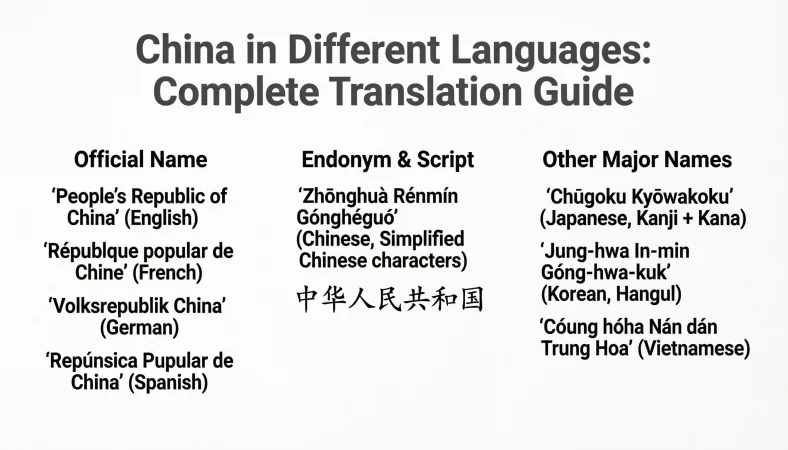
Chinese itself follows a different naming tradition. 中国 (Zhōngguó) is the standard short name used for the country, while the official state name is 中华人民共和国 (Zhōnghuá Rénmín Gònghéguó), meaning the People’s Republic of China.
China in Asian Languages
Asian languages often show particularly interesting differences because of geography and centuries of cultural exchange.
For example:
- Mandarin Chinese: 中国
- Cantonese: 中國
- Japanese: 中国
- Korean: 중국
- Vietnamese: Trung Quốc
- Thai: จีน
- Hindi: चीन
- Urdu: چین
- Bengali: চীন
- Persian: چین
- Arabic: الصين
- Turkish: Çin
- Kazakh: Қытай
- Uzbek: Xitoy
Some neighboring languages have names that developed through long-standing regional interactions rather than simply copying the English word “China.”
China in European Languages
European languages show two broad patterns.
The first group contains names closely resembling “China,” including Spanish China, French Chine, Italian Cina, Portuguese China, Romanian China, and Dutch China.
The second group uses forms that are less immediately recognizable. Slavic languages such as Russian, Bulgarian, Ukrainian, and Belarusian use forms related to Kitay or Kitaj.
This makes China in different languages an interesting example of how one country can have several completely different linguistic identities.
How to Say China in Different Languages
If your goal is simply to learn how to say China in different languages, start with the languages you are most likely to encounter.
For English speakers, some of the easiest forms are:
- Spanish: China
- Italian: Cina
- French: Chine
- German: China
- Portuguese: China
- Swedish: Kina
- Danish: Kina
- Turkish: Çin
- Arabic: الصين
- Persian: چین
- Hindi: चीन
- Japanese: 中国
- Korean: 중국
- Vietnamese: Trung Quốc
The pronunciation can change substantially even when the written form looks familiar. For example, China in Spanish is pronounced differently from the English word “China,” while Japanese 中国 has a completely different pronunciation from Mandarin 中国.
China Around the World: What the Names Tell Us
Looking at China around the world reveals how languages preserve history.
A country’s name can travel across borders and change along the way. A word may be borrowed from a neighboring language, adapted to a new writing system, or reshaped to fit the sounds available in the receiving language.
That is why there is no requirement for every language to use a form resembling the English word “China.”
The same pattern can be seen with many other countries. Germany, for example, is called Deutschland in German, Allemagne in French, and Germany in English. Country names often have several established forms depending on the language.
China Translations for Travel and Language Learning
Knowing the local name for China can be useful when traveling, studying languages, searching local websites, or communicating with native speakers.
If you are learning Mandarin, 中国 (Zhōngguó) is an essential vocabulary word. It appears frequently in conversations, news, maps, educational materials, and international contexts.
Language learners should also remember that the name of a country and the word for its people or language may be different.
For example, in Mandarin:
- 中国 — China
- 中国人 — Chinese person or Chinese people
- 中文 — Chinese language/writing
Learning these related words together can make vocabulary easier to remember and use naturally.
Is “China” the Same in Every Language?
No. Some languages use a word that closely resembles “China,” while others have forms that are historically unrelated to the modern English spelling.
For example, China, Chine, and Cina are visually similar, but 中国, จีน, Читай, and Xitoy look and sound very different.
These differences do not mean that one translation is more correct than another. Each is the conventional form used by that language.
What Is the Native Chinese Name for China?
The standard Chinese name is 中国 in Simplified Chinese and 中國 in Traditional Chinese.
It is pronounced Zhōngguó in Standard Mandarin.
The first character, 中, is associated with “middle” or “central,” while 国/國 means “country” or “state.” Together, the name is commonly rendered in English as “China.”
Frequently Asked Questions
1. How do you say China in different languages?
China has different names in different languages. Examples include China in Spanish, Chine in French, Cina in Italian, 中国 in Mandarin, 中国 in Japanese, 중국 in Korean, จีน in Thai, and Trung Quốc in Vietnamese.
2. What is China called in Mandarin?
China is called 中国 (Zhōngguó) in Standard Mandarin. The Simplified Chinese form is 中国, while the Traditional Chinese form is 中國.
3. Why is China called China in English?
The English name “China” developed through historical linguistic transmission involving older names associated with the region. The ultimate origin is commonly connected with the ancient Qin name, although the exact etymological pathway has been debated.
4. What is China called in Japanese and Korean?
In Japanese, China is written 中国 and commonly pronounced Chūgoku. In Korean, it is written 중국 and pronounced Jungguk. Both forms have historical connections with Chinese characters and vocabulary.
5. What is the most common translation of China around the world?
There is no single translation used by every language. Many European languages use forms related to “China,” while languages across Asia and other regions use several distinct historical forms.
Conclusion
Learning China in different languages is more than memorizing 70 translations. It shows how languages preserve history, geography, trade, culture, and centuries of communication.
From 中国 (Zhōngguó) in Mandarin to Chine in French, Cina in Italian, Çin in Turkish, and Trung Quốc in Vietnamese, each form reflects the linguistic traditions of its speakers.
if you searched for China in all languages, China translations, or simply wanted to know how to say China in different languages, this list provides a practical starting point for exploring the country’s name around the world.

I am Danny James, an Administrator at LingoHives, passionate about languages, communication, and cultural diversity. I enjoy helping people discover languages, understand words, and connect with different cultures through simple, useful, and engaging content.