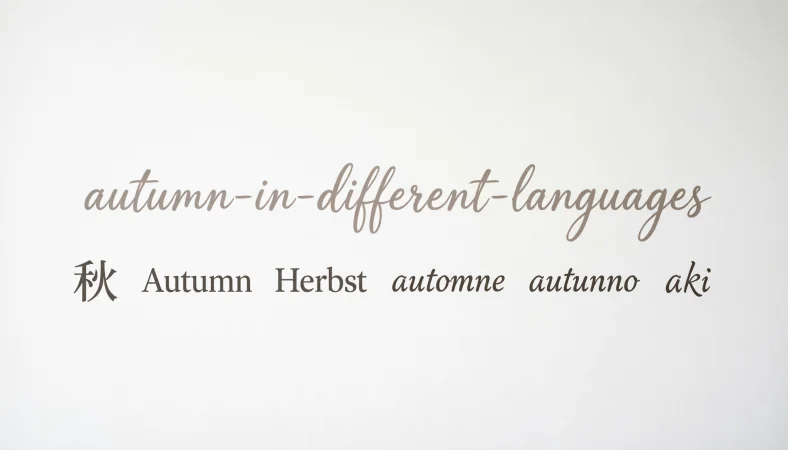
Autumn is one of the most recognizable seasons of the year, known for cooler if , changing leaves, harvests, and shorter days. But how do people around the world describe this beautiful season?
If you are searching for autumn in different languages, this guide gives you 70 useful translations, including the native word, an easy English pronunciation, a short everyday example, and its English meaning.
You will also discover how different languages distinguish between “autumn” and “fall,” making this a practical resource for language learners, travelers, students, writers, and anyone interested in world languages.
The following table answers the common search query “how to say autumn in different languages” with 70 languages from Europe, Asia, Africa, Oceania, and the Americas.
Language Native phrase Easy English pronunciation Example sentence English meaning
1 English autumn AW-tum Autumn is my favorite season. Autumn is my favorite season.
2 Spanish otoño oh-TOH-nyoh Me gusta el otoño. I like autumn.
3 French automne oh-TON J’aime l’automne. I love autumn.
4 German Herbst HERPST Ich mag den Herbst. I like autumn.
5 Italian autunno ow-TOON-noh Amo l’autunno. I love autumn.
6 Portuguese outono oh-TOH-noh Gosto do outono. I like autumn.
7 Dutch herfst HURFST Ik hou van de herfst. I love autumn.
8 Afrikaans herfs HERFS Ek hou van die herfs. I love autumn.
9 Swedish höst HURST Jag gillar hösten. I like autumn.
10 Norwegian høst HURST Jeg liker høsten. I like autumn.
11 Danish efterår EF-ter-or Jeg elsker efteråret. I love autumn.
12 Finnish syksy SÜK-see Pidän syksystä. I like autumn.
13 Icelandic haust HOWST Mér finnst haustið fallegt. I think autumn is beautiful.
14 Irish fómhar FOH-war Is maith liom an fómhar. I like autumn.
15 Welsh hydref HUH-drev Dw i’n hoffi’r hydref. I like autumn.
16 Scottish Gaelic foghar FOH-ar Is toil leam am foghar. I like autumn.
17 Polish jesień YEH-shen Lubię jesień. I like autumn.
18 Czech podzim POHD-zeem Mám rád podzim. I like autumn.
19 Slovak jeseň YEH-sen Mám rád jeseň. I like autumn.
20 Slovenian jesen YEH-sen Rad imam jesen. I like autumn.
21 Croatian jesen YEH-sen Volim jesen. I love autumn.
22 Serbian јесен YEH-sen Волим јесен. I love autumn.
23 Bosnian jesen YEH-sen Volim jesen. I love autumn.
24 Bulgarian есен EH-sen Обичам есента. I love autumn.
25 Macedonian есен EH-sen Ја сакам есента. I love autumn.
26 Russian осень OH-syen Я люблю осень. I love autumn.
27 Ukrainian осінь OH-seen Я люблю осінь. I love autumn.
28 Belarusian восень VOH-syen Я люблю восень. I love autumn.
29 Lithuanian ruduo roo-DOH-oh Man patinka ruduo. I like autumn.
30 Latvian rudens ROO-dens Man patīk rudens. I like autumn.
31 Estonian sügis SOO-gis Mulle meeldib sügis. I like autumn.
32 Greek φθινόπωρο fthi-NOH-po-roh Μου αρέσει το φθινόπωρο. I like autumn.
33 Albanian vjeshtë VYESHT-uh Më pëlqen vjeshta. I like autumn.
34 Romanian toamnă TWAHM-nuh Îmi place toamna. I like autumn.
35 Hungarian ősz URSH Szeretem az őszt. I love autumn.
36 Turkish sonbahar son-ba-HAR Sonbaharı seviyorum. I love autumn.
37 Azerbaijani payız pah-YUZ Mən payızı sevirəm. I love autumn.
38 Armenian աշուն ah-SHOON Ես սիրում եմ աշունը։ I love autumn.
39 Georgian შემოდგომა sheh-mod-GOH-mah მე მიყვარს შემოდგომა. I love autumn.
40 Arabic خريف kha-REEF أحب الخريف. I love autumn.
41 Hebrew סתיו sah-TAHV אני אוהב סתיו. I love autumn.
42 Persian پاییز pah-YEEZ من پاییز را دوست دارم. I like autumn.
43 Urdu خزاں kha-ZAAN مجھے خزاں پسند ہے۔ I like autumn.
44 Hindi पतझड़ pat-JHUR मुझे पतझड़ पसंद है। I like autumn.
45 Bengali শরৎ SHO-rot আমার শরৎ ভালো লাগে। I like autumn.
46 Punjabi ਪਤਝੜ pat-JHAR ਮੈਨੂੰ ਪਤਝੜ ਪਸੰਦ ਹੈ। I like autumn.
47 Gujarati પાનખર PAAN-khar મને પાનખર ગમે છે. I like autumn.
48 Marathi शरद ऋतू SHUH-rud RI-too मला शरद ऋतू आवडतो. I like autumn.
49 Nepali शरद ऋतु SHUH-rud RI-too मलाई शरद ऋतु मन पर्छ। I like autumn.
50 Sinhala සරත් කාලය sah-rath KAA-lah-yah මම සරත් කාලයට කැමතියි. I like autumn.
51 Tamil இலையுதிர் காலம் ih-LIE-yoo-thir KAA-lum எனக்கு இலையுதிர் காலம் பிடிக்கும். I like autumn.
52 Telugu శరదృతువు sha-ra-DA-ri-too-voo నాకు శరదృతువు ఇష్టం. I like autumn.
53 Kannada ಶರತ್ಕಾಲ sha-rat-KAA-la ನನಗೆ ಶರತ್ಕಾಲ ಇಷ್ಟ. I like autumn.
54 Malayalam ശരത്കാലം sha-rath-KAA-lum എനിക്ക് ശരത്കാലം ഇഷ്ടമാണ്. I like autumn.
55 Thai ฤดูใบไม้ร่วง rue-doo bai-MAI ru-ang ฉันชอบฤดูใบไม้ร่วง I like autumn.
56 Vietnamese mùa thu moo-ah TOO Tôi thích mùa thu. I like autumn.
57 Indonesian musim gugur MOO-seem goo-GOOR Saya suka musim gugur. I like autumn.
58 Malay musim luruh MOO-seem LOO-rooh Saya suka musim luruh. I like autumn.
59 Filipino taglagas tag-LAH-gas Gusto ko ang taglagas. I like autumn.
60 Chinese (Mandarin) 秋天 chyoh-tyen 我喜欢秋天。 I like autumn.
61 Japanese 秋 ah-kee 秋が好きです。 I like autumn.
62 Korean 가을 gah-eul 저는 가을을 좋아해요. I like autumn.
63 Mongolian намар nah-MAHR Би намарт дуртай. I like autumn.
64 Kazakh күз KOOS Маған күз ұнайды. I like autumn.
65 Uzbek kuz KOOZ Men kuzni yaxshi ko’raman. I love autumn.
66 Swahili vuli VOO-lee Ninapenda vuli. I like autumn.
67 Amharic መኸር MEH-her መኸርን እወዳለሁ። I like autumn.
68 Malagasy fararano fah-rah-RAH-noo Tiako ny fararano. I like autumn.
69 Māori ngahuru ngah-HOO-roo He pai ki ahau te ngahuru. I like autumn.
70 Hawaiian hāʻule hah-OO-leh Aloha au i ka hāʻule. I love autumn.
Autumn vs. Fall: What Is the Difference?
“Autumn” and “fall” generally refer to the same season in English.
Autumn is particularly common in British English and is also widely understood in other varieties of English. Fall is especially common in American English.
The two terms do not represent different seasons. They are simply different names for the same part of the year.
The word “fall” is associated with the falling of leaves, while “autumn” has a much older history connected with the season of harvest and the transition toward winter.
How to Say Autumn in European Languages
European languages offer some interesting patterns in autumn translations.
German uses Herbst, Dutch uses herfst, and Afrikaans uses herfs. Scandinavian languages also have related-looking forms: Swedish höst, Norwegian høst, and Danish efterår.
Several Slavic languages have closely related words. Polish uses jesień, Czech uses podzim, while Croatian, Serbian, Bosnian, and Slovenian use forms based on jesen.
Romance languages often have forms connected to Latin autumnus. Spanish uses otoño, French uses automne, Italian uses autunno, and Portuguese uses outono.
Autumn in Asian Languages
The concept of autumn appears in many different forms across Asia.
Mandarin Chinese uses 秋天, Japanese uses 秋, and Korean uses 가을. Turkish uses sonbahar, Persian uses پاییز, and Arabic uses خريف.
South Asian languages can have especially interesting seasonal vocabulary. Hindi commonly uses पतझड़, Urdu uses خزاں, while Bengali uses শরৎ. Some languages use terms associated with falling leaves, while others use traditional names for the season.
Autumn Around the World
Autumn does not look identical everywhere. In countries farther from the equator, it can bring dramatic changes in temperature, daylight, and foliage. In other regions, seasonal changes may be less pronounced.
This cultural and geographical variation makes autumn around the world an interesting topic for language learners. A single English word can correspond to words with different historical origins, cultural associations, and seasonal meanings.
In some languages, the word is closely associated with falling leaves. In others, it is connected with harvests, cooler weather, or a particular period in the traditional calendar.
Why Learn Autumn in Different Languages?
Learning seasonal vocabulary can be an easy way to expand everyday language skills.
The word “autumn” is useful when discussing weather, travel, clothing, holidays, school terms, nature, photography, food, and seasonal activities. Learning it alongside a simple sentence makes the vocabulary easier to use naturally.
For students and travelers, knowing seasonal words can also make conversations more practical. Instead of memorizing isolated vocabulary, try combining the word with expressions such as “I like autumn,” “Autumn is beautiful,” or “The leaves change in autumn.”
Autumn Vocabulary for Language Learners
Once you know the word for autumn, you can build a larger seasonal vocabulary around it.
Useful related English words include:
Autumn leaves
Cool weather
Falling leaves
Harvest
Rain
Wind
Sweater
Pumpkin
October
Seasonal colors
Cooler temperatures
Changing trees
Learning these words together creates a stronger vocabulary network than memorizing the translation of “autumn” alone.
Frequently Asked Questions
- How do you say autumn in different languages?
The word for autumn varies widely. For example, Spanish uses otoño, French uses automne, German uses Herbst, Italian uses autunno, Japanese uses 秋, Chinese uses 秋天, and Korean uses 가을.
- What is autumn called in 70 languages?
There are many different translations for autumn, including manzana—no, otoño in Spanish, jesień in Polish, осень in Russian, خريف in Arabic, पतझड़ in Hindi, 秋 in Japanese, and ngahuru in Māori. The complete list of 70 languages appears in the table above.
- What is the difference between autumn and fall?
Autumn and fall usually mean the same season. “Autumn” is more common in British English, while “fall” is especially common in American English.
- What is autumn called in Spanish, French, and German?
Autumn is otoño in Spanish, automne in French, and Herbst in German. These are among the most useful autumn translations for English speakers learning European languages.
- How do you say autumn in Japanese and Chinese?
In Japanese, autumn is 秋 (aki). In Mandarin Chinese, it is 秋天 (qiūtiān). Both terms are commonly associated with the autumn season.
Conclusion
Learning autumn in different languages is a simple way to explore vocabulary, pronunciation, culture, and the history of language. From otoño and automne to осень, 秋, and 가을, the 70 translations above show how differently languages describe the same season.
if you are studying a new language, preparing for a trip, writing about the seasons, or exploring autumn around the world, these translations provide a practical foundation for learning and everyday conversation.

I am Jimmy Michael, a language enthusiast and writer passionate about exploring different languages, words, and cultures. I create simple, useful content that helps readers understand languages better and discover new ways to communicate globally.