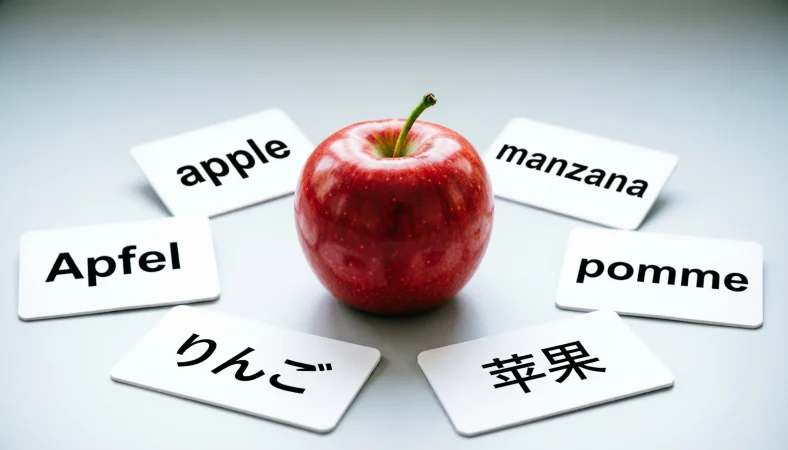
If you want to know apple in different languages, you are in the right place. The word “apple” has fascinating variations across languages, from familiar forms such as manzana in Spanish to completely different words such as μήλο in Greek.
This guide gives you apple in all languages in a simple, easy-to-read format. For every language, you will find the native word, an easy English pronunciation, a practical example sentence, and the English meaning.
if you are learning languages, traveling, studying vocabulary, or simply curious about apple translations around the world, this list provides a useful starting point.
Apple in Different Languages at a Glance
The table below answers the common search query “how to say apple in different languages” and includes 70 languages from different regions.
| # | Language | Native phrase | Easy English pronunciation | Example sentence | English meaning |
|---|---|---|---|---|---|
| 1 | English | apple | AP-uhl | I ate an apple. | I ate an apple. |
| 2 | Spanish | manzana | mahn-SAH-nah | Como una manzana. | I eat an apple. |
| 3 | French | pomme | pom | Je mange une pomme. | I am eating an apple. |
| 4 | German | Apfel | AP-fel | Ich esse einen Apfel. | I am eating an apple. |
| 5 | Italian | mela | MEH-lah | Mangio una mela. | I am eating an apple. |
| 6 | Portuguese | maçã | mah-SAHN | Eu como uma maçã. | I eat an apple. |
| 7 | Dutch | appel | AH-pel | Ik eet een appel. | I am eating an apple. |
| 8 | Afrikaans | appel | AH-pel | Ek eet ‘n appel. | I am eating an apple. |
| 9 | Swedish | äpple | EP-pleh | Jag äter ett äpple. | I am eating an apple. |
| 10 | Norwegian | eple | EH-pleh | Jeg spiser et eple. | I am eating an apple. |
| 11 | Danish | æble | EH-bleh | Jeg spiser et æble. | I am eating an apple. |
| 12 | Finnish | omena | OH-meh-nah | Syön omenan. | I am eating an apple. |
| 13 | Icelandic | epli | EP-lee | Ég borða epli. | I am eating an apple. |
| 14 | Irish | úll | ool | Tá úll agam. | I have an apple. |
| 15 | Welsh | afal | AH-val | Rwy’n bwyta afal. | I am eating an apple. |
| 16 | Scottish Gaelic | ubhal | OO-al | Tha ubhal agam. | I have an apple. |
| 17 | Polish | jabłko | YAHB-koh | Jem jabłko. | I am eating an apple. |
| 18 | Czech | jablko | YAHB-lkoh | Jím jablko. | I am eating an apple. |
| 19 | Slovak | jablko | YAHB-lkoh | Jem jablko. | I am eating an apple. |
| 20 | Slovenian | jabolko | YAH-bohl-koh | Jem jabolko. | I am eating an apple. |
| 21 | Croatian | jabuka | YAH-boo-kah | Jedem jabuku. | I am eating an apple. |
| 22 | Serbian | јабука | YAH-boo-kah | Једем јабуку. | I am eating an apple. |
| 23 | Bosnian | jabuka | YAH-boo-kah | Jedem jabuku. | I am eating an apple. |
| 24 | Bulgarian | ябълка | YAH-buhl-kah | Ям ябълка. | I am eating an apple. |
| 25 | Macedonian | јаболко | YAH-bohl-koh | Јадам јаболко. | I am eating an apple. |
| 26 | Russian | яблоко | YAH-bluh-koh | Я ем яблоко. | I am eating an apple. |
| 27 | Ukrainian | яблуко | YAH-bloo-koh | Я їм яблуко. | I am eating an apple. |
| 28 | Belarusian | яблык | YAH-blyk | Я ем яблык. | I am eating an apple. |
| 29 | Lithuanian | obuolys | oh-boo-OH-lis | Aš valgau obuolį. | I am eating an apple. |
| 30 | Latvian | ābols | AH-bols | Es ēdu ābolu. | I am eating an apple. |
| 31 | Estonian | õun | uh-oon | Ma söön õuna. | I am eating an apple. |
| 32 | Greek | μήλο | MEE-loh | Τρώω ένα μήλο. | I am eating an apple. |
| 33 | Albanian | mollë | MOHL-uh | Unë ha një mollë. | I eat an apple. |
| 34 | Romanian | măr | muhr | Mănânc un măr. | I am eating an apple. |
| 35 | Hungarian | alma | AHL-mah | Almát eszem. | I am eating an apple. |
| 36 | Turkish | elma | EL-mah | Bir elma yiyorum. | I am eating an apple. |
| 37 | Azerbaijani | alma | AHL-mah | Mən alma yeyirəm. | I am eating an apple. |
| 38 | Armenian | խնձոր | khun-DZOR | Ես խնձոր եմ ուտում։ | I am eating an apple. |
| 39 | Georgian | ვაშლი | VASH-lee | მე ვაშლს ვჭამ. | I am eating an apple. |
| 40 | Arabic | تفاحة | tif-FAH-hah | آكل تفاحة. | I am eating an apple. |
| 41 | Hebrew | תפוח | ta-POO-akh | אני אוכל תפוח. | I am eating an apple. |
| 42 | Persian | سیب | seeb | من یک سیب میخورم. | I am eating an apple. |
| 43 | Urdu | سیب | SEB | میں ایک سیب کھاتا ہوں۔ | I eat an apple. |
| 44 | Hindi | सेब | SEB | मैं एक सेब खाता हूँ। | I eat an apple. |
| 45 | Bengali | আপেল | AH-pel | আমি একটি আপেল খাই। | I eat an apple. |
| 46 | Punjabi | ਸੇਬ | SEB | ਮੈਂ ਇੱਕ ਸੇਬ ਖਾਂਦਾ ਹਾਂ। | I eat an apple. |
| 47 | Gujarati | સફરજન | suh-fur-JUN | હું સફરજન ખાઉં છું. | I eat an apple. |
| 48 | Marathi | सफरचंद | suh-fur-CHUND | मी सफरचंद खातो. | I eat an apple. |
| 49 | Nepali | स्याउ | syow | म स्याउ खान्छु। | I eat an apple. |
| 50 | Sinhala | ඇපල් | EP-al | මම ඇපල් කනවා. | I eat an apple. |
| 51 | Tamil | ஆப்பிள் | AAP-pil | நான் ஒரு ஆப்பிள் சாப்பிடுகிறேன். | I am eating an apple. |
| 52 | Telugu | ఆపిల్ | AA-pil | నేను ఆపిల్ తింటున్నాను. | I am eating an apple. |
| 53 | Kannada | ಸೇಬು | SAY-boo | ನಾನು ಸೇಬು ತಿನ್ನುತ್ತೇನೆ. | I eat an apple. |
| 54 | Malayalam | ആപ്പിൾ | AAP-pil | ഞാൻ ഒരു ആപ്പിൾ കഴിക്കുന്നു. | I am eating an apple. |
| 55 | Thai | แอปเปิล | AP-pern | ฉันกินแอปเปิล | I am eating an apple. |
| 56 | Vietnamese | quả táo | gwah TOW | Tôi ăn một quả táo. | I eat an apple. |
| 57 | Indonesian | apel | AH-pel | Saya makan apel. | I eat an apple. |
| 58 | Malay | epal | EH-pal | Saya makan epal. | I eat an apple. |
| 59 | Filipino | mansanas | mahn-SAH-nahs | Kumakain ako ng mansanas. | I am eating an apple. |
| 60 | Chinese (Mandarin) | 苹果 | píngguǒ | 我吃一个苹果。 | I am eating an apple. |
| 61 | Japanese | りんご | REEN-goh | りんごを食べます。 | I eat an apple. |
| 62 | Korean | 사과 | sah-GWA | 사과를 먹어요. | I eat an apple. |
| 63 | Mongolian | алим | ah-LEEM | Би алим иддэг. | I eat apples. |
| 64 | Kazakh | алма | AHL-mah | Мен алма жеймін. | I eat an apple. |
| 65 | Uzbek | olma | OHL-mah | Men olma yeyman. | I eat an apple. |
| 66 | Swahili | tufaha | too-FAH-hah | Ninakula tufaha. | I am eating an apple. |
| 67 | Amharic | ፖም | pom | ፖም እበላለሁ። | I eat an apple. |
| 68 | Malagasy | paoma | pah-OH-mah | Mihinana paoma aho. | I am eating an apple. |
| 69 | Māori | āporo | AH-paw-raw | Kei te kai ahau i te āporo. | I am eating an apple. |
| 70 | Hawaiian | ʻāpala | AH-pah-lah | ʻAi au i ka ʻāpala. | I eat the apple. |
How to Say Apple in Different Languages
The word apple changes considerably from one language to another. Some languages have closely related forms because they share historical linguistic roots. For example, English apple, Dutch appel, German Apfel, and Scandinavian forms such as Swedish äpple and Danish æble have noticeable similarities.
Other languages use words that look and sound very different. Spanish uses manzana, French uses pomme, Greek uses μήλο, and Japanese uses りんご.
These differences make apple translations useful for language learners because one familiar object can introduce vocabulary, pronunciation, grammar, and writing systems at the same time.
Apple Around the World
Apples are recognized in many cultures, but the way people name them depends on the language they speak.
In Europe, several languages use words that share historical connections. German has Apfel, Dutch has appel, while Polish, Czech, and Slovak use forms based on jabłko or jablko.
In South Asia, the word is especially interesting because several languages use forms borrowed from English or have their own traditional terms. Hindi and Urdu commonly use सेब and سیب, while Bengali uses আপেল.
Across East and Southeast Asia, you can see even greater variety. Mandarin Chinese uses 苹果, Japanese uses りんご, Korean uses 사과, and Vietnamese uses quả táo.
Why Apple Has Different Names in Different Languages
Languages develop independently and borrow words from one another over centuries. Trade, migration, geography, agriculture, and cultural contact can all influence vocabulary.
This is why two neighboring languages may have similar words for apple, while languages from completely different regions may use entirely unrelated terms.
Pronunciation can also vary substantially. A native spelling may contain sounds that do not have an exact equivalent in English, so the pronunciation guides in the table are intentionally simplified for English speakers.
Common Apple Translation Patterns
When learning apple in different languages, it helps to notice recurring patterns.
- Several Germanic languages have similar-looking forms, such as apple, appel, Apfel, äpple, and eple.
- Many Slavic languages use related forms such as jabłko, jablko, jabuka, and яблоко.
- Turkish, Azerbaijani, Kazakh, Hungarian, and several other languages use forms related to alma.
- Some Asian languages use loanwords or modern adaptations of the English word.
- Languages with different writing systems may have native forms that look completely different from the Latin alphabet.
Apple in Different Writing Systems
One of the most useful parts of learning apple in all languages is seeing how the same everyday concept can be written in different scripts.
For example, Chinese uses Chinese characters: 苹果. Japanese uses hiragana: りんご. Korean uses Hangul: 사과. Arabic is written as تفاحة, while Hindi uses Devanagari: सेब.
Learning these words can therefore be useful beyond vocabulary. It can help beginners become familiar with different alphabets, scripts, and writing traditions.
Tips for Learning Apple in New Languages
Start with a small group of languages rather than trying to memorize all 70 words at once.
First, learn the native word. Then practice the pronunciation aloud. Finally, use the word in a short sentence. Connecting vocabulary with a real-life action, such as eating or buying an apple, can make the word easier to remember.
You can also group related languages together. Learning apple, appel, and Apfel side by side, for example, can help you recognize similarities between Germanic languages.
For languages using unfamiliar scripts, learn the written form separately from the pronunciation. This makes the learning process more manageable.
Frequently Asked Questions
1. What is apple in the most commonly spoken languages?
Some common translations include manzana in Spanish, pomme in French, Apfel in German, mela in Italian, maçã in Portuguese, 苹果 in Mandarin Chinese, りんご in Japanese, 사과 in Korean, सेब in Hindi, and سیب in Urdu.
2. How do you say apple in 70 languages?
“Apple” can be translated into dozens of languages, including the 70 examples in this guide. The native word, pronunciation, and sentence can vary significantly depending on the language and grammatical context.
3. What is apple in Spanish, French, and German?
Apple is manzana in Spanish, pomme in French, and Apfel in German. These are three of the most commonly searched apple translations.
4. What is apple in Japanese and Chinese?
In Japanese, apple is りんご (ringo). In Mandarin Chinese, it is 苹果 (píngguǒ). Both languages use writing systems that differ from the Latin alphabet.
5. Why do some languages have similar words for apple?
Languages often share vocabulary because of common ancestry, geographic proximity, historical contact, or borrowing. Similar forms such as apple, appel, and Apfel reflect historical relationships between languages, while other terms developed through different linguistic histories.
Conclusion
Learning apple in different languages is a simple way to explore global vocabulary and discover how languages differ in pronunciation, spelling, and writing systems.
From manzana and pomme to яблоко, 苹果, and りんご, these 70 translations show how one familiar fruit can have many fascinating names around the world.
if you are learning a new language, preparing for travel, studying vocabulary, or simply exploring apple around the world, this collection gives you practical words and sentences you can start using right away.

I am Johnny Thomas, a passionate language enthusiast and writer. I enjoy exploring different languages, cultures, words, and expressions. I create helpful, easy-to-understand content to help readers discover languages and communicate confidently.