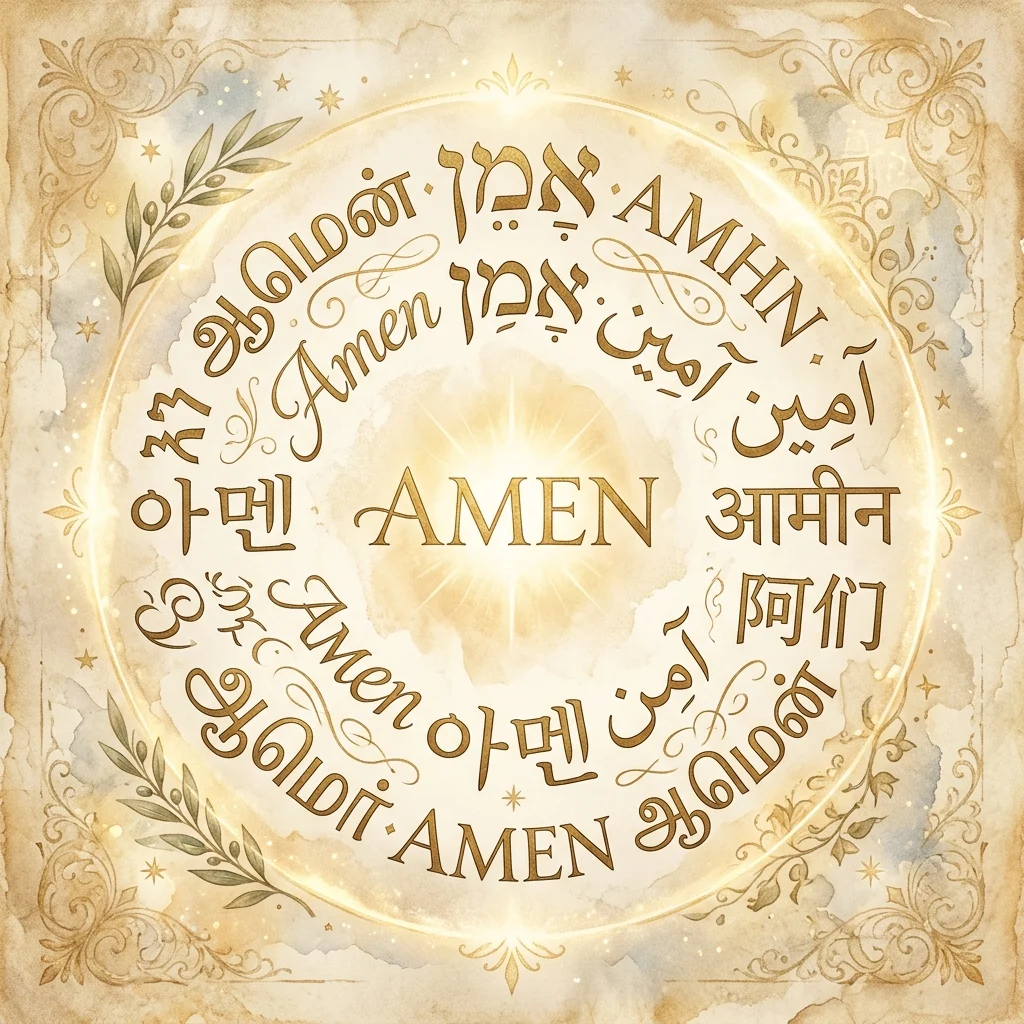
“Amen” is one of the most recognizable words used in prayer, worship, and religious expression.
Although its spelling and pronunciation can change from one language to another, its central idea is often connected with agreement, affirmation, truth, or “so be it.”
The word has ancient Hebrew roots and passed into Greek, Latin, Arabic, and many modern languages, often remaining remarkably close to its original form. (Wiktionary)
If you are looking for amen in different languages, this guide gives you 70 examples in one easy-to-scan table.
You will find the native phrase, a simple English pronunciation, a practical example sentence, and the English meaning of each example.
Some languages use a direct form of “amen,” while others traditionally use a culturally or religiously equivalent expression such as “so be it.”
This distinction matters when looking at amen in all languages rather than simply translating the spelling word-for-word. (Bible Gateway)
Amen Translations Around the World
The following list focuses on commonly recognized forms used in religious or prayer contexts. In many languages, “amen” is borrowed rather than translated, which explains why many forms look and sound similar. (Divinity Atlas)
| # | Language | Native phrase | Easy English pronunciation | Real-life example sentence | English meaning |
|---|---|---|---|---|---|
| 1 | English | Amen | ah-MEN | We ended the prayer with Amen. | We ended the prayer with Amen. |
| 2 | Arabic | آمين | aa-MEEN | قال الجميع: آمين. | Everyone said: Amen. |
| 3 | Hebrew | אָמֵן | ah-MEN | כולם אמרו אמן. | Everyone said Amen. |
| 4 | Urdu | آمین | aa-MEEN | سب نے کہا، آمین۔ | Everyone said, Amen. |
| 5 | Persian | آمین | aa-MEEN | همه گفتند آمین. | Everyone said Amen. |
| 6 | Turkish | amin | ah-MEEN | Herkes amin dedi. | Everyone said Amen. |
| 7 | French | amen | ah-MEN | Nous avons dit amen. | We said Amen. |
| 8 | Spanish | amén | ah-MEN | Todos dijeron amén. | Everyone said Amen. |
| 9 | Portuguese | amém | ah-MEM | Todos disseram amém. | Everyone said Amen. |
| 10 | Italian | amen | ah-MEN | Tutti dissero amen. | Everyone said Amen. |
| 11 | German | Amen | ah-MEN | Alle sagten Amen. | Everyone said Amen. |
| 12 | Dutch | amen | ah-MEN | Iedereen zei amen. | Everyone said Amen. |
| 13 | Afrikaans | amen | ah-MEN | Almal het amen gesê. | Everyone said Amen. |
| 14 | Swedish | amen | ah-MEN | Alla sade amen. | Everyone said Amen. |
| 15 | Danish | amen | ah-MEN | Alle sagde amen. | Everyone said Amen. |
| 16 | Norwegian | amen | ah-MEN | Alle sa amen. | Everyone said Amen. |
| 17 | Icelandic | amen | ah-MEN | Allir sögðu amen. | Everyone said Amen. |
| 18 | Finnish | aamen | AH-men | Kaikki sanoivat aamen. | Everyone said Amen. |
| 19 | Estonian | aamen | AH-men | Kõik ütlesid aamen. | Everyone said Amen. |
| 20 | Hungarian | ámen | AH-men | Mindenki azt mondta: ámen. | Everyone said Amen. |
| 21 | Polish | amen | AH-men | Wszyscy powiedzieli amen. | Everyone said Amen. |
| 22 | Czech | amen | AH-men | Všichni řekli amen. | Everyone said Amen. |
| 23 | Slovak | amen | AH-men | Všetci povedali amen. | Everyone said Amen. |
| 24 | Slovenian | amen | AH-men | Vsi so rekli amen. | Everyone said Amen. |
| 25 | Croatian | amen | AH-men | Svi su rekli amen. | Everyone said Amen. |
| 26 | Serbian | амин | ah-MEEN | Svi su rekli amin. | Everyone said Amen. |
| 27 | Bulgarian | амин | ah-MEEN | Всички казаха амин. | Everyone said Amen. |
| 28 | Macedonian | амин | ah-MEEN | Сите рекоа амин. | Everyone said Amen. |
| 29 | Russian | аминь | ah-MEEN | Все сказали аминь. | Everyone said Amen. |
| 30 | Ukrainian | амінь | ah-MEEN | Усі сказали амінь. | Everyone said Amen. |
| 31 | Belarusian | амін | ah-MEEN | Усе сказалі амін. | Everyone said Amen. |
| 32 | Romanian | amin | ah-MEEN | Toți au spus amin. | Everyone said Amen. |
| 33 | Albanian | amin | ah-MEEN | Të gjithë thanë amin. | Everyone said Amen. |
| 34 | Armenian | ամեն | ah-MEN | Բոլորը ասացին ամեն։ | Everyone said Amen. |
| 35 | Georgian | ამინ | ah-MEEN | ყველამ თქვა ამინ. | Everyone said Amen. |
| 36 | Azerbaijani | amin | ah-MEEN | Hamı amin dedi. | Everyone said Amen. |
| 37 | Kazakh | әумин | ow-MEEN | Барлығы әумин деді. | Everyone said Amen. |
| 38 | Uzbek | omin | oh-MEEN | Hamma omin dedi. | Everyone said Amen. |
| 39 | Tajik | омин | oh-MEEN | Ҳама омин гуфтанд. | Everyone said Amen. |
| 40 | Uyghur | ئامىن | ah-MEEN | ھەممەيلەن ئامىن دېدى. | Everyone said Amen. |
| 41 | Greek | αμήν | ah-MEEN | Όλοι είπαν αμήν. | Everyone said Amen. |
| 42 | Latin | amen | AH-men | Omnes dixerunt amen. | Everyone said Amen. |
| 43 | Irish | áiméan | AY-mean | Dúirt gach duine áiméan. | Everyone said Amen. |
| 44 | Scottish Gaelic | amen | AH-men | Thuirt a h-uile duine amen. | Everyone said Amen. |
| 45 | Welsh | amen | AH-men | Dywedodd pawb amen. | Everyone said Amen. |
| 46 | Catalan | amén | ah-MEN | Tothom va dir amén. | Everyone said Amen. |
| 47 | Galician | amén | ah-MEN | Todos dixeron amén. | Everyone said Amen. |
| 48 | Basque | amen | AH-men | Denek amen esan zuten. | Everyone said Amen. |
| 49 | Esperanto | amen | ah-MEN | Ĉiuj diris amen. | Everyone said Amen. |
| 50 | Maltese | amen | AH-men | Kulħadd qal amen. | Everyone said Amen. |
| 51 | Amharic | አሜን | ah-MEN | ሁሉም አሜን አሉ። | Everyone said Amen. |
| 52 | Swahili | amina | ah-MEE-na | Wote walisema amina. | Everyone said Amen. |
| 53 | Hausa | amin | ah-MEEN | Kowa ya ce amin. | Everyone said Amen. |
| 54 | Yoruba | àmín | ah-MEEN | Gbogbo wọn sọ àmín. | Everyone said Amen. |
| 55 | Indonesian | amin | ah-MEEN | Semua berkata amin. | Everyone said Amen. |
| 56 | Malay | amin | ah-MEEN | Semua berkata amin. | Everyone said Amen. |
| 57 | Filipino | amen | ah-MEN | Lahat ay nagsabi ng amen. | Everyone said Amen. |
| 58 | Chinese (Mandarin) | 阿门 | ah-MEN | 大家都说阿门。 | Everyone said Amen. |
| 59 | Cantonese | 阿們 | ah-MUN | 大家都話阿們。 | Everyone said Amen. |
| 60 | Japanese | アーメン | AH-men | みんなでアーメンと言いました。 | Everyone said Amen. |
| 61 | Korean | 아멘 | ah-MEN | 모두 아멘이라고 했어요. | Everyone said Amen. |
| 62 | Vietnamese | a-men | ah-MEN | Mọi người đều nói a-men. | Everyone said Amen. |
| 63 | Thai | สาธุ | sah-THOO | ทุกคนพูดว่าสาธุ | Everyone said Amen. |
| 64 | Hindi | तथास्तु | tuh-THAA-stoo | सभी ने कहा, तथास्तु। | Everyone said, so be it. |
| 65 | Gujarati | આમેન | AH-men | બધાએ આમેન કહ્યું. | Everyone said Amen. |
| 66 | Tamil | ஆமென் | AH-men | அனைவரும் ஆமென் என்றார்கள். | Everyone said Amen. |
| 67 | Telugu | ఆమేన్ | AH-men | అందరూ ఆమేన్ అన్నారు. | Everyone said Amen. |
| 68 | Kannada | ಅಮೆನ್ | AH-men | ಎಲ್ಲರೂ ಅಮೆನ್ ಎಂದರು. | Everyone said Amen. |
| 69 | Bengali | আমেন | AH-men | সবাই আমেন বলল। | Everyone said Amen. |
| 70 | Yiddish | אָמן | OH-men | אַלע האָבן געזאָגט אָמן. | Everyone said Amen. |
The forms above reflect the fact that “Amen” has often been retained as a loanword across languages rather than replaced with a completely unrelated native word. Major reference sources list forms including Arabic آمين, Hebrew אָמֵן, Greek αμήν, Japanese アーメン, Korean 아멘, Spanish amén, Portuguese amém, Russian аминь, Urdu آمین, and many others. (Wiktionary)
What Does Amen Mean?
The word amen is traditionally associated with ideas such as “truly,” “certainly,” “so be it,” and affirmation. In prayer, it commonly expresses agreement with the words that have just been spoken. (Bible Gateway)
Its roots can be traced to Biblical Hebrew אָמֵן (ʾāmēn) and a Semitic root associated with firmness, reliability, and confirmation. The expression later entered Greek and Latin and spread into many other languages. (Wikipedia)
This is why amen translations are unusual: in many cases, the “translation” is actually a pronunciation or spelling adaptation of the same ancient word.
How to Say Amen in Different Languages
If you want to know how to say amen in different languages, the easiest approach is to learn both the written form and its approximate pronunciation.
For example:
- Spanish: amén — “ah-MEN”
- French: amen — “ah-MEN”
- Arabic: آمين — “aa-MEEN”
- Hebrew: אָמֵן — “ah-MEN”
- Russian: аминь — “ah-MEEN”
- Japanese: アーメン — “AH-men”
- Korean: 아멘 — “ah-MEN”
- Portuguese: amém — “ah-MEM”
Pronunciation can vary by region, religious tradition, and individual speaker, so an English pronunciation guide should be treated as an approximation rather than a substitute for native pronunciation.
Why Is Amen Similar in So Many Languages?
One reason amen around the world looks surprisingly similar is its long history of transmission between religious languages. The word moved from Hebrew into Greek and Latin and was subsequently adopted by many vernacular languages. (Wiktionary)
Rather than translating the word into a completely different expression, many languages preserved it with small changes in spelling or pronunciation.
For example, English uses Amen, Spanish uses amén, Portuguese uses amém, and Russian uses аминь. These forms look different, but their historical relationship is clear. (Wiktionary)
Amen in Religious and Everyday Speech
Amen is especially common at the conclusion of prayers, blessings, hymns, and religious statements. It can also be used informally in English to express strong agreement, as in “Amen to that.” (Cambridge Dictionary)
The exact usage depends on religious tradition and language. In some cultures, a direct form of amen is preferred, while another language may use an equivalent expression meaning “so be it.”
This is particularly important when comparing amen in all languages because a literal dictionary translation does not always capture how a word is actually used in worship.
Amen Around the World: What Makes It Unique?
Few religious expressions have traveled across so many linguistic boundaries while remaining recognizable.
The word is used across Jewish, Christian, and Muslim traditions, although its pronunciation, spelling, and precise religious context can differ. Its enduring use reflects its role as an expression of affirmation and agreement. (Divinity Atlas)
For language learners, this makes amen a useful example of how words can move between cultures without losing their basic identity.
Frequently Asked Questions About Amen in Different Languages
1. What is amen in different languages?
“Amen” has similar forms in many languages. Examples include amén in Spanish, amém in Portuguese, amin in Turkish, آمين in Arabic, אָמֵן in Hebrew, アーメン in Japanese, and 아멘 in Korean.
2. How do you say amen in 70 languages?
There is no single pronunciation shared by all 70 languages. The table above provides the native written form and an easy English pronunciation for each language, along with a practical example.
3. What does amen mean in English?
Amen generally expresses agreement, affirmation, or the idea “so be it.” In prayer, it is commonly said at the end to affirm what has been spoken. (Cambridge Dictionary)
4. Is amen the same word in every language?
No. Many languages use a form derived from or borrowed from the ancient word, while some traditions use an equivalent expression. For example, Hindi may use तथास्तु, meaning “so be it,” in an equivalent context, while Thai can use สาธุ in religious settings.
5. Why is amen used around the world?
Amen spread widely through Jewish, Christian, and later Islamic religious traditions. Its ancient Hebrew origin and transmission through Greek and Latin helped it become a widely recognized religious expression across languages. (Wikipedia)
Conclusion
Learning amen in different languages shows how a short religious expression can cross borders, cultures, and centuries while retaining a remarkably consistent meaning. From Hebrew אָמֵן and Arabic آمين to Spanish amén, Japanese アーメン, and Korean 아멘, the word continues to connect people through affirmation, prayer, and faith.
Whether you are studying languages, researching religious vocabulary, or simply curious about amen translations around the world, these 70 examples provide a practical starting point for understanding how the expression is written, pronounced, and used across different cultures.

I am Johnny Thomas, a passionate language enthusiast and writer. I enjoy exploring different languages, cultures, words, and expressions. I create helpful, easy-to-understand content to help readers discover languages and communicate confidently.