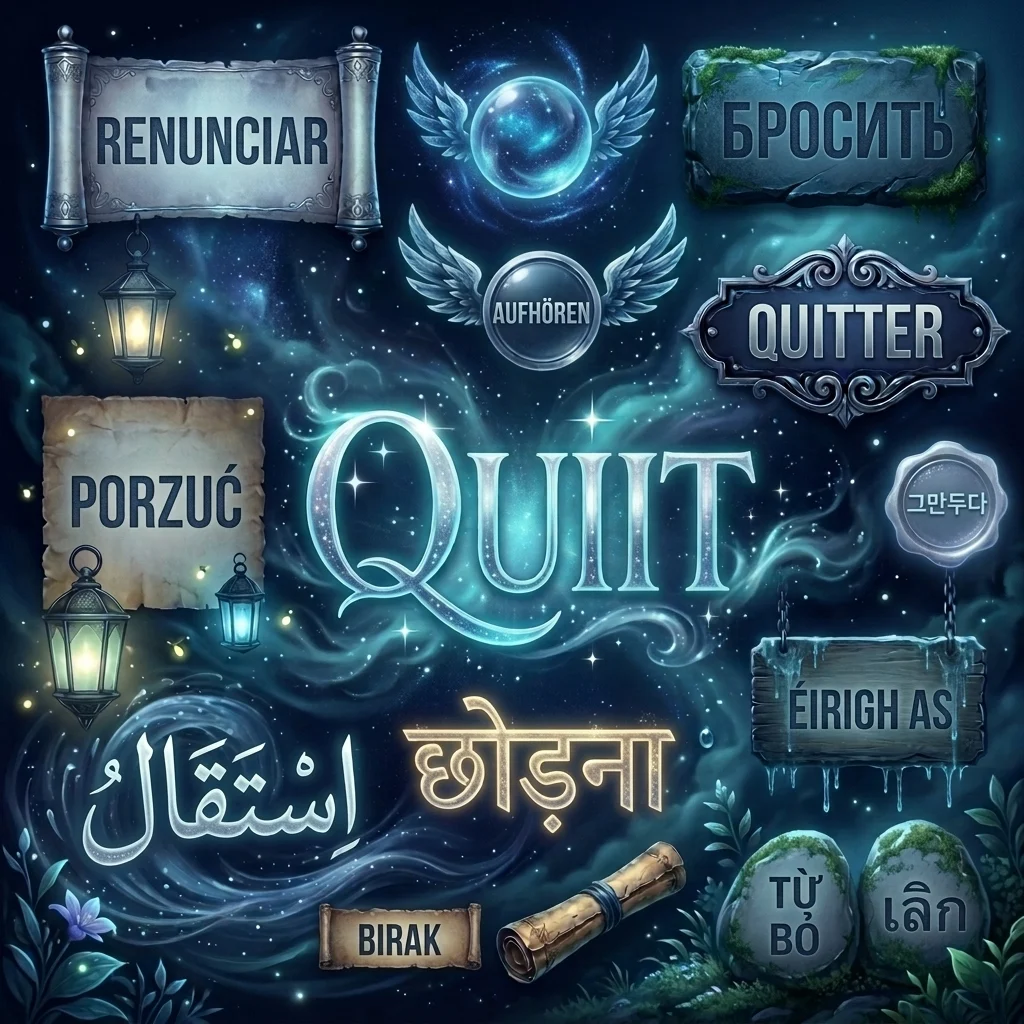
The word “quit” is used in everyday conversations to describe stopping an activity, leaving a job, giving up a habit, or deciding not to continue something.
Although it is a short English word, its translation can change depending on the situation and the meaning you want to express.
Learning quit in different languages can help you communicate more naturally while traveling, studying a foreign language,
writing dialogue, or exploring how people express the idea of stopping something around the world.
In this guide, you will discover 70 translations of “quit,” including native phrases, easy English pronunciations, practical example sentences, and their English meanings.
You will also learn the difference between quitting a job, stopping an activity, and giving up on a goal.
Quit in Different Languages: Quick Overview
The English word “quit” has several meanings. It can mean to stop doing something, leave a position, or abandon an activity. The best translation depends on the context.
Here are some common translations:
| Language | Native translation | Easy pronunciation |
|---|---|---|
| Spanish | Dejar | deh-HAR |
| French | Arrêter | ah-reh-TAY |
| German | Aufhören | OUF-huh-ren |
| Italian | Smettere | SMEHT-teh-reh |
| Portuguese | Parar | pah-RAR |
| Dutch | Stoppen | STOP-pen |
| Russian | Бросить (Brosit’) | BRAH-seet |
| Arabic | يتوقف (Yatawaqqaf) | ya-ta-waq-qaf |
| Hindi | छोड़ना (Chhoṛnā) | chhor-naa |
| Urdu | چھوڑنا (Chhorna) | chhor-naa |
| Japanese | やめる (Yameru) | yah-meh-roo |
| Chinese (Mandarin) | 停止 (Tíngzhǐ) | ting-jr |
These words are useful starting points, but they are not interchangeable in every sentence. For example, leaving a job may require a different expression from stopping smoking or giving up a game.
How to Say Quit in Different Languages: 70 Translations
The following table presents 70 languages with a natural expression for “quit,” an approximate English pronunciation, an example sentence in the native language, and its English meaning.
The examples focus mainly on stopping an activity or habit. Where a language uses a different verb form in a sentence, the phrase reflects natural usage rather than a strict word-for-word translation.
| No. | Language | Native phrase for “quit” | Easy pronunciation | Example sentence in the language | English meaning |
|---|---|---|---|---|---|
| 1 | Spanish | Dejar | deh-HAR | Quiero dejar de fumar. | I want to quit smoking. |
| 2 | French | Arrêter | ah-reh-TAY | Je veux arrêter de fumer. | I want to quit smoking. |
| 3 | German | Aufhören | OUF-huh-ren | Ich will mit dem Rauchen aufhören. | I want to quit smoking. |
| 4 | Italian | Smettere | SMEHT-teh-reh | Voglio smettere di fumare. | I want to quit smoking. |
| 5 | Portuguese | Parar | pah-RAR | Quero parar de fumar. | I want to quit smoking. |
| 6 | Dutch | Stoppen | STOP-pen | Ik wil stoppen met roken. | I want to quit smoking. |
| 7 | Swedish | Sluta | SLOO-tah | Jag vill sluta röka. | I want to quit smoking. |
| 8 | Norwegian | Slutte | SLOOT-teh | Jeg vil slutte å røyke. | I want to quit smoking. |
| 9 | Danish | Stoppe | STOH-peh | Jeg vil stoppe med at ryge. | I want to quit smoking. |
| 10 | Finnish | Lopettaa | LOH-peht-tah | Haluan lopettaa tupakoinnin. | I want to quit smoking. |
| 11 | Icelandic | Hætta | HAIHT-tah | Ég vil hætta að reykja. | I want to quit smoking. |
| 12 | Irish | Éirí as | AY-ree ahs | Ba mhaith liom éirí as an tobac. | I want to quit tobacco. |
| 13 | Welsh | Rhoi’r gorau i | roy-r GOW-rai ee | Dw i eisiau rhoi’r gorau i ysmygu. | I want to quit smoking. |
| 14 | Scottish Gaelic | Sguir | skoor | Tha mi airson sgur de smocadh. | I want to quit smoking. |
| 15 | Polish | Rzucić | ZHOO-cheech | Chcę rzucić palenie. | I want to quit smoking. |
| 16 | Czech | Přestat | PSHES-taht | Chci přestat kouřit. | I want to quit smoking. |
| 17 | Slovak | Prestať | PRES-taht | Chcem prestať fajčiť. | I want to quit smoking. |
| 18 | Slovenian | Prenehati | preh-neh-HAH-tee | Želim prenehati kaditi. | I want to quit smoking. |
| 19 | Croatian | Prestati | PRES-tah-tee | Želim prestati pušiti. | I want to quit smoking. |
| 20 | Serbian | Престати (Prestati) | PRES-tah-tee | Желим да престанем да пушим. | I want to quit smoking. |
| 21 | Bosnian | Prestati | PRES-tah-tee | Želim prestati pušiti. | I want to quit smoking. |
| 22 | Bulgarian | Спра (Spra) | sprah | Искам да спра да пуша. | I want to quit smoking. |
| 23 | Macedonian | Престанам (Prestанам) | pres-TAH-nam | Сакам да престанам да пушам. | I want to quit smoking. |
| 24 | Russian | Бросить (Brosit’) | BRAH-seet | Я хочу бросить курить. | I want to quit smoking. |
| 25 | Ukrainian | Кинути (Kynuty) | kih-NOO-tih | Я хочу кинути курити. | I want to quit smoking. |
| 26 | Belarusian | Кінуць (Kinuts) | KEE-noots | Я хачу кінуць курыць. | I want to quit smoking. |
| 27 | Greek | Σταματώ (Stamató) | stah-mah-TOH | Θέλω να σταματήσω το κάπνισμα. | I want to quit smoking. |
| 28 | Romanian | A renunța | ah reh-noon-TSAH | Vreau să renunț la fumat. | I want to quit smoking. |
| 29 | Hungarian | Abbahagyni | AHB-bah-hahj-nee | Abba akarom hagyni a dohányzást. | I want to quit smoking. |
| 30 | Albanian | Lë | luh | Dua ta lë duhanin. | I want to quit smoking. |
| 31 | Lithuanian | Mesti | MES-tee | Noriu mesti rūkyti. | I want to quit smoking. |
| 32 | Latvian | Atmest | AHT-mest | Es gribu atmest smēķēšanu. | I want to quit smoking. |
| 33 | Estonian | Loobuma | LOH-boo-mah | Ma tahan suitsetamisest loobuda. | I want to quit smoking. |
| 34 | Turkish | Bırakmak | buh-rahk-MAHK | Sigarayı bırakmak istiyorum. | I want to quit smoking. |
| 35 | Azerbaijani | Tərgitmək | ter-geet-MEK | Siqareti tərgitmək istəyirəm. | I want to quit smoking. |
| 36 | Kazakh | Тастау (Tastau) | tahs-TAH-oo | Мен темекіні тастағым келеді. | I want to quit smoking. |
| 37 | Uzbek | Tashlamoq | tash-lah-MOQ | Men chekishni tashlamoqchiman. | I want to quit smoking. |
| 38 | Kyrgyz | Таштоо (Tashtoo) | tash-TOH | Мен тамекини таштагым келет. | I want to quit smoking. |
| 39 | Persian | ترک کردن (Tark kardan) | tark kar-DAN | میخواهم سیگار را ترک کنم. | I want to quit smoking. |
| 40 | Arabic | الإقلاع عن (Al-iqlāʿ ʿan) | al-ik-LAA ahn | أريد الإقلاع عن التدخين. | I want to quit smoking. |
| 41 | Hebrew | להפסיק (Lehafsik) | leh-hahf-SEEK | אני רוצה להפסיק לעשן. | I want to quit smoking. |
| 42 | Hindi | छोड़ना (Chhoṛnā) | chhor-naa | मैं धूम्रपान छोड़ना चाहता हूँ। | I want to quit smoking. |
| 43 | Urdu | چھوڑنا (Chhorna) | chhor-naa | میں سگریٹ نوشی چھوڑنا چاہتا ہوں۔ | I want to quit smoking. |
| 44 | Bengali | ছেড়ে দেওয়া (Chheṛe dewa) | chheh-reh deh-WAH | আমি ধূমপান ছেড়ে দিতে চাই। | I want to quit smoking. |
| 45 | Punjabi | ਛੱਡਣਾ (Chhaḍḍṇā) | chhaḍ-naa | ਮੈਂ ਸਿਗਰਟ ਪੀਣੀ ਛੱਡਣੀ ਚਾਹੁੰਦਾ ਹਾਂ। | I want to quit smoking. |
| 46 | Gujarati | છોડી દેવું (Chhodi devu) | chho-dee deh-voo | મારે ધૂમ્રપાન છોડી દેવું છે. | I want to quit smoking. |
| 47 | Marathi | सोडणे (Sodaṇe) | SOH-duh-neh | मला धूम्रपान सोडायचे आहे. | I want to quit smoking. |
| 48 | Nepali | छोड्नु (Chhoḍnu) | chhod-noo | म धूम्रपान छोड्न चाहन्छु। | I want to quit smoking. |
| 49 | Sinhala | නවත්වනවා (Navaththana vā) | nah-vath-thah-NAH-vah | මට දුම්පානය නවත්වන්න ඕනෑ. | I want to quit smoking. |
| 50 | Tamil | கைவிடு (Kaiviḍu) | kai-vee-doo | நான் புகைப்பிடிப்பதை நிறுத்த விரும்புகிறேன். | I want to quit smoking. |
| 51 | Telugu | మానేయడం (Mānēyaḍam) | maa-neh-yuh-dum | నేను ధూమపానం మానేయాలనుకుంటున్నాను. | I want to quit smoking. |
| 52 | Kannada | ಬಿಡುವುದು (Biḍuvudu) | bee-doo-voo-doo | ನಾನು ಧೂಮಪಾನ ಬಿಡಲು ಬಯಸುತ್ತೇನೆ. | I want to quit smoking. |
| 53 | Malayalam | നിർത്തുക (Nirthuka) | neer-thoo-kah | എനിക്ക് പുകവലി നിർത്തണം. | I want to quit smoking. |
| 54 | Thai | เลิก (Lœ̂k) | lerk | ฉันอยากเลิกสูบบุหรี่ | I want to quit smoking. |
| 55 | Lao | ເຊົາ (Sao) | sao | ຂ້ອຍຢາກເຊົາສູບຢາ. | I want to quit smoking. |
| 56 | Khmer | ឈប់ (Chhop) | chhop | ខ្ញុំចង់ឈប់ជក់បារី។ | I want to quit smoking. |
| 57 | Vietnamese | Bỏ | baw | Tôi muốn bỏ thuốc lá. | I want to quit smoking. |
| 58 | Indonesian | Berhenti | ber-HEN-tee | Saya ingin berhenti merokok. | I want to quit smoking. |
| 59 | Malay | Berhenti | ber-HEN-tee | Saya mahu berhenti merokok. | I want to quit smoking. |
| 60 | Filipino (Tagalog) | Tumigil | too-MEE-gil | Gusto kong tumigil sa paninigarilyo. | I want to quit smoking. |
| 61 | Chinese (Mandarin) | 戒掉 (Jièdiào) | jyeh-dyaow | 我想戒掉抽烟的习惯。 | I want to quit smoking. |
| 62 | Japanese | やめる (Yameru) | yah-meh-roo | タバコをやめたいです。 | I want to quit smoking. |
| 63 | Korean | 그만두다 (Geumanduda) | guh-man-doo-dah | 담배를 끊고 싶어요. | I want to quit smoking. |
| 64 | Mongolian | Болих (Bolikh) | BOH-likh | Би тамхи татахаа болимоор байна. | I want to quit smoking. |
| 65 | Swahili | Kuacha | koo-AH-chah | Ninataka kuacha kuvuta sigara. | I want to quit smoking. |
| 66 | Amharic | ማቆም (Māqom) | mah-QOM | ማጨስን ማቆም እፈልጋለሁ። | I want to quit smoking. |
| 67 | Somali | Joojin | joh-OH-jeen | Waxaan rabaa inaan joojiyo sigaarka. | I want to quit smoking. |
| 68 | Yoruba | Dídáwọ́ dúró | dee-dah-WOH DOO-roh | Mo fẹ́ dáwọ́ sìgá mímu dúró. | I want to quit smoking. |
| 69 | Zulu | Ukuyeka | oo-koo-YEH-kah | Ngifuna ukuyeka ukubhema. | I want to quit smoking. |
| 70 | Afrikaans | Ophou | OP-how | Ek wil ophou rook. | I want to quit smoking. |
Different Meanings of Quit in Everyday Conversations
Although the English word “quit” is short, it can express several different ideas. Understanding these meanings helps you choose a suitable translation.
1. Quit an activity
When someone quits an activity, they stop doing it.
Examples:
- I want to quit smoking.
- She decided to quit the game.
- He quit playing football.
In Spanish, dejar can mean to leave or stop doing something. In German, aufhören is commonly used to express stopping an activity.
2. Quit a job
Quitting a job means leaving your employment, usually by choice. Many languages use specific expressions for resigning rather than the general verb for stopping.
Examples:
- English: I decided to resign from my job.
- Spanish: Decidí renunciar a mi trabajo. — I decided to resign from my job.
- French: J’ai décidé de démissionner. — I decided to resign.
- German: Ich habe beschlossen zu kündigen. — I decided to resign.
When talking about employment, choosing a word meaning “resign” is often more accurate than using a general expression for “stop.”
3. Quit or give up on something
The phrase “give up” can mean abandoning a goal or stopping an attempt.
Examples:
- I will not give up on my dream.
- She refused to give up.
- Do not quit before you try.
Some languages use the same verb for quitting an activity and giving up, while others distinguish between these ideas. Context makes the intended meaning clear.
Why Learn Quit in Different Languages?
Learning how to say “quit” in other languages can help in several practical situations.
- Travel: Understand instructions and communicate when you need someone to stop an activity.
- Language learning: Expand your vocabulary with useful everyday verbs.
- Workplace communication: Learn how to discuss resignation and leaving a position.
- Writing: Create more natural dialogue and multilingual content.
- Daily conversation: Express decisions, habits, and changes in behavior more clearly.
The word is particularly useful because it appears in many common expressions, including “quit smoking,” “quit a job,” “quit playing,” and “never quit.”
Tips for Using Quit Translations Correctly
A direct translation is not always the most natural choice. Follow these tips to improve your understanding.
Learn the word in a sentence. Memorize a complete example instead of learning the verb alone.
Check the context. Stopping a habit, leaving a job, and abandoning a goal can require different expressions.
Pay attention to grammar. Some languages change verb forms depending on tense, person, or sentence structure.
Practice pronunciation. Read the native phrase aloud and repeat it until it becomes familiar.
Understand formality. A phrase used among friends may not be suitable for a formal workplace conversation.
Frequently Asked Questions
1. How do you say quit in different languages?
Some common translations of “quit” include dejar in Spanish, arrêter in French, aufhören in German, smettere in Italian, chhoṛnā in Hindi, and yameru in Japanese. The best translation depends on what someone is quitting.
2. What is the difference between quit and stop?
“Stop” generally means to cease an action, while “quit” often suggests ending an activity, leaving a job, or giving up a habit. The words overlap, but “quit a job” is more natural than “stop a job” in ordinary English.
3. How do you say quit a job in different languages?
The expression varies by language. Spanish commonly uses renunciar a un trabajo, French uses démissionner, and German uses kündigen. These expressions specifically relate to resigning or leaving employment.
4. What is the difference between quit and give up?
“Quit” means to stop an activity or leave something, while “give up” often emphasizes abandoning an attempt or goal. For example, you can quit a game, but “give up on a dream” emphasizes no longer pursuing that ambition.
5. Why does quit have different translations in different languages?
Languages organize meanings differently. One verb may cover stopping an activity, leaving a habit, and giving something up, while another language may use separate verbs for each meaning. The surrounding sentence determines the most natural translation.
Conclusion
Learning quit in different languages helps you express the idea of stopping an activity, leaving a job, or giving up a habit across cultures. From Spanish dejar to French arrêter, German aufhören, and Japanese yameru, these 70 translations offer a useful starting point for building your vocabulary.
Practice the words with their example sentences, pay attention to context, and remember that quitting an activity is not always expressed the same way as resigning from a job. Understanding these differences will help you communicate more naturally.

I am Danny James, an Administrator at LingoHives, passionate about languages, communication, and cultural diversity. I enjoy helping people discover languages, understand words, and connect with different cultures through simple, useful, and engaging content.