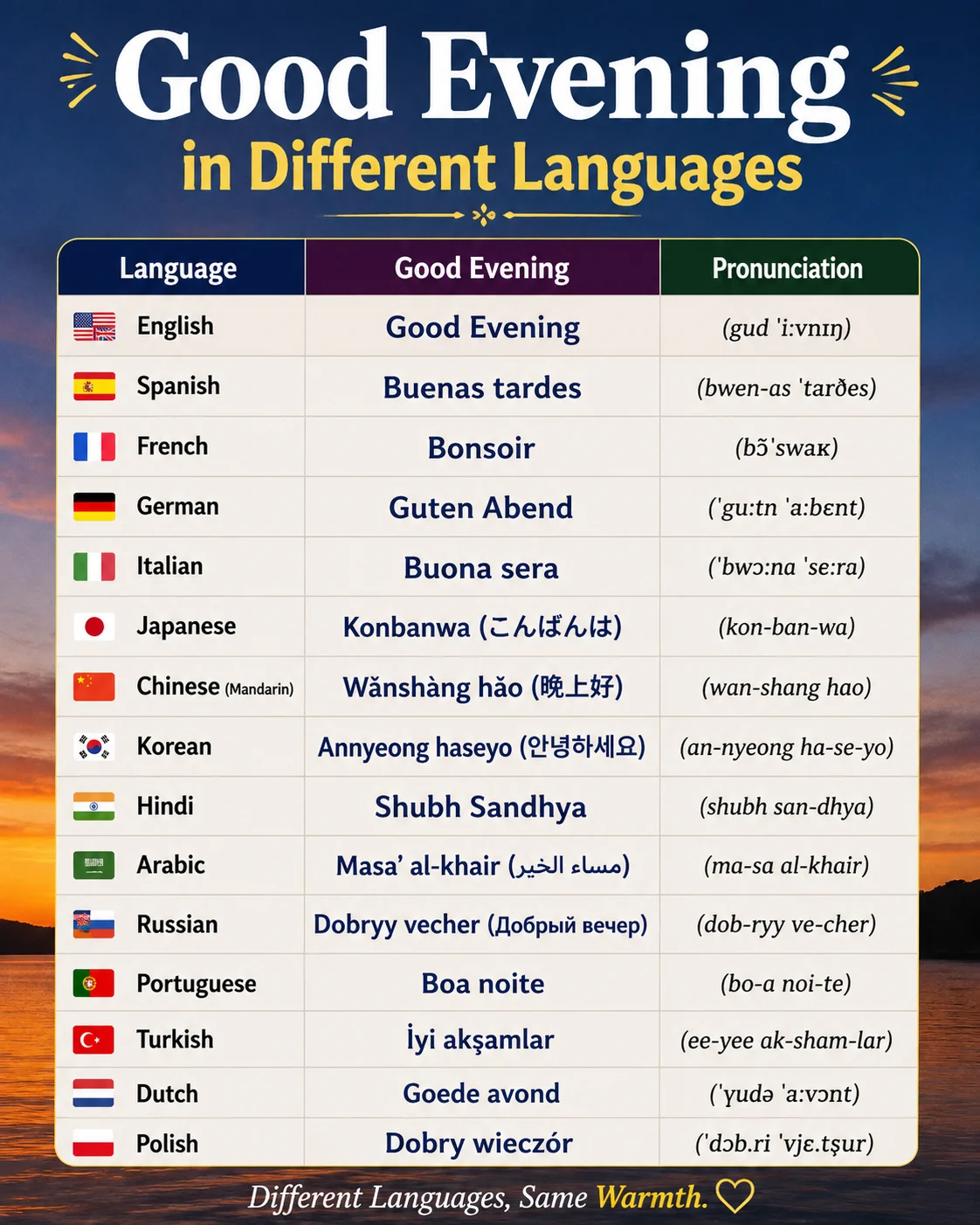
Saying good evening in different languages is a simple way to make conversations warmer, show respect, and connect with people from different cultures.
if you are traveling, learning a language, greeting international friends, or looking for good evening translations, the right phrase can make a surprisingly positive impression.
Below, you will find 70 languages, including the native phrase, an easy English pronunciation, a practical example, and the English meaning of that example.
Because cultures do not always divide the day in exactly the same way, some languages use an evening greeting that can also cover late afternoon or nighttime.
Good Evening in All Languages: 70 Translations
| # | Language | Native phrase | Easy English pronunciation | Real-life example | English meaning |
|---|---|---|---|---|---|
| 1 | English | Good evening | gud EE-vuh-ning | Good evening, everyone. | A polite evening greeting to everyone. |
| 2 | Spanish | Buenas tardes | BWEH-nas TAR-des | Buenas tardes, amigo. | Good evening, friend. |
| 3 | French | Bonsoir | bon-SWAR | Bonsoir, madame. | Good evening, ma’am. |
| 4 | German | Guten Abend | GOO-ten AH-bent | Guten Abend, Herr Müller. | Good evening, Mr. Müller. |
| 5 | Italian | Buonasera | bwo-na-SEH-ra | Buonasera, signora. | Good evening, ma’am. |
| 6 | Portuguese | Boa noite | BO-ah NOY-tchee | Boa noite a todos. | Good evening, everyone. |
| 7 | Dutch | Goedenavond | HOO-den-ah-vont | Goedenavond, allemaal. | Good evening, everyone. |
| 8 | Afrikaans | Goeienaand | KHOY-naant | Goeienaand, almal. | Good evening, everyone. |
| 9 | Swedish | God kväll | good KVEL | God kväll, vännen. | Good evening, my friend. |
| 10 | Norwegian | God kveld | good KVEL | God kveld, alle sammen. | Good evening, everyone. |
| 11 | Danish | God aften | good AF-ten | God aften, venner. | Good evening, friends. |
| 12 | Finnish | Hyvää iltaa | HOO-vaa EEL-taa | Hyvää iltaa kaikille. | Good evening, everyone. |
| 13 | Icelandic | Gott kvöld | got KVOELD | Gott kvöld, vinur. | Good evening, friend. |
| 14 | Irish | Tráthnóna maith | TRAW-no-na mah | Tráthnóna maith duit. | Good evening to you. |
| 15 | Welsh | Noswaith dda | NOS-waith dha | Noswaith dda, bawb. | Good evening, everyone. |
| 16 | Scottish Gaelic | Feasgar math | FESH-kar mah | Feasgar math, a charaid. | Good evening, friend. |
| 17 | Polish | Dobry wieczór | DOH-bry VYEH-choor | Dobry wieczór, państwu. | Good evening, everyone. |
| 18 | Czech | Dobrý večer | DOH-bree VEH-cher | Dobrý večer, pane. | Good evening, sir. |
| 19 | Slovak | Dobrý večer | DOH-bree VEH-cher | Dobrý večer, priatelia. | Good evening, friends. |
| 20 | Slovenian | Dober večer | DOH-ber VEH-cher | Dober večer, prijatelj. | Good evening, friend. |
| 21 | Croatian | Dobra večer | DOH-bra VEH-cher | Dobra večer, svima. | Good evening, everyone. |
| 22 | Serbian | Добро вече | DOH-bro VEH-che | Добро вече, пријатељу. | Good evening, friend. |
| 23 | Bosnian | Dobro veče | DOH-bro VEH-che | Dobro veče, svima. | Good evening, everyone. |
| 24 | Bulgarian | Добър вечер | DOH-bur VEH-cher | Добър вечер, приятели. | Good evening, friends. |
| 25 | Macedonian | Добра вечер | DOH-bra VEH-cher | Добра вечер, пријатели. | Good evening, friends. |
| 26 | Romanian | Bună seara | BOO-na SEH-a-ra | Bună seara, doamnă. | Good evening, ma’am. |
| 27 | Hungarian | Jó estét | yoh ESH-tate | Jó estét kívánok. | I wish you a good evening. |
| 28 | Greek | Καλησπέρα | ka-lee-SPE-ra | Καλησπέρα, φίλοι μου. | Good evening, my friends. |
| 29 | Albanian | Mirëmbrëma | meer-um-BREH-ma | Mirëmbrëma, të gjithëve. | Good evening, everyone. |
| 30 | Lithuanian | Labas vakaras | LA-bas va-KA-ras | Labas vakaras, drauge. | Good evening, friend. |
| 31 | Latvian | Labvakar | LAB-va-kar | Labvakar, draugi. | Good evening, friends. |
| 32 | Estonian | Tere õhtust | TEH-re URH-tust | Tere õhtust, kõik. | Good evening, everyone. |
| 33 | Russian | Добрый вечер | DOH-bry VEH-cher | Добрый вечер, друзья. | Good evening, friends. |
| 34 | Ukrainian | Доброго вечора | DOH-bro-ho VEH-cho-ra | Доброго вечора, друзі. | Good evening, friends. |
| 35 | Belarusian | Добры вечар | DOH-bry VEH-char | Добры вечар, сябры. | Good evening, friends. |
| 36 | Turkish | İyi akşamlar | EE-yee ak-SHAM-lar | İyi akşamlar, arkadaşlar. | Good evening, friends. |
| 37 | Azerbaijani | Axşamınız xeyir | ak-sha-muh-NUZ khay-EER | Axşamınız xeyir, dostlar. | Good evening, friends. |
| 38 | Armenian | Բարի երեկո | BA-ree ye-re-KO | Բարի երեկո, ընկերներ։ | Good evening, friends. |
| 39 | Georgian | საღამო მშვიდობისა | sa-GHA-mo mshvee-DO-bee-sa | საღამო მშვიდობისა, მეგობარო. | Good evening, friend. |
| 40 | Arabic | مساء الخير | ma-SAA al-KHAYR | مساء الخير يا أصدقاء. | Good evening, friends. |
| 41 | Hebrew | ערב טוב | EH-rev tov | ערב טוב, חברים. | Good evening, friends. |
| 42 | Persian | عصر بخیر | ASR be-KHAYR | عصر بخیر، دوستان. | Good evening, friends. |
| 43 | Urdu | شام بخیر | SHAAM ba-KHAIR | شام بخیر، دوستو۔ | Good evening, friends. |
| 44 | Hindi | शुभ संध्या | shubh SANDH-ya | शुभ संध्या, दोस्तों। | Good evening, friends. |
| 45 | Bengali | শুভ সন্ধ্যা | SHOO-bho SHOND-hya | শুভ সন্ধ্যা, বন্ধুরা। | Good evening, friends. |
| 46 | Punjabi | ਸ਼ੁਭ ਸ਼ਾਮ | shubh SHAAM | ਸ਼ੁਭ ਸ਼ਾਮ, ਦੋਸਤੋ। | Good evening, friends. |
| 47 | Gujarati | શુભ સાંજ | shubh SAANJ | શુભ સાંજ, મિત્રો. | Good evening, friends. |
| 48 | Marathi | शुभ संध्याकाळ | shubh SANDH-ya-kaal | शुभ संध्याकाळ, मित्रांनो. | Good evening, friends. |
| 49 | Nepali | शुभ साँझ | shubh SAANJ | शुभ साँझ, साथीहरू। | Good evening, friends. |
| 50 | Tamil | மாலை வணக்கம் | MAA-lai va-NAK-kam | மாலை வணக்கம், நண்பரே. | Good evening, friend. |
| 51 | Telugu | శుభ సాయంత్రం | SHU-bha saa-YAN-tram | శుభ సాయంత్రం అందరికీ. | Good evening, everyone. |
| 52 | Kannada | ಶುಭ ಸಂಜೆ | SHU-bha SAN-je | ಶುಭ ಸಂಜೆ, ಸ್ನೇಹಿತ. | Good evening, friend. |
| 53 | Malayalam | ശുഭസന്ധ്യ | SHU-bha SANDH-ya | ശുഭസന്ധ്യ, എല്ലാവർക്കും. | Good evening, everyone. |
| 54 | Sinhala | සුභ සන්ධ්යාවක් | SOO-bha SAN-dhyaa-vak | සුභ සන්ධ්යාවක්, මිතුරා. | Good evening, friend. |
| 55 | Mandarin Chinese | 晚上好 | wahn-SHANG how | 晚上好,朋友。 | Good evening, friend. |
| 56 | Cantonese | 晚上好 | maan-SEUNG hou | 晚上好,朋友。 | Good evening, friend. |
| 57 | Japanese | こんばんは | kon-BAHN-wa | こんばんは、先生。 | Good evening, teacher. |
| 58 | Korean | 안녕하세요 | an-nyeong-ha-SE-yo | 안녕하세요, 여러분. | Good evening, everyone. |
| 59 | Thai | สวัสดีตอนเย็น | sa-wat-DEE ton yen | สวัสดีตอนเย็นครับ | Good evening. |
| 60 | Vietnamese | Chào buổi tối | chow boo-oy TOY | Chào buổi tối, bạn. | Good evening, friend. |
| 61 | Indonesian | Selamat sore | se-LA-mat SO-re | Selamat sore, semuanya. | Good evening, everyone. |
| 62 | Malay | Selamat petang | se-LA-mat pe-TANG | Selamat petang, kawan. | Good evening, friend. |
| 63 | Filipino (Tagalog) | Magandang gabi | ma-GAN-dang GA-bi | Magandang gabi po. | Good evening, respectfully. |
| 64 | Swahili | Habari ya jioni | ha-BA-ri ya jee-O-ni | Habari ya jioni, rafiki. | Good evening, friend. |
| 65 | Zulu | Sawubona kusihlwa | sa-woo-BO-na koo-SEEL-hlwa | Sawubona kusihlwa, mngane. | Good evening, friend. |
| 66 | Somali | Fiid wanaagsan | feed wa-na-GAN | Fiid wanaagsan, saaxiib. | Good evening, friend. |
| 67 | Amharic | መልካም ምሽት | mel-KAM mish-it | መልካም ምሽት፣ ጓደኛዬ። | Good evening, my friend. |
| 68 | Hausa | Barka da yamma | BAR-ka da YAM-ma | Barka da yamma, abokina. | Good evening, my friend. |
| 69 | Yoruba | Ẹ kú alẹ́ | eh koo a-LEH | Ẹ kú alẹ́, ọ̀rẹ́ mi. | Good evening, my friend. |
| 70 | Igbo | Mgbede ọma | mg-BEH-deh OH-ma | Mgbede ọma, enyi m. | Good evening, my friend. |
The wording above reflects common evening greetings, but the exact time at which an evening greeting becomes natural varies by language and culture. For example, Spanish can use buenas tardes for a period that English speakers may already consider evening, while languages such as Japanese use a dedicated evening greeting.
How to Say Good Evening in Different Languages
The easiest way to learn how to say good evening in different languages is to start with the pronunciation and then practice the phrase in a complete sentence.
For example:
- French: Bonsoir
- German: Guten Abend
- Italian: Buonasera
- Arabic: مساء الخير
- Japanese: こんばんは
- Mandarin: 晚上好
- Urdu: شام بخیر
- Spanish: Buenas tardes
Learning the complete greeting rather than memorizing an isolated translation also makes it easier to use naturally in conversation.
Good Evening Around the World: What Changes by Culture?
A direct word-for-word translation is not always the phrase native speakers would actually use. In some languages, the same expression can cover late afternoon and evening. In others, an evening greeting may be closer to “hello” than a literal translation of “good evening.”
This is especially important when learning greetings for travel or business. A phrase can be grammatically correct but sound overly formal, old-fashioned, or unusual in everyday conversation.
For example, শুভ সন্ধ্যা in Bengali and शुभ संध्या in Hindi are recognizable evening greetings, but everyday speakers may also use more general greetings depending on the situation. Likewise, Korean commonly uses 안녕하세요 as a greeting rather than relying on a separate phrase equivalent to English “good evening.”
Formal and Informal Good Evening Greetings
The situation matters just as much as the language.
For a formal setting, such as meeting a client, teacher, older person, or professional group, choose the standard polite greeting. In casual situations, a shorter or more general greeting may sound more natural.
A useful rule is:
When in doubt, use the standard polite form first.
You can then listen to how native speakers respond and adapt your style to the conversation.
Good Evening Translations for Travel and Daily Conversation
These good evening translations are particularly useful when traveling because greetings are often the first words exchanged with hotel staff, restaurant workers, colleagues, guides, or new friends.
Before using a phrase, remember three things:
- Pronunciation matters. Even an imperfect accent is usually appreciated when the greeting is sincere.
- Timing matters. The definition of “evening” differs between cultures.
- Formality matters. Some greetings have formal and informal variations.
If you are unsure, start with the pronunciation shown in the table and use a friendly, respectful tone.
Good Evening in All Languages: Quick Favorites to Learn First
If memorizing all 70 languages feels like too much, start with these widely useful greetings:
- French: Bonsoir
- German: Guten Abend
- Italian: Buonasera
- Spanish: Buenas tardes
- Portuguese: Boa noite
- Dutch: Goedenavond
- Russian: Добрый вечер
- Arabic: مساء الخير
- Turkish: İyi akşamlar
- Japanese: こんばんは
- Mandarin: 晚上好
- Korean: 안녕하세요
- Hindi: शुभ संध्या
- Urdu: شام بخیر
- Swahili: Habari ya jioni
These provide a useful starting point for travelers, students, language learners, and anyone who wants to greet people around the world more confidently.
Why Learning Evening Greetings Is Useful
Learning a simple greeting can do more than help you communicate. It shows that you have made an effort to understand another language and culture.
Even one correctly pronounced phrase can help break the ice in a conversation. It can also make introductions, dinners, meetings, travel experiences, and online conversations feel more personal.
That is why learning good evening around the world is a small but practical language skill.
Frequently Asked Questions
1. How do you say good evening in different languages?
The phrase depends on the language. For example, French uses Bonsoir, German uses Guten Abend, Italian uses Buonasera, Arabic uses مساء الخير, Japanese uses こんばんは, and Mandarin Chinese uses 晚上好.
2. What is the most common translation of good evening?
There is no single worldwide translation. Common examples include Bonsoir in French, Guten Abend in German, Buonasera in Italian, and God kväll in Swedish. Some languages use a broader greeting rather than a direct word-for-word equivalent.
3. Is good evening the same as good night in every language?
No. In many languages, the evening greeting and nighttime farewell are different. For example, French uses Bonsoir as an evening greeting but Bonne nuit when wishing someone good night. Spanish also distinguishes between greetings and nighttime expressions depending on context.
4. What is good evening in Urdu?
In Urdu, شام بخیر is a common way to say “good evening.” It is pronounced approximately shaam ba-khair and can be used as a polite evening greeting.
5. Why are good evening translations different from one language to another?
Languages divide the day differently, and cultures have their own greeting conventions. Some languages use a phrase specifically for evening, while others use an afternoon, nighttime, or general greeting during the same period.
Conclusion
Learning good evening in different languages is an easy way to improve your communication skills and show respect for other cultures.
From Bonsoir in French to こんばんは in Japanese and شام بخیر in Urdu, each greeting offers a simple opportunity to connect.
The most important thing is not perfect pronunciation. It is using the right phrase at the right time and with genuine respect.
Keep this list of 70 good evening translations handy, practice a few phrases regularly, and you will be ready to greet people around the world with confidence.

I am Jimmy Michael, a language enthusiast and writer passionate about exploring different languages, words, and cultures. I create simple, useful content that helps readers understand languages better and discover new ways to communicate globally.