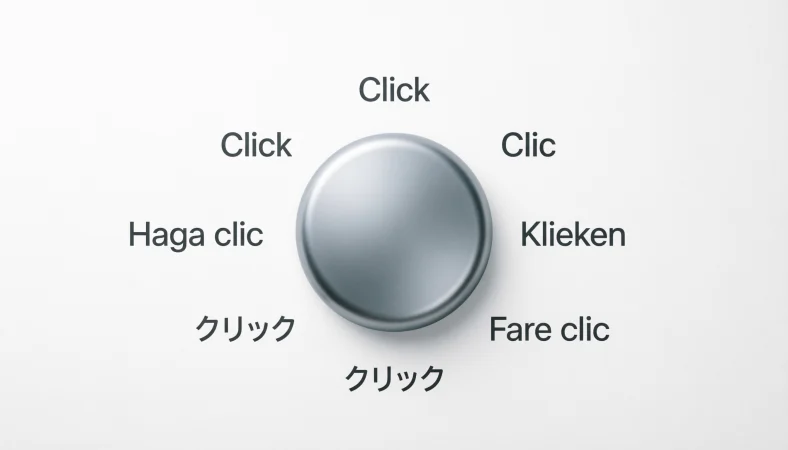
If you want to know how to say “click” in different languages, you are in the right place. The word is commonly used when talking about computers, websites, buttons, links, apps, and everyday actions.
While many languages use a word similar to the English “click,” others use a native verb meaning “press,” “tap,” or “select.”
This guide gives you click in all languages in one easy-to-read table, including the native phrase, simple English pronunciation, a practical example, and the English meaning.
It is useful for language learners, travelers, website creators, multilingual writers, and anyone searching for click translations.
Click in Different Languages: 70 Translations
The translations below focus mainly on the computer or button action of clicking. In some languages, the most natural expression can change depending on whether you are talking about a mouse, touchscreen, button, link, or a clicking sound.
| # | Language | Native phrase | Easy English pronunciation | Example sentence | English meaning |
|---|---|---|---|---|---|
| 1 | English | Click | klik | Click the button. | Click the button. |
| 2 | Spanish | hacer clic | ah-SEHR kleek | Haz clic en el enlace. | Click the link. |
| 3 | French | cliquer | klee-KAY | Cliquez sur le bouton. | Click the button. |
| 4 | German | klicken | KLIK-en | Klicken Sie hier. | Click here. |
| 5 | Italian | cliccare | klee-KAH-reh | Clicca sul link. | Click the link. |
| 6 | Portuguese | clicar | klee-KAR | Clique no botão. | Click the button. |
| 7 | Dutch | klikken | KLIK-en | Klik hier. | Click here. |
| 8 | Swedish | klicka | KLIK-ah | Klicka på länken. | Click the link. |
| 9 | Norwegian | klikk | klik | Klikk her. | Click here. |
| 10 | Danish | klik | klik | Klik på knappen. | Click the button. |
| 11 | Finnish | klikata | KLEE-kah-tah | Klikkaa tästä. | Click here. |
| 12 | Icelandic | smellur | SMEH-tlur | Smelltu á hnappinn. | Click the button. |
| 13 | Irish | cliceáil | KLIKH-ayl | Cliceáil anseo. | Click here. |
| 14 | Welsh | cliciwch | KLIK-yoogh | Cliciwch yma. | Click here. |
| 15 | Polish | kliknij | KLEEK-neey | Kliknij tutaj. | Click here. |
| 16 | Czech | klikněte | KLIK-nyeh-teh | Klikněte zde. | Click here. |
| 17 | Slovak | kliknite | KLIK-nee-teh | Kliknite sem. | Click here. |
| 18 | Slovenian | kliknite | KLIK-nee-teh | Kliknite tukaj. | Click here. |
| 19 | Croatian | klik | klik | Kliknite ovdje. | Click here. |
| 20 | Serbian | клик | kleek | Кликните овде. | Click here. |
| 21 | Bosnian | kliknite | KLIK-nee-teh | Kliknite ovdje. | Click here. |
| 22 | Bulgarian | щракнете | shrahk-NEH-teh | Щракнете тук. | Click here. |
| 23 | Macedonian | кликнете | KLIK-neh-teh | Кликнете овде. | Click here. |
| 24 | Romanian | a da clic | ah dah kleek | Dați clic aici. | Click here. |
| 25 | Hungarian | kattintson | KAT-chint-shon | Kattintson ide. | Click here. |
| 26 | Albanian | klikoni | klee-KOH-nee | Klikoni këtu. | Click here. |
| 27 | Greek | Κάντε κλικ | KAN-teh kleek | Κάντε κλικ εδώ. | Click here. |
| 28 | Russian | нажмите | nah-ZHMEE-teh | Нажмите здесь. | Click here. |
| 29 | Ukrainian | натисніть | nah-tyse-NEET | Натисніть тут. | Click here. |
| 30 | Belarusian | націсніце | nah-TSIS-nee-tseh | Націсніце тут. | Click here. |
| 31 | Lithuanian | spustelėkite | spoos-teh-LYAY-kee-teh | Spustelėkite čia. | Click here. |
| 32 | Latvian | klikšķiniet | KLIK-shkee-nee-et | Klikšķiniet šeit. | Click here. |
| 33 | Estonian | klõpsa | KLUHP-sah | Klõpsa siia. | Click here. |
| 34 | Turkish | tıklamak | TUHK-lah-mahk | Buraya tıklayın. | Click here. |
| 35 | Azerbaijani | basın | bah-SUHN | Buraya basın. | Press here. |
| 36 | Armenian | սեղմել | seh-GHMEL | Սեղմեք այստեղ։ | Click here. |
| 37 | Georgian | დააწკაპუნეთ | dah-ats-kah-POO-net | დააწკაპუნეთ აქ. | Click here. |
| 38 | Hebrew | נְקִישָׁה | neh-kee-SHAH | לחץ כאן. | Click here. |
| 39 | Arabic | انقر | IN-kar | انقر هنا. | Click here. |
| 40 | Persian | کلیک | keh-LEEK | روی اینجا کلیک کنید. | Click here. |
| 41 | Urdu | کلک کریں | KLIK ka-REEN | یہاں کلک کریں۔ | Click here. |
| 42 | Hindi | क्लिक करें | KLIK ka-REN | यहाँ क्लिक करें। | Click here. |
| 43 | Bengali | ক্লিক করুন | KLIK koo-roon | এখানে ক্লিক করুন। | Click here. |
| 44 | Punjabi | ਕਲਿੱਕ ਕਰੋ | KLIK ka-roh | ਇੱਥੇ ਕਲਿੱਕ ਕਰੋ। | Click here. |
| 45 | Gujarati | ક્લિક કરો | KLIK ka-roh | અહીં ક્લિક કરો. | Click here. |
| 46 | Marathi | क्लिक करा | KLIK ka-RAH | येथे क्लिक करा. | Click here. |
| 47 | Nepali | क्लिक गर्नुहोस् | KLIK gar-noo-hos | यहाँ क्लिक गर्नुहोस्। | Click here. |
| 48 | Sinhala | ක්ලික් කරන්න | KLIK kar-anna | මෙහි ක්ලික් කරන්න. | Click here. |
| 49 | Tamil | கிளிக் செய்யவும் | KLIK sey-ya-vum | இங்கே கிளிக் செய்யவும். | Click here. |
| 50 | Telugu | క్లిక్ చేయండి | KLIK chey-yan-dee | ఇక్కడ క్లిక్ చేయండి. | Click here. |
| 51 | Kannada | ಕ್ಲಿಕ್ ಮಾಡಿ | KLIK maa-dee | ಇಲ್ಲಿ ಕ್ಲಿಕ್ ಮಾಡಿ. | Click here. |
| 52 | Malayalam | ക്ലിക്ക് ചെയ്യുക | KLIK chey-yoo-kah | ഇവിടെ ക്ലിക്ക് ചെയ്യുക. | Click here. |
| 53 | Thai | คลิก | klik | คลิกที่นี่ | Click here. |
| 54 | Vietnamese | nhấp chuột | nyap choot | Nhấp chuột vào đây. | Click here. |
| 55 | Indonesian | klik | klik | Klik di sini. | Click here. |
| 56 | Malay | klik | klik | Klik di sini. | Click here. |
| 57 | Filipino | i-click | ee-KLIK | I-click ang button. | Click the button. |
| 58 | Chinese (Simplified) | 点击 | diǎn jī | 点击这里。 | Click here. |
| 59 | Japanese | クリックする | koo-RIK-koo soo-roo | ここをクリックしてください。 | Please click here. |
| 60 | Korean | 클릭하다 | keul-LEEK-ha-da | 여기를 클릭하세요. | Click here. |
| 61 | Mongolian | дарна уу | DAR-nah oo | Энд дарна уу. | Click here. |
| 62 | Kazakh | басыңыз | bah-SUH-nguz | Мұнда басыңыз. | Click here. |
| 63 | Uzbek | bosing | BOH-sing | Bu yerga bosing. | Click here. |
| 64 | Kyrgyz | чыкылдатыңыз | chuh-kul-dah-ting-iz | Бул жерди чыкылдатыңыз. | Click here. |
| 65 | Swahili | bonyeza | bohn-YEH-zah | Bofya hapa. | Click here. |
| 66 | Zulu | chofoza | cho-FOH-zah | Chofoza lapha. | Click here. |
| 67 | Xhosa | cofa | KOH-fah | Cofa apha. | Click here. |
| 68 | Afrikaans | klik | klik | Klik hier. | Click here. |
| 69 | Amharic | ጠቅ ያድርጉ | tek yah-dur-goo | እዚህ ጠቅ ያድርጉ። | Click here. |
| 70 | Hausa | danna | DAN-nah | Danna nan. | Click here. |
How to Say “Click” in Different Languages
There is no single universal translation for “click.” The best word depends on the context.
For websites and computer interfaces, languages often use a borrowed form of the English word. Examples include clic, klik, and klick. Other languages use a native expression closer to press, tap, or select.
For example, Spanish commonly uses hacer clic, while French uses cliquer. German uses klicken, Italian uses cliccare, and Portuguese uses clicar.
This is why a literal dictionary translation is not always the most natural choice for a real website instruction.
“Click” in All Languages: What Does It Mean?
In everyday technology, “click” usually means pressing a mouse button to activate something on a computer. The same idea can also apply to selecting a link, opening a menu, confirming an option, or activating a button.
On smartphones and tablets, tap is often more natural than click because users interact directly with a touchscreen. However, many digital interfaces still use terminology derived from “click.”
The word can also describe a short, sharp sound. That meaning is different from the computer-related action and may require a completely different translation.
Click Translations for Websites and Apps
If you are translating a website, application, tutorial, or digital advertisement, context matters.
A button labeled “Click Here” may need an imperative expression rather than a direct dictionary translation. Likewise, “click the link,” “click the icon,” and “double-click the file” can require different grammatical forms.
For multilingual websites, the safest approach is to translate the complete instruction naturally rather than translating the word click by itself.
Click Around the World
The table shows how widely the concept of clicking is represented across languages. Many European languages use words that sound similar to English because computer terminology has spread internationally.
In other regions, native verbs meaning “press” or “select” can be more natural. Asian and African languages demonstrate particularly useful examples of how the same digital action can be expressed in different ways.
Knowing these differences can help when creating multilingual instructions, software interfaces, educational material, or international marketing content.
Why Learning “Click” in Different Languages Is Useful
Learning a simple technology word can be surprisingly practical.
- Language learning: It introduces useful vocabulary for everyday digital conversations.
- Travel: It can help when using websites, ticket machines, maps, and public information systems.
- Technology: It makes computer instructions easier to understand in another language.
- Localization: It helps writers create more natural multilingual website instructions.
- Communication: It provides useful vocabulary for explaining apps, links, buttons, and online services.
Frequently Asked Questions
1. How do you say “click” in different languages?
“Click” has different translations depending on the language and context. Common examples include hacer clic in Spanish, cliquer in French, klicken in German, cliccare in Italian, 点击 in Chinese, and クリックする in Japanese.
2. What is “click” in Spanish?
The common computer-related expression is hacer clic. For example, “Haz clic en el enlace” means “Click the link.”
3. What is “click” in French?
The computer verb is cliquer. A common instruction is Cliquez sur le bouton, meaning “Click the button.”
4. What is “click” in Chinese?
In Simplified Chinese, the common computer term is 点击 (diǎn jī). It is used for actions such as clicking a button, link, or menu item.
5. Why are “click” translations different between languages?
Languages use different grammatical structures and vocabulary for the same action. Some borrow the English technology term, while others use words meaning “press,” “tap,” or “select.” The most natural translation therefore depends on the language and situation.
Conclusion
Learning click in different languages is a simple way to expand practical vocabulary for technology and everyday communication. Although many languages have adopted a word similar to “click,” others use native expressions that describe pressing, selecting, or activating something.
For accurate click translations, always consider the context. A natural translation for a computer button may not be the same as the word used for a clicking sound or a touchscreen action.

I am Jimmy Michael, a language enthusiast and writer passionate about exploring different languages, words, and cultures. I create simple, useful content that helps readers understand languages better and discover new ways to communicate globally.