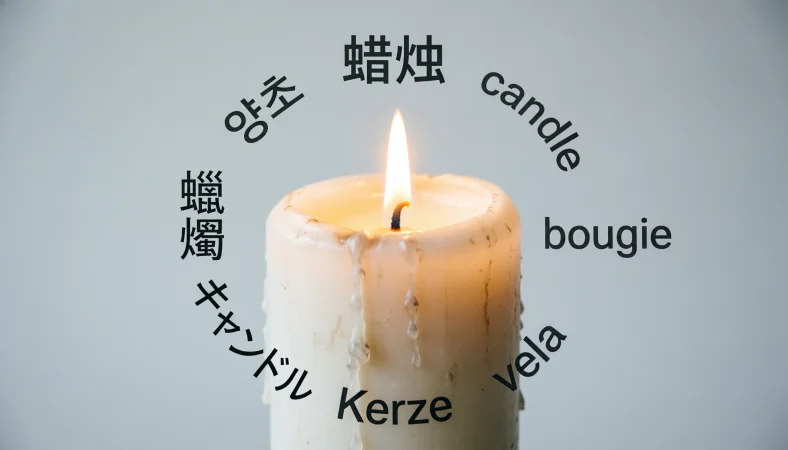
A candle is a simple object with a surprisingly rich vocabulary across cultures. if you are learning languages, creating multilingual content.
choosing a meaningful name, or simply curious about world languages, knowing the word for candle in different languages is a useful place to start.
Below, you will find 70 candle translations from languages spoken across Europe, Asia, Africa, the Middle East, and the Americas.
Each entry includes the native word or phrase, an easy English pronunciation, a short everyday example, and its English meaning.
Candle in All Languages
The table below answers the common search query “how to say candle in different languages” while also showing how the word naturally appears in a sentence.
| # | Language | Native phrase | Easy English pronunciation | Example sentence | English meaning |
|---|---|---|---|---|---|
| 1 | English | candle | KAN-dəl | I lit a candle. | I lit a candle. |
| 2 | Spanish | vela | VEH-lah | Encendí una vela. | I lit a candle. |
| 3 | French | bougie | BOO-zhee | J’allume une bougie. | I light a candle. |
| 4 | German | Kerze | KAIR-tsuh | Ich zünde eine Kerze an. | I light a candle. |
| 5 | Italian | candela | kan-DEH-lah | Accendo una candela. | I light a candle. |
| 6 | Portuguese | vela | VEH-lah | Acendi uma vela. | I lit a candle. |
| 7 | Dutch | kaars | KAHRSS | Ik steek een kaars aan. | I light a candle. |
| 8 | Swedish | ljus | YOOS | Jag tänder ett ljus. | I light a candle. |
| 9 | Danish | lys | LOOSE | Jeg tænder et lys. | I light a candle. |
| 10 | Norwegian | lys | LOOSE | Jeg tenner et lys. | I light a candle. |
| 11 | Finnish | kynttilä | KÜN-tee-lah | Sytytän kynttilän. | I light a candle. |
| 12 | Icelandic | kerti | KER-ti | Ég kveiki á kerti. | I light a candle. |
| 13 | Irish | coinneal | KIN-yəl | Las mé coinneal. | I lit a candle. |
| 14 | Welsh | cannwyll | KAN-will | Rwy’n cynnau cannwyll. | I light a candle. |
| 15 | Scottish Gaelic | coinnle | KOIN-lyuh | Las mi coinnle. | I lit a candle. |
| 16 | Latin | candela | kan-DEH-lah | Candela ardet. | The candle is burning. |
| 17 | Greek | κερί | keh-REE | Ανάβω ένα κερί. | I light a candle. |
| 18 | Russian | свеча | svyeh-CHA | Я зажигаю свечу. | I light a candle. |
| 19 | Ukrainian | свічка | SVEECH-kah | Я запалюю свічку. | I light a candle. |
| 20 | Polish | świeca | SHVYEH-tsah | Zapalam świecę. | I light a candle. |
| 21 | Czech | svíčka | SVEECH-kah | Zapaluji svíčku. | I light a candle. |
| 22 | Slovak | sviečka | SVYECH-kah | Zapálim sviečku. | I light a candle. |
| 23 | Slovenian | sveča | SVEH-chah | Prižgem svečo. | I light a candle. |
| 24 | Croatian | svijeća | SVYAY-chah | Palim svijeću. | I light a candle. |
| 25 | Serbian | свећа | SVEH-cha | Палимо свећу. | We light a candle. |
| 26 | Bulgarian | свещ | SVESH | Запалих свещ. | I lit a candle. |
| 27 | Macedonian | свеќа | SVEH-kyah | Запалив свеќа. | I lit a candle. |
| 28 | Romanian | lumânare | loo-muh-NAH-reh | Aprind o lumânare. | I light a candle. |
| 29 | Hungarian | gyertya | DYER-tyah | Meggyújtok egy gyertyát. | I light a candle. |
| 30 | Albanian | qiri | CHEE-ree | Ndez një qiri. | I light a candle. |
| 31 | Armenian | մոմ | MOM | Ես մոմ եմ վառում։ | I light a candle. |
| 32 | Georgian | სანთელი | SAN-teh-lee | სანთელს ვანთებ. | I light a candle. |
| 33 | Turkish | mum | MOOM | Bir mum yakıyorum. | I am lighting a candle. |
| 34 | Azerbaijani | şam | SHAHM | Mən şam yandırıram. | I am lighting a candle. |
| 35 | Persian | شمع | SHAM | من یک شمع روشن میکنم. | I light a candle. |
| 36 | Arabic | شمعة | SHAM-ah | أشعل شمعة. | I light a candle. |
| 37 | Hebrew | נר | NAIR | אני מדליק נר. | I light a candle. |
| 38 | Hindi | मोमबत्ती | mohm-BUT-tee | मैंने मोमबत्ती जलाई। | I lit a candle. |
| 39 | Urdu | موم بتی | MOHM-bat-tee | میں نے موم بتی جلائی۔ | I lit a candle. |
| 40 | Bengali | মোমবাতি | moh-muh-BAH-tee | আমি একটি মোমবাতি জ্বালাই। | I light a candle. |
| 41 | Punjabi | ਮੋਮਬੱਤੀ | MOHM-but-tee | ਮੈਂ ਮੋਮਬੱਤੀ ਜਗਾਈ। | I lit a candle. |
| 42 | Gujarati | મીણબત્તી | MEEN-but-tee | મેં મીણબત્તી પ્રગટાવી. | I lit a candle. |
| 43 | Marathi | मेणबत्ती | MAYN-but-tee | मी मेणबत्ती लावली. | I lit a candle. |
| 44 | Nepali | मैनबत्ती | MAIN-but-tee | मैले मैनबत्ती बालें। | I lit a candle. |
| 45 | Sinhala | ඉටිපන්දම | ee-tee-PAN-dah-ma | මම ඉටිපන්දමක් දැල්වුවා. | I lit a candle. |
| 46 | Tamil | மெழுகுவர்த்தி | meh-loo-goo-VAR-thee | நான் மெழுகுவர்த்தியை ஏற்றினேன். | I lit a candle. |
| 47 | Telugu | కొవ్వొత్తి | KOV-voht-tee | నేను కొవ్వొత్తి వెలిగించాను. | I lit a candle. |
| 48 | Kannada | ಮೇಣದಬತ್ತಿ | MAY-na-da-BUT-tee | ನಾನು ಮೇಣದಬತ್ತಿ ಹಚ್ಚಿದೆ. | I lit a candle. |
| 49 | Malayalam | മെഴുകുതിരി | meh-zhoo-goo-TEE-ree | ഞാൻ മെഴുകുതിരി കത്തിച്ചു. | I lit a candle. |
| 50 | Odia | ମହମବତୀ | moh-hom-boh-TEE | ମୁଁ ମହମବତୀ ଜାଳାଇଲି। | I lit a candle. |
| 51 | Chinese (Mandarin) | 蜡烛 | làzhú | 我点了一根蜡烛。 | I lit a candle. |
| 52 | Japanese | ろうそく | rōsoku | ろうそくに火をつけました。 | I lit a candle. |
| 53 | Korean | 양초 | yang-cho | 양초에 불을 켰어요. | I lit a candle. |
| 54 | Vietnamese | nến | nen | Tôi thắp một cây nến. | I light a candle. |
| 55 | Thai | เทียน | thian | ฉันจุดเทียน | I light a candle. |
| 56 | Indonesian | lilin | LEE-lin | Saya menyalakan lilin. | I light a candle. |
| 57 | Malay | lilin | LEE-lin | Saya menyalakan lilin. | I light a candle. |
| 58 | Filipino | kandila | kan-DEE-lah | Nagsindi ako ng kandila. | I lit a candle. |
| 59 | Javanese | lilin | LEE-lin | Aku nyumet lilin. | I light a candle. |
| 60 | Khmer | ទៀន | tee-en | ខ្ញុំអុជទៀនមួយ។ | I light a candle. |
| 61 | Burmese | ဖယောင်းတိုင် | pah-YAUNG-dine | ကျွန်တော် ဖယောင်းတိုင် ထွန်းတယ်။ | I light a candle. |
| 62 | Mongolian | лаа | LAA | Би лаа асаалаа. | I lit a candle. |
| 63 | Kazakh | шам | SHAM | Мен шам жақтым. | I lit a candle. |
| 64 | Swahili | mshumaa | m-shoo-MAA | Nimewasha mshumaa. | I have lit a candle. |
| 65 | Amharic | ሻማ | SHA-ma | ሻማ አበራሁ። | I lit a candle. |
| 66 | Somali | shumac | SHOO-mak | Waxaan shiday shumac. | I lit a candle. |
| 67 | Afrikaans | kers | KERS | Ek steek ‘n kers aan. | I light a candle. |
| 68 | Zulu | ikhandlela | ee-KHAN-dleh-lah | Ngikhanyisa ikhandlela. | I light a candle. |
| 69 | Haitian Creole | bouji | BOO-zhee | Mwen limen yon bouji. | I light a candle. |
| 70 | Esperanto | kandelo | kan-DEH-loh | Mi ekbruligas kandelon. | I light a candle. |
How to Say Candle in Different Languages
The English word candle has many unrelated equivalents because languages developed their own vocabulary for candles, wax, flames, and lighting traditions.
Some words are particularly easy to recognize across languages. For example, vela is used in both Spanish and Portuguese, while lilin appears in Indonesian and Malay. The French bougie is also the source of related vocabulary in Haitian Creole.
In other languages, the word looks completely different. Mandarin uses 蜡烛, Japanese uses ろうそく, Korean uses 양초, Arabic uses شمعة, and Hindi uses मोमबत्ती.
This variety makes candle translations useful for language learners and anyone researching words associated with light, celebration, remembrance, and home decoration.
Candle Translations Around the World
The word for candle often appears in everyday situations. People light candles during birthdays, religious ceremonies, power outages, romantic dinners, memorials, festivals, and quiet evenings at home.
The surrounding vocabulary can also change depending on the culture. A translation may refer specifically to a wax candle, a traditional candle.r simply an object used for producing light. That is why direct word-for-word translation is not always enough when learning a new language.
For practical communication, it is helpful to learn the candle translation together with a simple sentence, such as “I lit a candle” or “The candle is burning.”
Candle Vocabulary for Language Learners
If you are learning a new language, remember that the noun is only the starting point. Useful related expressions include:
- light a candle
- blow out a candle
- candle flame
- scented candle
- birthday candle
- candle holder
- candle wax
- candlelight
- burn a candle
- buy a candle
Learning these phrases alongside the main noun can make it easier to use the word naturally in conversation.
Why Candles Have Different Names
Languages do not necessarily share the same historical roots. Words for everyday objects can develop independently or enter a language through cultural contact.
The word candle itself has a long history in English and is connected with older terms for light-producing objects. Other languages have developed their own words based on local linguistic history, materials, or borrowed vocabulary.
This is why candle in all languages does not produce one universal word. Instead, it reveals how different languages describe the same familiar object.
Candle Around the World: Cultural Uses
Candles have practical and symbolic uses worldwide. They can provide light when electricity is unavailable, create a warm atmosphere at home, mark birthdays, and form part of religious or cultural ceremonies.
In many communities, candlelight is also associated with remembrance and reflection. During celebrations, a candle may represent joy or a special milestone. In quieter settings, it can create a sense of calm.
The object is simple, but its cultural meanings can be much broader than its dictionary definition.
Tips for Using Candle Translations Correctly
When using a foreign-language word for candle, consider the context. A dictionary translation may identify the noun, but a natural sentence may require a particular verb or grammatical form.
Pronunciation is another important point. The English pronunciation guides in the table are intentionally simplified for English speakers. They are useful starting points, but they do not reproduce every sound or accent perfectly.
For serious language study, it is best to learn the word together with native examples and the grammatical rules of the target language.
Frequently Asked Questions
1. What is the word for candle in different languages?
There are many different words for candle. Examples include vela in Spanish, bougie in French, Kerze in German, candela in Italian, 蜡烛 in Mandarin Chinese, ろうそく in Japanese, 양초 in Korean, and شمعة in Arabic.
2. How do you say candle in Spanish?
In Spanish, candle is vela. For example, “Encendí una vela” means “I lit a candle.”
3. What is candle called in Hindi and Urdu?
In Hindi, candle is मोमबत्ती (mombatti). In Urdu, it is commonly written موم بتی (mom batti).
4. Which languages use a word similar to candle?
Several languages have historically related words or words influenced by similar linguistic roots. Italian candela and Latin candela are closely related, while English candle developed from the same broader Latin-root family through historical linguistic changes.
5. Why is the word candle different in every language?
Languages develop independently and borrow words from other languages at different points in history. Cultural contact, pronunciation changes, and local vocabulary all influence how an everyday object such as a candle is named.
Conclusion
Learning the word candle in different languages is a simple way to explore global vocabulary and culture.
From vela in Spanish to 蜡烛 in Mandarin and mshumaa in Swahili, the 70 translations above show how one familiar object can have remarkably different names around the world.
For language learners, the most useful approach is to remember each translation with a short, natural sentence.
That makes the vocabulary easier to recognize, pronounce, and use in real-life conversations.

I am Jimmy Michael, a language enthusiast and writer passionate about exploring different languages, words, and cultures. I create simple, useful content that helps readers understand languages better and discover new ways to communicate globally.