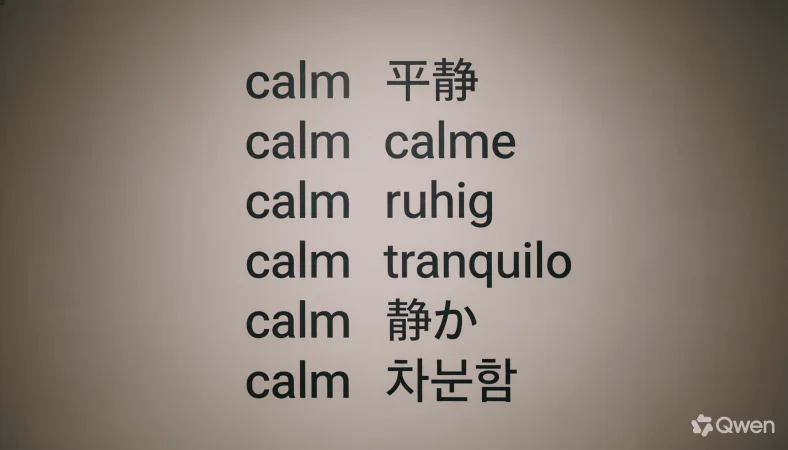
The word calm expresses peace, emotional balance, stillness, and freedom from worry. But the exact word used to describe a calm person, a peaceful place, or still weather can change from one language to another.
If you are looking for calm in different languages, this guide gives you 70 useful translations with native phrases, easy English pronunciation, practical example sentences, and their English meanings.
if you are learning a language, writing a message, choosing a meaningful word, or simply exploring how people express peace around the world, these translations provide a helpful starting point.
Calm in All Languages: 70 Translations
The table below focuses mainly on the adjective or everyday expression used for being calm, peaceful, composed, or tranquil. Some languages change the form according to gender, number, or context.
| # | Language | Native phrase | Easy English pronunciation | Real-life example | English meaning |
|---|---|---|---|---|---|
| 1 | English | calm | kahm | Stay calm during the meeting. | Stay peaceful and composed during the meeting. |
| 2 | Spanish | tranquilo / tranquila | trahn-KEE-loh / trahn-KEE-lah | Estoy tranquilo ahora. | I am calm now. |
| 3 | French | calme | kahlm | Je reste calme. | I remain calm. |
| 4 | German | ruhig | ROO-ikh | Bleib ruhig. | Stay calm. |
| 5 | Italian | calmo / calma | KAHL-moh / KAHL-mah | Rimani calmo. | Stay calm. |
| 6 | Portuguese | calmo / calma | KAHL-moh / KAHL-mah | Fique calmo. | Stay calm. |
| 7 | Dutch | kalm | kahlm | Blijf kalm. | Stay calm. |
| 8 | Afrikaans | kalm | kahlm | Bly kalm. | Stay calm. |
| 9 | Swedish | lugn | loong | Var lugn. | Stay calm. |
| 10 | Norwegian | rolig | ROO-lee | Vær rolig. | Be calm. |
| 11 | Danish | rolig | ROH-lee | Vær rolig. | Be calm. |
| 12 | Finnish | rauhallinen | ROW-hah-lee-nen | Ole rauhallinen. | Be calm. |
| 13 | Icelandic | rólegur / róleg | ROH-leh-gur / ROH-leh | Vertu rólegur. | Stay calm. |
| 14 | Irish | ciúin | KYOO-in | Fan ciúin. | Stay quiet and calm. |
| 15 | Welsh | tawel | TOW-el | Mae’r môr yn dawel. | The sea is calm. |
| 16 | Scottish Gaelic | socair | SOH-kir | Bí socair. | Be calm. |
| 17 | Polish | spokojny / spokojna | spoh-KOY-nih / spoh-KOY-nah | Zachowaj spokój. | Keep calm. |
| 18 | Czech | klidný / klidná | KLEED-nih / KLEED-nah | Zůstaň klidný. | Stay calm. |
| 19 | Slovak | pokojný / pokojná | poh-KOY-nih / poh-KOY-nah | Zostaň pokojný. | Stay calm. |
| 20 | Slovenian | miren / mirna | MEE-ren / MEER-nah | Ostani miren. | Stay calm. |
| 21 | Croatian | miran / mirna | MEE-rahn / MEER-nah | Ostani miran. | Stay calm. |
| 22 | Serbian | miran / мирan | MEE-rahn | Ostani miran. | Stay calm. |
| 23 | Bosnian | miran / mirna | MEE-rahn / MEER-nah | Ostani miran. | Stay calm. |
| 24 | Bulgarian | спокоен / спокойна | spoh-KOH-en / spoh-KOH-nah | Остани спокоен. | Stay calm. |
| 25 | Macedonian | мирен / мирна | MEE-ren / MEER-nah | Остани мирен. | Stay calm. |
| 26 | Russian | спокойный | spah-KOY-nih | Оставайся спокойным. | Stay calm. |
| 27 | Ukrainian | спокійний | spoh-KEE-nee | Залишайся спокійним. | Stay calm. |
| 28 | Belarusian | спакойны | spah-KOY-nih | Заставайся спакойным. | Stay calm. |
| 29 | Lithuanian | ramus / rami | RAH-moos / RAH-mee | Būk ramus. | Be calm. |
| 30 | Latvian | mierīgs / mierīga | MYEH-reeks / MYEH-ree-gah | Esi mierīgs. | Be calm. |
| 31 | Estonian | rahulik | RAH-hoo-lik | Ole rahulik. | Be calm. |
| 32 | Hungarian | nyugodt | NYOO-got | Maradj nyugodt. | Stay calm. |
| 33 | Romanian | calm / calmă | kahlm / KAHM-luh | Rămâi calm. | Stay calm. |
| 34 | Albanian | i qetë / e qetë | ee CHEH-tuh / eh CHEH-tuh | Qëndro i qetë. | Stay calm. |
| 35 | Greek | ήρεμος / ήρεμη | EE-reh-mos / EE-reh-mee | Μείνε ήρεμος. | Stay calm. |
| 36 | Turkish | sakin | sah-KEEN | Sakin ol. | Stay calm. |
| 37 | Maltese | kalm | kahlm | Ibqa’ kalm. | Stay calm. |
| 38 | Arabic | هادئ / هادئة | HAA-dee / HAA-dee-ah | ابق هادئًا. | Stay calm. |
| 39 | Hebrew | רגוע / רגועה | rah-GOO-ah / rah-goo-AH | הישאר רגוע. | Stay calm. |
| 40 | Persian | آرام | aa-RAAM | آرام باش. | Be calm. |
| 41 | Urdu | پُرسکون | pur-suh-KOON | پُرسکون رہیں۔ | Stay calm. |
| 42 | Hindi | शांत | shaant | शांत रहो। | Stay calm. |
| 43 | Bengali | শান্ত | SHAAN-toh | শান্ত থাকো। | Stay calm. |
| 44 | Punjabi | ਸ਼ਾਂਤ | shaant | ਸ਼ਾਂਤ ਰਹੋ। | Stay calm. |
| 45 | Gujarati | શાંત | shaant | શાંત રહો. | Stay calm. |
| 46 | Marathi | शांत | shaant | शांत रहा. | Stay calm. |
| 47 | Nepali | शान्त | shaant | शान्त रहनुहोस्। | Please stay calm. |
| 48 | Sinhala | සන්සුන් | san-SOON | සන්සුන්ව සිටින්න. | Stay calm. |
| 49 | Tamil | அமைதியான | uh-MY-dee-yaa-na | அமைதியாக இருங்கள். | Please stay calm. |
| 50 | Telugu | ప్రశాంతమైన | pruh-SHAAN-tuh-mye-nah | ప్రశాంతంగా ఉండండి. | Please stay calm. |
| 51 | Kannada | ಶಾಂತ | shaanta | ಶಾಂತವಾಗಿರಿ. | Please stay calm. |
| 52 | Malayalam | ശാന്തമായ | SHAAN-tha-maaya | ശാന്തമായിരിക്കുക. | Stay calm. |
| 53 | Odia | ଶାନ୍ତ | shaanta | ଶାନ୍ତ ରୁହନ୍ତୁ। | Please stay calm. |
| 54 | Assamese | শান্ত | shaanto | শান্ত হৈ থাকক। | Please stay calm. |
| 55 | Mandarin Chinese | 平静 | píngjìng | 保持平静。 | Stay calm. |
| 56 | Japanese | 穏やか | odayaka | 穏やかな海です。 | The sea is calm. |
| 57 | Korean | 차분한 | cha-bun-han | 차분한 마음을 가지세요. | Keep a calm mind. |
| 58 | Vietnamese | bình tĩnh | bing TING | Hãy bình tĩnh. | Stay calm. |
| 59 | Thai | สงบ | sa-NGOP | ใจเย็น ๆ นะ | Please stay calm. |
| 60 | Indonesian | tenang | tuh-NANG | Tetap tenang. | Stay calm. |
| 61 | Malay | tenang | tuh-NANG | Kekal tenang. | Stay calm. |
| 62 | Filipino | kalmado / kalmado | kal-MAH-doh | Manatiling kalmado. | Stay calm. |
| 63 | Burmese | ငြိမ်သက်သော | nyain-thet-thaw | ငြိမ်သက်စွာနေပါ။ | Please remain calm. |
| 64 | Khmer | ស្ងប់ស្ងាត់ | sngop-sngat | សូមស្ងប់ស្ងាត់។ | Please stay calm and quiet. |
| 65 | Lao | ສະຫງົບ | sa-NGOP | ຈົ່ງສະຫງົບ. | Stay calm. |
| 66 | Mongolian | тайван | TAI-van | Тайван байгаарай. | Please stay calm. |
| 67 | Swahili | tulivu | too-LEE-voo | Kaa mtulivu. | Stay calm. |
| 68 | Somali | deggan | DEH-gan | Isdeji oo degganow. | Calm down and stay composed. |
| 69 | Amharic | ረጋ ያለ | REH-ga ya-leh | ረጋ ያለ ሁን። | Be calm. |
| 70 | Zulu | ezolile | eh-zoh-LEE-leh | Hlala uzolile. | Stay calm. |
How to Say Calm in Different Languages
There is no single translation that works perfectly in every situation. The English word calm can describe a person’s emotional state, a peaceful environment, quiet if , or water without strong waves.
This distinction matters when learning calm translations because a dictionary equivalent may not always be the most natural word in a complete sentence.
Calm in Different Languages for Everyday Conversations
If your goal is conversation, short expressions are often more useful than memorizing isolated vocabulary.
Some of the most practical expressions include:
- Spanish: Mantén la calma — Stay calm.
- French: Reste calme — Stay calm.
- German: Bleib ruhig — Stay calm.
- Italian: Rimani calmo — Stay calm.
- Portuguese: Fique calmo — Stay calm.
- Turkish: Sakin ol — Stay calm.
- Persian: آرام باش — Be calm.
- Urdu: پُرسکون رہیں — Stay calm.
- Hindi: शांत रहो — Stay calm.
- Mandarin Chinese: 保持平静 — Stay calm.
- Japanese: 落ち着いて — Calm down / Take it easy.
- Korean: 진정하세요 — Please calm down.
- Vietnamese: Hãy bình tĩnh — Stay calm.
- Indonesian: Tetap tenang — Stay calm.
- Swahili: Kaa mtulivu — Stay calm.
The best choice depends on whether you are talking about a person, a place, an atmosphere, or an emotional response.
Calm Around the World: Similar Ideas, Different Words
In some languages, the most natural expression focuses on peace of mind. In others, the same idea is closer to quietness, stillness, or composure.
That is why learning calm in all languages is more useful when you also understand the context. A word that describes a calm person may not be the word used for calm water or peaceful weather.
Calm vs. Calm Down: Why the Difference Matters
The English adjective calm describes a state, while calm down usually describes a change into that state.
For example:
- She is calm. — She is already peaceful and composed.
- She calmed down. — She became less upset.
- Stay calm. — Continue to remain composed.
- The sea is calm. — The water has little movement or few waves.
Other languages make similar distinctions, but their grammar and preferred expressions can be different.
If you are using one of these translations in a message, tattoo, username, design, or formal text, checking the exact context is especially important.
How to Choose the Right Calm Translation
When choosing a word for calm, consider what you actually want to express.
If you mean emotionally peaceful, look for the word normally used for a calm person. If you mean quiet and without noise, a word meaning quiet may be more appropriate.
If you mean peaceful or tranquil surroundings, the language may use a different adjective.
For important personal or permanent uses, such as artwork or a tattoo, the full sentence or intended meaning should be checked rather than relying only on a one-word translation.
Why People Search for Calm Translations
People look for calm in different languages for many reasons. Language learners may want useful vocabulary, travelers may want a simple expression for stressful situations, and writers may be searching for a culturally meaningful word.
Exploring calm around the world also shows how languages divide similar concepts into slightly different shades of meaning.
Frequently Asked Questions
1. What is the word for calm in different languages?
The word varies by language. Examples include calme in French, ruhig in German, calmo in Italian, tranquilo in Spanish, sakin in Turkish, tenang in Indonesian and Malay, and 平静 in Mandarin Chinese.
2. How do you say calm in all languages?
There is no single universal word because languages can use different expressions depending on context. The table above provides 70 translations of calm, along with native forms, pronunciation guides, and example sentences.
3. What is the most common translation of calm?
There is no universally most common translation. European languages often have words that resemble calm, while other languages use terms connected with peace, stillness, tranquility, or composure.
4. What is calm in Japanese?
A useful Japanese translation is 穏やか, pronounced approximately odayaka. Depending on the situation, Japanese can also use other expressions, such as 落ち着いて, when telling someone to calm down.
5. What is calm in Urdu and Hindi?
In Urdu, پُرسکون means peaceful or calm. In Hindi, शांत means calm, peaceful, or quiet depending on context. Both are useful words for describing a peaceful emotional state.
Conclusion
Learning calm in different languages is more than memorizing 70 words. It reveals how different cultures express peace, emotional balance, quietness, and tranquility.
if you are searching for how to say calm in different languages, studying vocabulary, writing creatively, or looking for a meaningful international word, context is the key.
Use the native phrase, pronunciation, and example together to understand how each translation naturally works.

I am Jimmy Michael, a language enthusiast and writer passionate about exploring different languages, words, and cultures. I create simple, useful content that helps readers understand languages better and discover new ways to communicate globally.