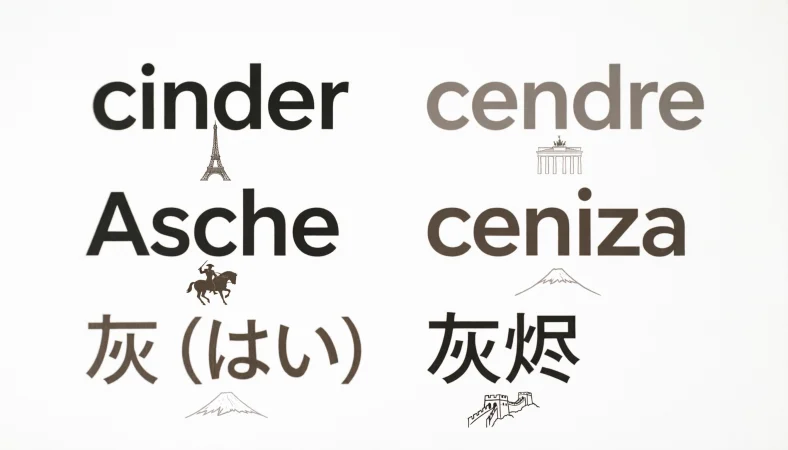
Wondering how to say “cinder” in different languages? The English word cinder usually refers to a small piece of partly burned coal, wood, or other combustible material that remains after a fire.
It can also describe a small, burned fragment left behind after something has been consumed by fire.
Learning the word for cinder in another language is useful for travelers, language learners, writers, translators, and anyone interested in vocabulary from around the world.
Below, you will find cinder translations in 70 languages, including the native word or phrase, an easy English pronunciation, and a practical example sentence.
This guide to cinder in all languages focuses on common everyday equivalents rather than literal word-for-word translations that may sound unnatural to native speakers.
Cinder in Different Languages
The table below shows how to say cinder in different languages, along with a simple real-life example and its English meaning.
| # | Language | Native phrase | Easy English pronunciation | Example sentence | English meaning |
|---|---|---|---|---|---|
| 1 | Afrikaans | sintel | SIN-tel | Die sintel gloei nog. | The cinder is still glowing. |
| 2 | Albanian | prush | PROOSH | Prushi është ende i nxehtë. | The cinder is still hot. |
| 3 | Arabic | جمرة | JAM-ra | بقيت جمرة صغيرة في النار. | A small cinder remained in the fire. |
| 4 | Armenian | խարույկի ածուխ | kha-rooy-KEE a-TSOOKH | Կրակից մի ածուխ մնաց։ | A cinder remained from the fire. |
| 5 | Azerbaijani | köz | KUHZ | Köz hələ də istidir. | The cinder is still hot. |
| 6 | Basque | txingarra | chin-GAR-ra | Txingarra oraindik bero dago. | The cinder is still hot. |
| 7 | Belarusian | вугалёк | voo-ga-LYOK | Вугалёк яшчэ свеціцца. | The cinder is still glowing. |
| 8 | Bengali | জ্বলন্ত কয়লার টুকরা | JOL-onto koy-LAR TOO-kra | আগুনে একটি কয়লার টুকরা রয়ে গেছে। | A piece of cinder remains in the fire. |
| 9 | Bosnian | žar | ZHAR | Žar je još vruć. | The cinder is still hot. |
| 10 | Bulgarian | жар | ZHAR | Жарът още е горещ. | The cinder is still hot. |
| 11 | Catalan | brasa | BRAH-sa | Encara queda una brasa. | A cinder is still left. |
| 12 | Chinese (Mandarin) | 余烬 | yoo-JING | 火里还剩下一点余烬。 | A little cinder is still left in the fire. |
| 13 | Croatian | žar | ZHAR | Žar je još vruć. | The cinder is still hot. |
| 14 | Czech | žhavý uhlík | ZHAH-vee OO-leeek | V ohni zůstal žhavý uhlík. | A glowing cinder remained in the fire. |
| 15 | Danish | glød | GLUHTH | Der er stadig en glød i ilden. | There is still a cinder in the fire. |
| 16 | Dutch | sintel | SIN-tel | Er ligt nog een sintel in het vuur. | There is still a cinder in the fire. |
| 17 | Estonian | süsi | SOO-see | Tules on veel süsi. | There is still a cinder in the fire. |
| 18 | Finnish | kekäle | KEK-eh-leh | Tulessa on vielä kekäle. | There is still a cinder in the fire. |
| 19 | French | braise | BREHZ | Il reste une braise dans le feu. | A cinder remains in the fire. |
| 20 | Georgian | ნაკვერჩხალი | nak-VER-chkhah-lee | ცეცხლში ნაკვერჩხალი დარჩა. | A cinder remained in the fire. |
| 21 | German | Glut | GLOOT | In der Feuerstelle liegt noch Glut. | There are still glowing cinders in the fireplace. |
| 22 | Greek | κάρβουνο | KAR-voo-no | Ένα κάρβουνο έμεινε στη φωτιά. | A cinder remained in the fire. |
| 23 | Gujarati | અંગારો | un-GAA-ro | આગમાં હજુ એક અંગારો છે. | There is still a cinder in the fire. |
| 24 | Haitian Creole | tizan | tee-ZAN | Gen yon ti tizan ki rete. | A small cinder remains. |
| 25 | Hebrew | גחלת | GOKH-let | נשארה גחלת קטנה באש. | A small cinder remained in the fire. |
| 26 | Hindi | अंगारा | ang-GAA-raa | आग में अभी एक अंगारा है। | There is still a cinder in the fire. |
| 27 | Hungarian | parázs | PAH-rahzh | Még van egy parázs a tűzben. | There is still a cinder in the fire. |
| 28 | Icelandic | glóð | GLOTH | Enn er glóð í eldinum. | There is still a cinder in the fire. |
| 29 | Indonesian | bara | BAH-ra | Masih ada bara di dalam api. | There are still cinders in the fire. |
| 30 | Irish | bréigín | BRAY-geen | Tá bréigín fós sa tine. | A cinder is still in the fire. |
| 31 | Italian | brace | BRAH-cheh | È rimasta una brace nel fuoco. | A cinder remains in the fire. |
| 32 | Japanese | 燃え殻 | moh-eh-GAH-ra | 火の中に燃え殻が残っている。 | Cinders remain in the fire. |
| 33 | Kazakh | шоқ | SHOK | Отта әлі шоқ бар. | There are still cinders in the fire. |
| 34 | Korean | 불씨 | bool-ssi | 불씨가 아직 남아 있다. | A cinder is still left. |
| 35 | Latvian | kvēle | KVAY-leh | Uguns vēl kvēl. | The fire still has glowing cinders. |
| 36 | Lithuanian | žarija | zhah-REE-ya | Žarija dar karšta. | The cinder is still hot. |
| 37 | Macedonian | жар | ZHAR | Жарот сè уште е жежок. | The cinder is still hot. |
| 38 | Malay | bara | BAH-ra | Masih ada bara dalam api. | There are still cinders in the fire. |
| 39 | Maltese | ġamra | JAM-ra | Fadal ġamra fin-nar. | A cinder remains in the fire. |
| 40 | Marathi | निखारा | nee-KHAA-raa | आगीत अजून निखारा आहे. | There is still a cinder in the fire. |
| 41 | Mongolian | цог | TSOG | Галд цог үлдсэн байна. | A cinder remains in the fire. |
| 42 | Nepali | अंगारो | un-GAA-ro | आगोमा अझै अंगारो छ। | There is still a cinder in the fire. |
| 43 | Norwegian | glør | GLUHR | Det er fortsatt glør i ilden. | There are still cinders in the fire. |
| 44 | Persian | اخگر | OKH-gar | هنوز یک اخگر در آتش مانده است. | A cinder is still left in the fire. |
| 45 | Polish | żar | ZHAR | W ogniu został jeszcze żar. | Cinders are still left in the fire. |
| 46 | Portuguese | brasa | BRAH-za | Ainda há uma brasa no fogo. | There is still a cinder in the fire. |
| 47 | Punjabi | ਅੰਗਿਆਰ | un-GYAAR | ਅੱਗ ਵਿੱਚ ਅਜੇ ਵੀ ਅੰਗਿਆਰ ਹੈ। | There is still a cinder in the fire. |
| 48 | Romanian | jar | ZHAR | A mai rămas un jar în foc. | A cinder remains in the fire. |
| 49 | Russian | уголёк | oo-ga-LYOK | В огне остался уголёк. | A cinder remained in the fire. |
| 50 | Serbian | žar | ZHAR | Žar je još vruć. | The cinder is still hot. |
| 51 | Slovak | žeravý uhlík | ZHEH-rah-vee OOHL-eek | V ohni zostal žeravý uhlík. | A glowing cinder remained in the fire. |
| 52 | Slovenian | žerjavica | zheh-rah-VEE-tsa | V ognju je še žerjavica. | There are still glowing cinders in the fire. |
| 53 | Spanish | brasa | BRAH-sa | Todavía queda una brasa en el fuego. | A cinder is still left in the fire. |
| 54 | Swahili | kaa | KAH-ah | Bado kuna kaa motoni. | There are still cinders in the fire. |
| 55 | Swedish | glöd | GLUHD | Det finns fortfarande glöd i elden. | There are still cinders in the fire. |
| 56 | Tamil | கனல் | kuh-NAL | நெருப்பில் இன்னும் கனல் உள்ளது. | There is still a cinder in the fire. |
| 57 | Telugu | నిప్పురవ్వ | nip-poo-RAV-va | మంటలో ఇంకా నిప్పురవ్వ ఉంది. | There is still a cinder in the fire. |
| 58 | Thai | ถ่านคุ | thaan KOO | ยังมีถ่านคุอยู่ในกองไฟ | There are still glowing cinders in the fire. |
| 59 | Turkish | kor | KOR | Ateşte hâlâ kor var. | There are still cinders in the fire. |
| 60 | Ukrainian | жарина | zha-RY-na | У вогні ще залишилася жарина. | A cinder is still left in the fire. |
| 61 | Urdu | انگارہ | an-GAA-ra | آگ میں ابھی ایک انگارہ ہے۔ | There is still a cinder in the fire. |
| 62 | Uzbek | choʻgʻ | CHOG | Olovda hali choʻgʻ bor. | There are still cinders in the fire. |
| 63 | Vietnamese | than hồng | TAN HONG | Trong lửa vẫn còn than hồng. | There are still glowing cinders in the fire. |
| 64 | Welsh | ember | EM-ber | Mae ember yn dal yn y tân. | A cinder is still in the fire. |
| 65 | Yiddish | גלוט | GLOOT | עס איז נאָך גלוט אין פֿײַער. | There are still cinders in the fire. |
| 66 | Zulu | amalahle avuthayo | ah-mah-LAH-leh ah-VOO-thah-yo | Kukhona amalahle avuthayo emlilweni. | There are glowing cinders in the fire. |
| 67 | Filipino | baga | BAH-ga | May baga pa sa apoy. | There are still cinders in the fire. |
| 68 | Estonian | hõõguv süsi | HUR-guhv SOO-see | Tules on hõõguv süsi. | There is a glowing cinder in the fire. |
| 69 | Slovene | žerjavica | zheh-rah-VEE-tsa | V ognju je še žerjavica. | There are still glowing cinders in the fire. |
| 70 | Latin | carbo ardens | KAR-bo ar-DENS | Carbo ardens in igne manet. | A glowing cinder remains in the fire. |
What Does “Cinder” Mean?
A cinder is generally a small piece of partly burned material left after a fire. It can be a fragment of coal, wood, or another combustible substance.
The word is closely associated with heat and fire, but the exact translation can change depending on context. Some languages use a word that more specifically means ember, glowing coal, charcoal, or burning fragment.
This distinction matters when choosing a translation for writing, conversation, literature, or technical use.
Cinder vs. Ember: Are They the Same?
Cinder and ember are related, but they are not always identical.
An ember usually refers to a glowing piece of wood or coal that remains after a fire has burned. A cinder can refer to a partly burned fragment and may emphasize the remaining material rather than its glow.
In everyday speech, however, the two words can overlap. That is why many cinder translations in other languages correspond more closely to “ember” or “glowing coal.”
How to Say Cinder in Different Languages
The easiest way to learn how to say cinder in different languages is to remember the context.
If you are talking about a glowing piece left in a campfire, a translation meaning ember, glowing coal, or hot cinder is often the most natural choice.
For example, English speakers might say:
- “There are still cinders in the fire.”
- “A hot cinder fell onto the ground.”
- “The cinders were glowing after the fire went out.”
The best translation may change slightly for each sentence.
Cinder Translations Around the World
The word appears in many different forms around the world. European languages such as Spanish, French, Italian, Portuguese, and Catalan commonly use words related to burning embers or glowing material.
In South Asian languages, including Hindi, Urdu, Punjabi, Marathi, Bengali, and Nepali, words for burning coal, ember, or glowing fire material are commonly used.
East Asian languages may distinguish more carefully between ash, burnt remains, glowing embers, and charcoal. This is an important reminder that a dictionary translation is not always a perfect one-to-one match.
How to Use “Cinder” in Everyday English
Here are a few natural English sentences using the word:
“Be careful; a hot cinder fell from the fire.”
“The wind scattered the cinders across the ground.”
“Only a few cinders remained after the campfire went out.”
“The fireplace was full of warm cinders.”
These examples show that cinder is most often used when describing the remains of a fire.
Why Cinder Translations Can Differ
Languages divide the world into words in different ways. English has separate words such as ash, ember, coal, charcoal, and cinder, but another language may use one word for two or more of these ideas.
For this reason, the translations in a list of cinder in all languages should be understood as practical equivalents rather than identical dictionary definitions.
Context is especially important when translating literature, technical documents, poetry, or historical texts.
Frequently Asked Questions
1. What is cinder in simple English?
A cinder is a small piece of partly burned material left from a fire, often coal or wood. It may still be hot or glowing.
2. How do you say cinder in Spanish?
“Cinder” can be translated as brasa in Spanish when referring to a glowing or burning piece left in a fire.
3. What is cinder in Hindi?
In Hindi, a common word for a glowing cinder or ember is अंगारा (angāra).
4. What is the difference between cinder and ember?
A cinder is a partly burned fragment left after combustion, while an ember generally emphasizes a glowing piece of wood or coal. In everyday usage, their meanings can overlap.
5. Why are cinder translations different in different languages?
Different languages categorize fire-related materials differently. Depending on the language and context, a translation may correspond to cinder, ember, glowing coal, charcoal, or another partly burned material.
Conclusion
Learning cinder in different languages is a useful way to understand how languages describe fire, heat, coal, and burned materials.
While the exact equivalent can vary by context, the 70 translations above provide practical starting points for understanding and using the word around the world.
For the most natural translation, always consider if you mean a cinder, ember, glowing coal, ash, or another burned fragment. Context can make a significant difference in multilingual communication.

I am Johnny Thomas, a passionate language enthusiast and writer. I enjoy exploring different languages, cultures, words, and expressions. I create helpful, easy-to-understand content to help readers discover languages and communicate confidently.