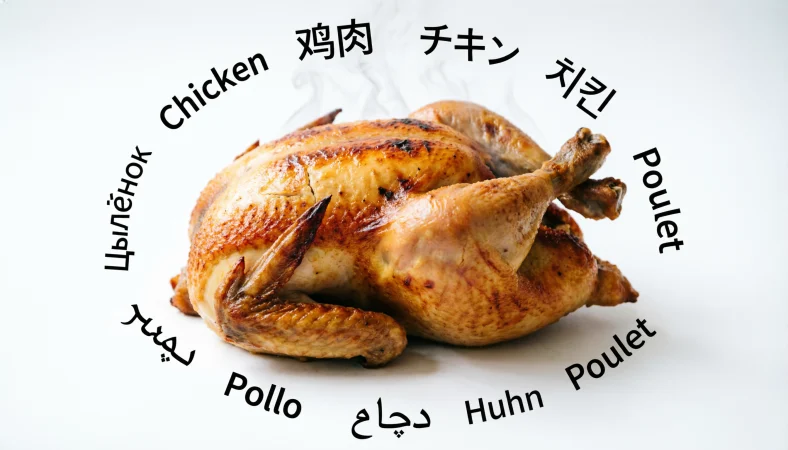
Wondering how to say chicken in different languages? if you are traveling, learning a new language, reading an international menu, writing recipes.
Simply exploring words from around the world, knowing common chicken translations can be surprisingly useful.
In this guide, you will find 70 different languages, including the native word for chicken, an easy English pronunciation, a practical example sentence, and the English meaning.
The list covers languages from Europe, Asia, Africa, and the Middle East, making it a useful reference for anyone searching for chicken in all languages.
Chicken in All Languages: 70 Translations
| # | Language | Native phrase | Easy English pronunciation | Real-life example | English meaning |
|---|---|---|---|---|---|
| 1 | English | Chicken | chik-en | I cooked chicken for dinner. | I cooked chicken for dinner. |
| 2 | Spanish | Pollo | poy-yoh | Me gusta el pollo. | I like chicken. |
| 3 | French | Poulet | poo-leh | J’aime le poulet. | I like chicken. |
| 4 | German | Hähnchen | hen-chen | Ich esse gern Hähnchen. | I like eating chicken. |
| 5 | Italian | Pollo | pol-loh | Mi piace il pollo. | I like chicken. |
| 6 | Portuguese | Frango | fran-goo | Eu gosto de frango. | I like chicken. |
| 7 | Dutch | Kip | kip | Ik hou van kip. | I like chicken. |
| 8 | Afrikaans | Hoender | hoon-der | Ek hou van hoender. | I like chicken. |
| 9 | Swedish | Kyckling | shik-ling | Jag gillar kyckling. | I like chicken. |
| 10 | Norwegian | Kylling | shil-ling | Jeg liker kylling. | I like chicken. |
| 11 | Danish | Kylling | kuh-ling | Jeg kan lide kylling. | I like chicken. |
| 12 | Finnish | Kana | kah-nah | Pidän kanasta. | I like chicken. |
| 13 | Icelandic | Kjúklingur | kyook-ling-ur | Mér líkar kjúklingur. | I like chicken. |
| 14 | Irish | Sicín | sik-een | Is maith liom sicín. | I like chicken. |
| 15 | Welsh | Cyw iâr | koo ee-ar | Rwy’n hoffi cyw iâr. | I like chicken. |
| 16 | Polish | Kurczak | koor-chak | Lubię kurczaka. | I like chicken. |
| 17 | Czech | Kuře | koo-rzheh | Mám rád kuře. | I like chicken. |
| 18 | Slovak | Kurča | koor-cha | Mám rád kurča. | I like chicken. |
| 19 | Slovenian | Piščanec | pish-cha-nets | Rad imam piščanca. | I like chicken. |
| 20 | Croatian | Piletina | pee-leh-tee-nah | Volim piletinu. | I like chicken. |
| 21 | Serbian | Piletina | pee-leh-tee-nah | Volim piletinu. | I like chicken. |
| 22 | Bulgarian | Пиле | pee-leh | Харесвам пиле. | I like chicken. |
| 23 | Macedonian | Пилешко | pee-lesh-koh | Сакам пилешко. | I like chicken. |
| 24 | Russian | Курица | koo-ree-tsah | Я люблю курицу. | I love chicken. |
| 25 | Ukrainian | Курка | koor-kah | Я люблю курку. | I love chicken. |
| 26 | Belarusian | Курыца | koo-ree-tsah | Я люблю курыцу. | I love chicken. |
| 27 | Lithuanian | Višta | veesh-tah | Aš mėgstu vištą. | I like chicken. |
| 28 | Latvian | Vista | vees-tah | Man garšo vista. | I like chicken. |
| 29 | Estonian | Kana | kah-nah | Mulle meeldib kana. | I like chicken. |
| 30 | Hungarian | Csirke | cheer-keh | Szeretem a csirkét. | I like chicken. |
| 31 | Romanian | Pui | poo-ee | Îmi place puiul. | I like chicken. |
| 32 | Albanian | Pulë | poo-leh | Më pëlqen pula. | I like chicken. |
| 33 | Greek | Κοτόπουλο | koh-toh-poo-loh | Μου αρέσει το κοτόπουλο. | I like chicken. |
| 34 | Turkish | Tavuk | tah-vook | Tavuk severim. | I like chicken. |
| 35 | Armenian | Հավ | hahv | Ես հավ եմ սիրում։ | I like chicken. |
| 36 | Georgian | ქათამი | kah-tah-mee | მე ქათამი მიყვარს. | I love chicken. |
| 37 | Azerbaijani | Toyuq | toy-ook | Mən toyuğu sevirəm. | I like chicken. |
| 38 | Persian | مرغ | morgh | من مرغ دوست دارم. | I like chicken. |
| 39 | Hebrew | עוף | ohf | אני אוהב עוף. | I like chicken. |
| 40 | Arabic | دجاج | da-jaj | أحب الدجاج. | I like chicken. |
| 41 | Hindi | मुर्गी | mur-gee | मुझे मुर्गी पसंद है। | I like chicken. |
| 42 | Urdu | مرغی | mur-gee | مجھے مرغی پسند ہے۔ | I like chicken. |
| 43 | Bengali | মুরগি | moor-gee | আমি মুরগি পছন্দ করি। | I like chicken. |
| 44 | Punjabi | ਮੁਰਗ਼ੀ | mur-gee | ਮੈਨੂੰ ਮੁਰਗ਼ੀ ਪਸੰਦ ਹੈ। | I like chicken. |
| 45 | Marathi | कोंबडी | kom-buh-dee | मला कोंबडी आवडते. | I like chicken. |
| 46 | Nepali | कुखुरा | koo-khoo-rah | मलाई कुखुरा मन पर्छ। | I like chicken. |
| 47 | Sinhala | කුකුල් මස් | koo-kul mas | මම කුකුල් මස් කැමතියි. | I like chicken. |
| 48 | Tamil | கோழி | koh-zhee | எனக்கு கோழி பிடிக்கும். | I like chicken. |
| 49 | Telugu | కోడి | koh-dee | నాకు కోడి ఇష్టం. | I like chicken. |
| 50 | Kannada | ಕೋಳಿ | koh-lee | ನನಗೆ ಕೋಳಿ ಇಷ್ಟ. | I like chicken. |
| 51 | Gujarati | કુકડું | koo-kuh-doo | મને કુકડું ગમે છે. | I like chicken. |
| 52 | Mandarin Chinese | 鸡 | jee | 我喜欢鸡肉。 | I like chicken. |
| 53 | Japanese | 鶏肉 | toh-ree-nee-koo | 鶏肉が好きです。 | I like chicken. |
| 54 | Korean | 닭고기 | dahk-goh-gee | 저는 닭고기를 좋아해요. | I like chicken. |
| 55 | Thai | ไก่ | guy | ฉันชอบไก่ | I like chicken. |
| 56 | Vietnamese | Gà | gah | Tôi thích gà. | I like chicken. |
| 57 | Indonesian | Ayam | ah-yam | Saya suka ayam. | I like chicken. |
| 58 | Malay | Ayam | ah-yam | Saya suka ayam. | I like chicken. |
| 59 | Filipino | Manok | mah-nok | Gusto ko ang manok. | I like chicken. |
| 60 | Swahili | Kuku | koo-koo | Ninapenda kuku. | I like chicken. |
| 61 | Zulu | Inkukhu | in-koo-koo | Ngithanda inkukhu. | I like chicken. |
| 62 | Amharic | ዶሮ | doh-roh | ዶሮ እወዳለሁ። | I like chicken. |
| 63 | Pashto | چرګ | char-ag | زه چرګ خوښوم. | I like chicken. |
| 64 | Kazakh | Тауық | tah-wuk | Мен тауықты жақсы көремін. | I like chicken. |
| 65 | Uzbek | Tovuq | toh-vook | Men tovuqni yaxshi ko’raman. | I like chicken. |
| 66 | Mongolian | Тахиа | tah-hee-ah | Би тахианд дуртай. | I like chicken. |
| 67 | Khmer | មាន់ | mo-an | ខ្ញុំចូលចិត្តមាន់។ | I like chicken. |
| 68 | Lao | ໄກ່ | kai | ຂ້ອຍມັກໄກ່. | I like chicken. |
| 69 | Maltese | Tiġieġ | tee-jeej | Inħobb it-tiġieġ. | I like chicken. |
| 70 | Somali | Digaag | dee-gaag | Waan jeclahay digaagga. | I like chicken. |
How to Say Chicken in Different Languages
The word chicken changes considerably from one language to another. In some languages, the common word refers specifically to the bird, while another form is preferred when talking about chicken as food.
For example, English uses “chicken” for both the animal and its meat. Other languages may use separate words depending on context, age, gender, or whether the speaker means the bird or the food.
This distinction is especially useful when ordering food or translating recipes.
Chicken Translations for Travel and Food
Knowing a few food-related words can make international travel easier. If you are reading a menu, shopping for ingredients, or ordering a meal, recognizing the local word for chicken can help you understand what you are being offered.
The same principle applies when searching for recipes. International recipes may use the native term rather than the English word “chicken,” so knowing common translations can make recipe searches more productive.
Chicken Around the World
Chicken is a familiar food in many different culinary traditions. It can appear grilled, roasted, fried, stewed, baked, or cooked with rice, vegetables, noodles, bread, and regional spices.
That is why chicken around the world is useful vocabulary for travelers, food enthusiasts, students, translators, and language learners. Learning the word in several languages also makes it easier to recognize dishes when exploring international cuisine.
Are Chicken and Chicken Meat Always the Same Word?
Not always.
Some languages commonly use one word for the chicken itself and another word for chicken meat. Others use the same everyday word in both situations.
For accurate translation, context matters. A restaurant menu, grocery label, farm conversation, and language-learning exercise may use different forms of the same basic concept.
Tips for Learning Chicken in Other Languages
Start by learning the word you are most likely to use. If you travel frequently, focus on the languages spoken in the countries you visit.
Next, learn the word inside a short sentence rather than memorizing it alone. For example, learning how to say “I like chicken” gives you useful grammar and vocabulary at the same time.
Finally, pay attention to pronunciation. The spelling can look familiar while the actual sound is completely different.
Frequently Asked Questions
1. How do you say chicken in different languages?
“Chicken” has different translations around the world. Examples include pollo in Spanish and Italian, poulet in French, kip in Dutch, tavuk in Turkish, ayam in Indonesian and Malay, and kuku in Swahili.
2. What is chicken called in the most widely spoken languages?
Common examples include pollo in Spanish, poulet in French, Hähnchen in German, 鸡 in Mandarin Chinese, 鶏肉 in Japanese, 닭고기 in Korean, دجاج in Arabic, and مرغی in Urdu.
3. Is the word for chicken the same as chicken meat?
It depends on the language. Some languages commonly use the same everyday word, while others distinguish between the live bird and its meat. Context is therefore important when translating “chicken.”
4. What is chicken in Spanish?
Chicken is pollo in Spanish. A common sentence is “Me gusta el pollo,” which means “I like chicken.”
5. Why should I learn chicken translations?
Learning chicken translations can help with travel, restaurant menus, international recipes, grocery shopping, language study, and everyday conversations. It is also an easy way to build practical food vocabulary.
Conclusion
Learning how to say chicken in different languages is a simple way to expand practical vocabulary and explore how languages describe a familiar part of everyday life.
With 70 translations, pronunciations, and example sentences, this guide provides a quick reference for recognizing chicken in all languages and using the word naturally around the world.

I am Johnny Thomas, a passionate language enthusiast and writer. I enjoy exploring different languages, cultures, words, and expressions. I create helpful, easy-to-understand content to help readers discover languages and communicate confidently.