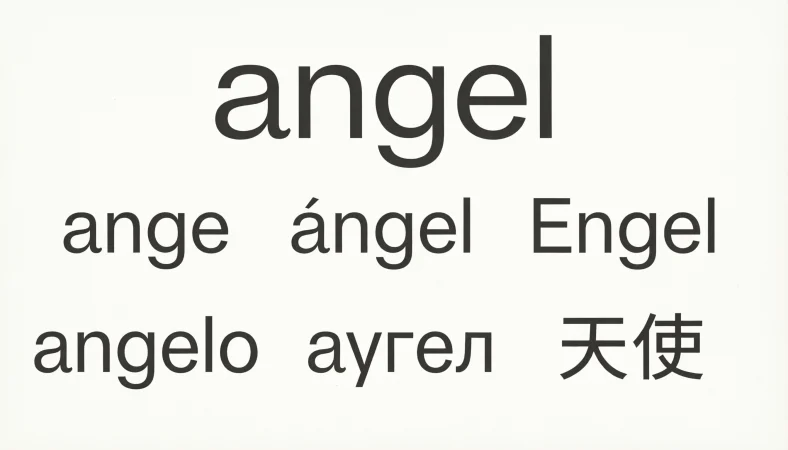
The word angel carries a beautiful meaning across cultures. It commonly refers to a divine or spiritual messenger, but it is also used in everyday language to describe someone who is exceptionally kind, caring, or helpful.
If you are searching for angel in different languages, this guide gives you 70 translations in one easy-to-read table. Each entry includes the native word or phrase, a simple English pronunciation, an example sentence, and the English meaning of that sentence.
if you are researching angel in all languages, learning vocabulary, choosing a meaningful name, writing creatively, or simply exploring how different cultures express the idea of an angel, this list provides a practical starting point.
Angel in Different Languages: 70 Translations
| # | Language | Native phrase | Easy English pronunciation | Example sentence | English meaning |
|---|---|---|---|---|---|
| 1 | English | angel | AYN-juhl | She is an angel to her family. | She is very kind and caring to her family. |
| 2 | Spanish | ángel | AHN-hel | Mi abuela es un ángel. | My grandmother is an angel. |
| 3 | French | ange | AHNZH | Cet enfant est un ange. | This child is an angel. |
| 4 | German | Engel | ENG-uhl | Sie ist ein Engel. | She is an angel. |
| 5 | Italian | angelo | AHN-jeh-loh | Lui è un angelo. | He is an angel. |
| 6 | Portuguese | anjo | AHN-zhoo | Ela é um anjo. | She is an angel. |
| 7 | Dutch | engel | ENG-uhl | Zij is een engel. | She is an angel. |
| 8 | Swedish | ängel | EN-yel | Hon är en ängel. | She is an angel. |
| 9 | Danish | engel | ENG-uhl | Hun er en engel. | She is an angel. |
| 10 | Norwegian | engel | ENG-uhl | Hun er en engel. | She is an angel. |
| 11 | Finnish | enkeli | EN-keh-lee | Hän on enkeli. | He or she is an angel. |
| 12 | Icelandic | engill | ENG-kil | Hún er engill. | She is an angel. |
| 13 | Irish | aingeal | ANG-yuhl | Is aingeal í. | She is an angel. |
| 14 | Welsh | angel | ANG-el | Mae hi’n angel. | She is an angel. |
| 15 | Scottish Gaelic | aingeal | ANG-yuhl | Tha i na h-aingeal. | She is an angel. |
| 16 | Latin | angelus | AN-jeh-loos | Angelus adest. | The angel is present. |
| 17 | Greek | άγγελος | AHN-ghe-los | Είναι ένας άγγελος. | He is an angel. |
| 18 | Russian | ангел | AHN-gel | Она ангел. | She is an angel. |
| 19 | Ukrainian | ангел | AHN-hel | Вона ангел. | She is an angel. |
| 20 | Belarusian | анёл | ah-NYOL | Яна анёл. | She is an angel. |
| 21 | Polish | anioł | AH-nyow | Ona jest aniołem. | She is an angel. |
| 22 | Czech | anděl | AHN-dyel | Ona je anděl. | She is an angel. |
| 23 | Slovak | anjel | AHN-yel | Ona je anjel. | She is an angel. |
| 24 | Slovenian | angel | AHN-gel | Ona je angel. | She is an angel. |
| 25 | Croatian | anđeo | AHN-jeh-oh | Ona je anđeo. | She is an angel. |
| 26 | Serbian | анђео | AHN-djeh-oh | Ona je anđeo. | She is an angel. |
| 27 | Bosnian | anđeo | AHN-djeh-oh | Ona je anđeo. | She is an angel. |
| 28 | Bulgarian | ангел | AHN-gel | Тя е ангел. | She is an angel. |
| 29 | Macedonian | ангел | AHN-gel | Таа е ангел. | She is an angel. |
| 30 | Romanian | înger | IN-jer | Ea este un înger. | She is an angel. |
| 31 | Albanian | engjëll | EN-gyel | Ajo është një engjëll. | She is an angel. |
| 32 | Hungarian | angyal | AHN-yahl | Ő egy angyal. | He or she is an angel. |
| 33 | Estonian | ingel | ING-el | Ta on ingel. | He or she is an angel. |
| 34 | Latvian | eņģelis | EN-jyeh-lis | Viņa ir eņģelis. | She is an angel. |
| 35 | Lithuanian | angelas | AHN-geh-las | Ji yra angelas. | She is an angel. |
| 36 | Maltese | anġlu | AN-jloo | Hija anġlu. | She is an angel. |
| 37 | Turkish | melek | MEH-lek | O bir melek. | He or she is an angel. |
| 38 | Azerbaijani | mələk | muh-LEK | O, mələkdir. | He or she is an angel. |
| 39 | Persian | فرشته | feh-RESH-teh | او مثل یک فرشته است. | He or she is like an angel. |
| 40 | Arabic | ملاك | MAH-lak | هي ملاك. | She is an angel. |
| 41 | Hebrew | מלאך | mah-LAKH | היא מלאך. | She is an angel. |
| 42 | Armenian | հրեշտակ | hreh-SHTAHK | Նա հրեշտակ է։ | He or she is an angel. |
| 43 | Georgian | ანგელოზი | an-geh-LOH-zee | ის ანგელოზია. | He or she is an angel. |
| 44 | Hindi | देवदूत | dayv-DOOT | वह एक देवदूत है। | He or she is an angel. |
| 45 | Bengali | দেবদূত | day-boh-DOOT | সে একজন দেবদূত। | He or she is an angel. |
| 46 | Punjabi | ਦੂਤ | DOOT | ਉਹ ਇੱਕ ਦੂਤ ਹੈ। | He or she is a messenger. |
| 47 | Gujarati | દેવદૂત | dayv-DOOT | તે દેવદૂત છે. | He or she is an angel. |
| 48 | Marathi | देवदूत | dayv-DOOT | ती देवदूत आहे. | She is an angel. |
| 49 | Nepali | देवदूत | dayv-DOOT | उनी देवदूत हुन्। | He or she is an angel. |
| 50 | Sanskrit | देवदूतः | day-vah-DOO-tah | सः देवदूतः अस्ति। | He is an angelic messenger. |
| 51 | Tamil | தேவதை | tay-vah-THAI | அவள் ஒரு தேவதை. | She is an angel. |
| 52 | Telugu | దేవదూత | day-vah-DOO-tah | ఆమె ఒక దేవదూత. | She is an angel. |
| 53 | Kannada | ದೇವದೂತ | day-vah-DOO-tah | ಅವಳು ದೇವದೂತಳು. | She is an angel. |
| 54 | Malayalam | മാലാഖ | maa-LAA-kha | അവൾ ഒരു മാലാഖയാണ്. | She is an angel. |
| 55 | Sinhala | දේවදූතයා | day-vah-DOO-tah-yah | ඇය දේවදූතයෙකි. | She is an angel. |
| 56 | Chinese (Mandarin) | 天使 | tiān shǐ | 她是天使。 | She is an angel. |
| 57 | Japanese | 天使 | tenshi | 彼女は天使です。 | She is an angel. |
| 58 | Korean | 천사 | cheon-sa | 그녀는 천사예요. | She is an angel. |
| 59 | Vietnamese | thiên thần | tee-en thuhn | Cô ấy là một thiên thần. | She is an angel. |
| 60 | Thai | เทวดา | tay-wah-DAA | เขาเป็นเทวดา | He is an angel. |
| 61 | Indonesian | malaikat | mah-LAI-kat | Dia adalah malaikat. | He or she is an angel. |
| 62 | Malay | malaikat | mah-LAI-kat | Dia seperti malaikat. | He or she is like an angel. |
| 63 | Filipino | anghel | ANG-hel | Isa siyang anghel. | He or she is an angel. |
| 64 | Tagalog | anghel | ANG-hel | Ang bata ay parang anghel. | The child is like an angel. |
| 65 | Swahili | malaika | mah-LAI-kah | Yeye ni malaika. | He or she is an angel. |
| 66 | Zulu | ingelosi | in-geh-LOH-see | Ungumngelosi. | He or she is an angel. |
| 67 | Afrikaans | engel | ENG-uhl | Sy is ‘n engel. | She is an angel. |
| 68 | Amharic | መልአክ | mel-AHK | እሷ መልአክ ናት። | She is an angel. |
| 69 | Somali | malag | MAH-lag | Iyadu waa malag. | She is an angel. |
| 70 | Haitian Creole | zanj | ZAHNZH | Li se yon zanj. | He or she is an angel. |
How to Say Angel in Different Languages
The word angel has several linguistic roots and forms. In many European languages, the modern word is historically connected to Greek angelos, meaning a messenger. This connection can be seen in words such as angelus in Latin, angelo in Italian, ángel in Spanish, and Engel in German.
Other languages use words that emphasize a divine messenger or supernatural being rather than directly resembling the English word. For example, Hindi commonly uses देवदूत, which conveys the idea of a divine messenger.
This is why angel translations can look very different even when they describe a similar spiritual concept.
Angel in European Languages
European languages offer some of the most recognizable forms of the word.
Romance languages generally have forms related to Latin and Greek traditions. Spanish uses ángel, French uses ange, Italian uses angelo, Portuguese uses anjo, and Romanian uses înger.
Germanic languages also have closely related forms. English uses angel, while German, Dutch, Swedish, Danish, Norwegian, and Afrikaans use forms based on similar historical roots.
Slavic languages show another interesting pattern. Polish uses anioł, Czech uses anděl, Croatian uses anđeo, and Russian uses ангел.
Angel in Asian Languages
Asian languages often express the idea of an angel through culturally specific terms.
In Mandarin Chinese, 天使 literally refers to a heavenly messenger or angel. Japanese uses 天使, pronounced tenshi, while Korean uses 천사, pronounced cheonsa.
Several South Asian languages use words connected with the idea of a divine messenger. Hindi, Bengali, Gujarati, Marathi, Nepali, and related languages commonly use forms based on देवदूत or related expressions.
Tamil uses தேவதை, while Malayalam has the distinctive word മാലാഖ.
Angel in Middle Eastern Languages
The concept of an angel has an important place in several Middle Eastern religious and linguistic traditions.
Arabic uses ملاك, while Hebrew uses מלאך. Persian commonly uses فرشته, and Armenian uses հրեշտակ.
Although these words can refer to angels in religious contexts, their exact cultural and theological associations can vary. A direct dictionary translation does not always capture every meaning a word has within its culture.
Angel Around the World
The idea of an angel appears in many cultures, but the everyday use of the word can extend beyond religion.
In English, calling someone “an angel” can be a warm compliment for a person who has helped you. Similar affectionate uses exist in many languages.
For example, someone might describe a helpful family member, caring friend, generous stranger, or exceptionally well-behaved child as an angel. In these contexts, the word expresses kindness, innocence, compassion, or gratitude rather than necessarily making a religious statement.
Angel Translations for Names, Tattoos, and Creative Writing
If you are looking for an angel translation for a tattoo, username, artwork, story, poem, or personal project, choosing the language should involve more than simply copying a dictionary word.
Consider the cultural meaning of the word, its writing system, pronunciation, grammatical form, and whether it sounds natural in the intended context.
For tattoos and permanent designs especially, it is worth checking the exact spelling and grammatical form with a fluent speaker of the language. A word that translates correctly in isolation may not communicate the intended meaning when placed into a sentence or phrase.
Tips for Using Angel in Another Language
When learning how to say angel in different languages, keep these points in mind:
- Check whether the word is masculine, feminine, or grammatically variable.
- Pay attention to accents and special characters.
- Use the pronunciation guide as a beginner-friendly approximation rather than a substitute for native pronunciation.
- Remember that pronunciation can vary between regions.
- Check the surrounding sentence when you need a grammatically complete translation.
- Consider cultural and religious context before using a word in a tattoo, artwork, or formal writing.
What Does Angel Mean in Different Cultures?
Across many traditions, an angel is associated with ideas such as divine messages, protection, spirituality, goodness, guidance, and heavenly beings.
However, the concept is not identical everywhere. Different religions and cultures have their own beliefs about angels, messengers, spirits, and supernatural beings.
The safest approach is to understand angel around the world as both a linguistic and cultural concept. The translated word may have a broadly similar meaning while carrying additional associations in its native culture.
Frequently Asked Questions
1. How do you say “angel” in different languages?
“Angel” can be translated in many ways. Examples include ángel in Spanish, ange in French, angelo in Italian, Engel in German, 天使 in Chinese and Japanese, 천사 in Korean, and malaika in Swahili.
2. What is the word for angel in the most languages?
There is no single universal translation because languages have different words and cultural concepts for angels. This guide provides 70 examples from European, Asian, African, Middle Eastern, and other languages.
3. What is “angel” in Latin?
The Latin word is angelus. It is historically important because many European forms of the word angel developed through Greek and Latin religious traditions.
4. What is the most common translation of angel?
There is no single translation that is most common worldwide. Forms such as Spanish ángel, Italian angelo, French ange, German Engel, and Chinese 天使 are widely recognized within their respective languages.
5. Which language is best for the word “angel” as a tattoo?
There is no universally best language. The right choice depends on the meaning, appearance, pronunciation, and cultural connection you want. Before getting a permanent tattoo, verify the exact spelling and grammatical usage with a fluent native speaker.
Conclusion
Learning the word angel in different languages is a simple way to explore how cultures express ideas of kindness, spirituality, protection, and divine messengers.
From familiar European forms to distinctive Asian, African, and Middle Eastern words, each translation offers a small glimpse into the language and culture behind it.
Use this list of 70 angel translations as a starting point for language learning, creative projects, cultural research, or discovering how the idea of an angel is expressed around the world.

I am Jimmy Michael, a language enthusiast and writer passionate about exploring different languages, words, and cultures. I create simple, useful content that helps readers understand languages better and discover new ways to communicate globally.