The word “adopt” has a meaningful place in everyday communication. It can describe welcoming a child into a family, taking an animal into your home, or choosing a new idea, habit, or approach.
Although the word has a similar purpose across many cultures, its translation changes depending on the language and context.
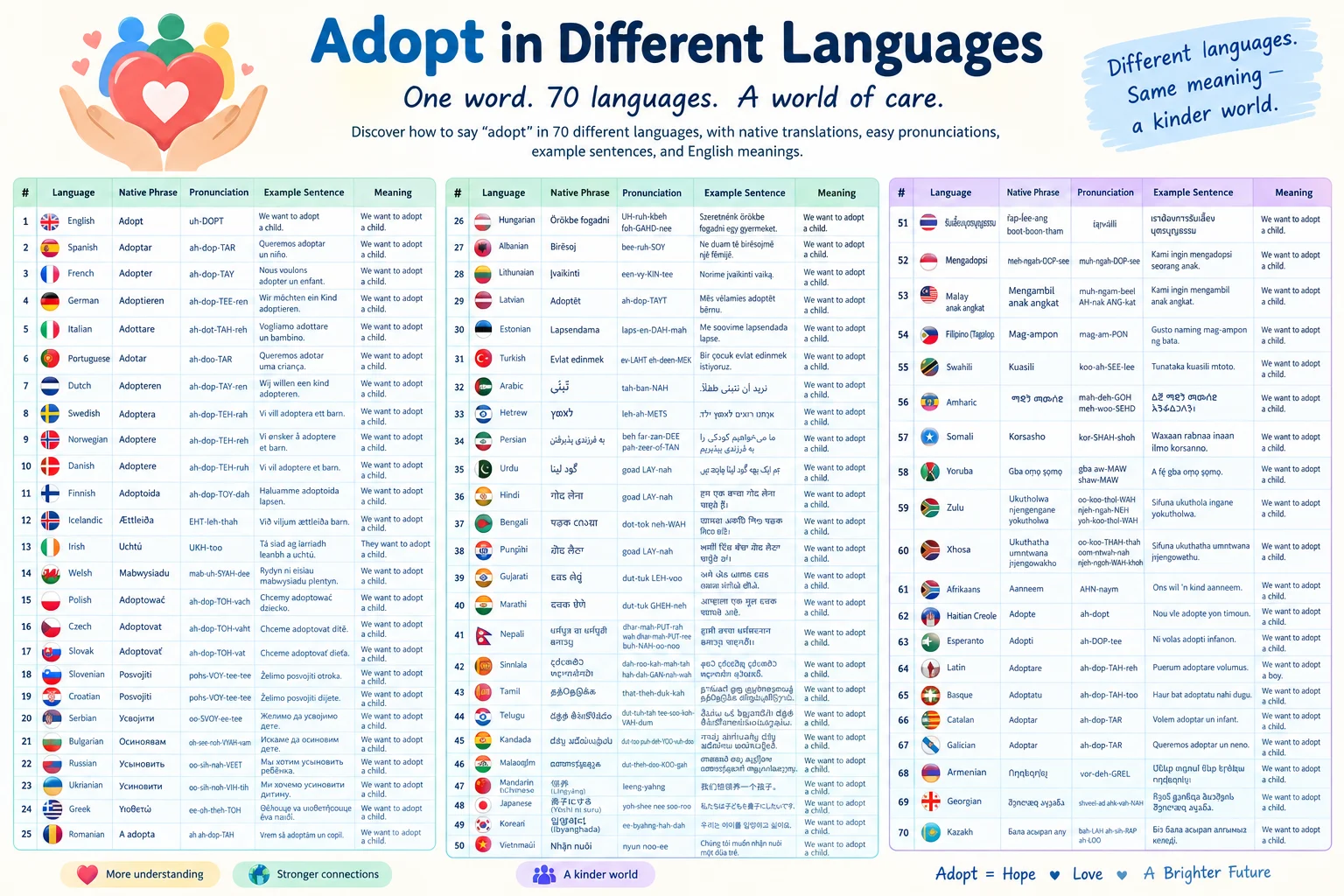
If you want to learn how to say adopt in different languages, this guide provides 70 translations, easy English pronunciations, and practical example sentences.
if you are learning a new language, writing multilingual content, traveling, or exploring adoption-related vocabulary, these translations will help you understand how the word is used around the world.
How to Say Adopt in Different Languages
The word “adopt” has different translations depending on the language and intended meaning. For example, some languages use one verb for adopting a child and another for adopting an idea or practice.
The table below focuses primarily on the verb meaning to adopt a child, welcome an animal into a home, or take someone or something into one’s care, while examples illustrate natural usage where possible.
Adopt in 70 Different Languages: Translations and Examples
The following table includes 70 languages, their native translations, easy pronunciation guides, example sentences, and English meanings.
Pronunciations are approximate guides for English speakers. Some translations may change depending on grammatical tense, formality, or context.
| # | Language | Native phrase | Easy pronunciation | Example sentence | English meaning |
|---|---|---|---|---|---|
| 1 | English | Adopt | uh-DOPT | We want to adopt a child. | We want to adopt a child. |
| 2 | Spanish | Adoptar | ah-dop-TAR | Queremos adoptar un niño. | We want to adopt a child. |
| 3 | French | Adopter | ah-dop-TAY | Nous voulons adopter un enfant. | We want to adopt a child. |
| 4 | German | Adoptieren | ah-dop-TEE-ren | Wir möchten ein Kind adoptieren. | We want to adopt a child. |
| 5 | Italian | Adottare | ah-dot-TAH-reh | Vogliamo adottare un bambino. | We want to adopt a child. |
| 6 | Portuguese | Adotar | ah-doo-TAR | Queremos adotar uma criança. | We want to adopt a child. |
| 7 | Dutch | Adopteren | ah-dop-TAY-ren | Wij willen een kind adopteren. | We want to adopt a child. |
| 8 | Swedish | Adoptera | ah-dop-TEH-rah | Vi vill adoptera ett barn. | We want to adopt a child. |
| 9 | Norwegian | Adoptere | ah-dop-TEH-reh | Vi ønsker å adoptere et barn. | We want to adopt a child. |
| 10 | Danish | Adoptere | ah-dop-TEH-ruh | Vi vil adoptere et barn. | We want to adopt a child. |
| 11 | Finnish | Adoptoida | ah-dop-TOY-dah | Haluamme adoptoida lapsen. | We want to adopt a child. |
| 12 | Icelandic | Ættleiða | EHT-leh-thah | Við viljum ættleiða barn. | We want to adopt a child. |
| 13 | Irish | Uchtú | UKH-too | Tá siad ag iarraidh leanbh a uchtú. | They want to adopt a child. |
| 14 | Welsh | Mabwysiadu | mab-uh-SYAH-dee | Rydyn ni eisiau mabwysiadu plentyn. | We want to adopt a child. |
| 15 | Polish | Adoptować | ah-dop-TOH-vach | Chcemy adoptować dziecko. | We want to adopt a child. |
| 16 | Czech | Adoptovat | ah-dop-TOH-vaht | Chceme adoptovat dítě. | We want to adopt a child. |
| 17 | Slovak | Adoptovať | ah-dop-TOH-vat | Chceme adoptovať dieťa. | We want to adopt a child. |
| 18 | Slovenian | Posvojiti | pohs-VOY-tee-tee | Želimo posvojiti otroka. | We want to adopt a child. |
| 19 | Croatian | Posvojiti | pohs-VOY-tee-tee | Želimo posvojiti dijete. | We want to adopt a child. |
| 20 | Serbian | Усвојити (Usvojiti) | oo-SVOY-ee-tee | Желимо да усвојимо дете. | We want to adopt a child. |
| 21 | Bulgarian | Осиновявам (Osinovyavam) | oh-see-noh-VYAH-vam | Искаме да осиновим дете. | We want to adopt a child. |
| 22 | Russian | Усыновить (Usynovit’) | oo-sih-nah-VEET | Мы хотим усыновить ребёнка. | We want to adopt a child. |
| 23 | Ukrainian | Усиновити (Usynovyty) | oo-sih-noh-VIH-tih | Ми хочемо усиновити дитину. | We want to adopt a child. |
| 24 | Greek | Υιοθετώ (Yiotheto) | ee-oh-theh-TOH | Θέλουμε να υιοθετήσουμε ένα παιδί. | We want to adopt a child. |
| 25 | Romanian | A adopta | ah ah-dop-TAH | Vrem să adoptăm un copil. | We want to adopt a child. |
| 26 | Hungarian | Örökbe fogadni | UH-ruh-kbeh foh-GAHD-nee | Szeretnénk örökbe fogadni egy gyermeket. | We want to adopt a child. |
| 27 | Albanian | Birësoj | bee-ruh-SOY | Ne duam të birësojmë një fëmijë. | We want to adopt a child. |
| 28 | Lithuanian | Įvaikinti | een-vy-KIN-tee | Norime įvaikinti vaiką. | We want to adopt a child. |
| 29 | Latvian | Adoptēt | ah-dop-TAYT | Mēs vēlamies adoptēt bērnu. | We want to adopt a child. |
| 30 | Estonian | Lapsendama | laps-en-DAH-mah | Me soovime lapsendada lapse. | We want to adopt a child. |
| 31 | Turkish | Evlat edinmek | ev-LAHT eh-deen-MEK | Bir çocuk evlat edinmek istiyoruz. | We want to adopt a child. |
| 32 | Arabic | تَبَنَّى (Tabannā) | tah-ban-NAH | نريد أن نتبنى طفلًا. | We want to adopt a child. |
| 33 | Hebrew | לאמץ (Le’amtz) | leh-ah-METS | אנחנו רוצים לאמץ ילד. | We want to adopt a child. |
| 34 | Persian | به فرزندی پذیرفتن | beh far-zan-DEE pah-zeer-of-TAN | ما میخواهیم کودکی را به فرزندی بپذیریم. | We want to adopt a child. |
| 35 | Urdu | گود لینا | goad LAY-nah | ہم ایک بچہ گود لینا چاہتے ہیں۔ | We want to adopt a child. |
| 36 | Hindi | गोद लेना | goad LAY-nah | हम एक बच्चा गोद लेना चाहते हैं। | We want to adopt a child. |
| 37 | Bengali | দত্তক নেওয়া | dot-tok neh-WAH | আমরা একটি শিশু দত্তক নিতে চাই। | We want to adopt a child. |
| 38 | Punjabi | ਗੋਦ ਲੈਣਾ | goad LAY-nah | ਅਸੀਂ ਇੱਕ ਬੱਚਾ ਗੋਦ ਲੈਣਾ ਚਾਹੁੰਦੇ ਹਾਂ। | We want to adopt a child. |
| 39 | Gujarati | દત્તક લેવું | dut-tuk LEH-voo | અમે એક બાળક દત્તક લેવા માંગીએ છીએ. | We want to adopt a child. |
| 40 | Marathi | दत्तक घेणे | dut-tuk GHEH-neh | आम्हाला एक मूल दत्तक घ्यायचे आहे. | We want to adopt a child. |
| 41 | Nepali | धर्मपुत्र वा धर्मपुत्री बनाउनु | dhar-mah-PUT-rah wah dhar-mah-PUT-ree buh-NAH-oo-noo | हामी बच्चा धर्मसन्तान बनाउन चाहन्छौँ। | We want to adopt a child. |
| 42 | Sinhala | දරුකමට හදාගන්නවා | dah-roo-kah-mah-tah hah-dah-GAN-nah-wah | අපට දරුවෙකු දරුකමට හදාගන්න අවශ්යයි. | We want to adopt a child. |
| 43 | Tamil | தத்தெடுக்க | that-theh-duk-kah | நாங்கள் ஒரு குழந்தையைத் தத்தெடுக்க விரும்புகிறோம். | We want to adopt a child. |
| 44 | Telugu | దత్తత తీసుకోవడం | dut-tuh-tah tee-soo-koh-VAH-dum | మేము ఒక పిల్లవాడిని దత్తత తీసుకోవాలనుకుంటున్నాము. | We want to adopt a child. |
| 45 | Kannada | ದತ್ತು ಪಡೆಯುವುದು | dut-too puh-deh-YOO-vuh-doo | ನಾವು ಮಗುವನ್ನು ದತ್ತು ಪಡೆಯಲು ಬಯಸುತ್ತೇವೆ. | We want to adopt a child. |
| 46 | Malayalam | ദത്തെടുക്കുക | dut-theh-doo-KOO-gah | ഞങ്ങൾ ഒരു കുട്ടിയെ ദത്തെടുക്കാൻ ആഗ്രഹിക്കുന്നു. | We want to adopt a child. |
| 47 | Mandarin Chinese | 领养 (Lǐngyǎng) | leeng-yahng | 我们想领养一个孩子。 | We want to adopt a child. |
| 48 | Japanese | 養子にする (Yōshi ni suru) | yoh-shee nee soo-roo | 私たちは子どもを養子にしたいです。 | We want to adopt a child. |
| 49 | Korean | 입양하다 (Ibyanghada) | ee-byahng-hah-dah | 우리는 아이를 입양하고 싶어요. | We want to adopt a child. |
| 50 | Vietnamese | Nhận nuôi | nyun noo-ee | Chúng tôi muốn nhận nuôi một đứa trẻ. | We want to adopt a child. |
| 51 | Thai | รับเลี้ยงบุตรบุญธรรม | rap-lee-ang boot-boon-tham | เราต้องการรับเลี้ยงบุตรบุญธรรม | We want to adopt a child. |
| 52 | Indonesian | Mengadopsi | muh-ngah-DOP-see | Kami ingin mengadopsi seorang anak. | We want to adopt a child. |
| 53 | Malay | Mengambil anak angkat | muh-ngam-beel AH-nak ANG-kat | Kami ingin mengambil anak angkat. | We want to adopt a child. |
| 54 | Filipino (Tagalog) | Mag-ampon | mag-am-PON | Gusto naming mag-ampon ng bata. | We want to adopt a child. |
| 55 | Swahili | Kuasili | koo-ah-SEE-lee | Tunataka kuasili mtoto. | We want to adopt a child. |
| 56 | Amharic | ማደጎ መውሰድ | mah-deh-GOH meh-woo-SEHD | ልጅ ማደጎ መውሰድ እንፈልጋለን። | We want to adopt a child. |
| 57 | Somali | Korsasho | kor-SHAH-shoh | Waxaan rabnaa inaan ilmo korsanno. | We want to adopt a child. |
| 58 | Yoruba | Gba ọmọ ṣọmọ | gba aw-MAW shaw-MAW | A fẹ́ gba ọmọ ṣọmọ. | We want to adopt a child. |
| 59 | Zulu | Ukutholwa njengengane yokutholwa | oo-koo-thol-WAH njeh-ngah-NEH yoh-koo-thol-WAH | Sifuna ukuthola ingane yokutholwa. | We want to adopt a child. |
| 60 | Xhosa | Ukuthatha umntwana njengowakho | oo-koo-THAH-thah oom-ntwah-nah njeh-ngoh-WAH-khoh | Sifuna ukuthatha umntwana njengowethu. | We want to adopt a child. |
| 61 | Afrikaans | Aanneem | AHN-naym | Ons wil ‘n kind aanneem. | We want to adopt a child. |
| 62 | Haitian Creole | Adopte | ah-dopt | Nou vle adopte yon timoun. | We want to adopt a child. |
| 63 | Esperanto | Adopti | ah-DOP-tee | Ni volas adopti infanon. | We want to adopt a child. |
| 64 | Latin | Adoptare | ah-dop-TAH-reh | Puerum adoptare volumus. | We want to adopt a boy. |
| 65 | Basque | Adoptatu | ah-dop-TAH-too | Haur bat adoptatu nahi dugu. | We want to adopt a child. |
| 66 | Catalan | Adoptar | ah-dop-TAR | Volem adoptar un infant. | We want to adopt a child. |
| 67 | Galician | Adoptar | ah-dop-TAR | Queremos adoptar un neno. | We want to adopt a child. |
| 68 | Armenian | Որդեգրել (Vორდegrel) | vor-deh-GREL | Մենք ուզում ենք երեխա որդեգրել։ | We want to adopt a child. |
| 69 | Georgian | შვილად აყვანა | shveel-ad ahk-vah-NAH | ჩვენ გვინდა ბავშვის შვილად აყვანა. | We want to adopt a child. |
| 70 | Kazakh | Бала асырап алу | bah-LAH ah-sih-RAP ah-LOO | Біз бала асырап алғымыз келеді. | We want to adopt a child. |
Translation note: Some entries use a specific child-adoption expression rather than a universal verb for every meaning of “adopt.” Example sentences are illustrative, and regional or grammatical alternatives may also be natural.
Understanding the Different Meanings of “Adopt”
The English word “adopt” has several meanings. Choosing the correct translation requires understanding the situation in which you plan to use it.
1. Adopting a Child
This meaning refers to legally or formally becoming the parent of a child who was not previously your child.
For example:
- English: We want to adopt a child.
- Spanish: Queremos adoptar un niño.
- French: Nous voulons adopter un enfant.
- Hindi: हम एक बच्चा गोद लेना चाहते हैं।
In some languages, child adoption has a specific verb or phrase that differs from ordinary adoption.
2. Adopting a Pet
When someone adopts a dog, cat, or another animal, the intended meaning is to take the animal into their care.
For example:
- English: I want to adopt a cat.
- Spanish: Quiero adoptar un gato.
- French: Je veux adopter un chat.
- German: Ich möchte eine Katze adoptieren.
Many languages use the same general verb for adopting a child and adopting a pet, although the most natural wording can vary.
3. Adopting an Idea or Practice
“Adopt” can also mean to accept, choose, or begin using a new idea, policy, habit, or method.
For example:
- English: The company adopted a new policy.
- Spanish: La empresa adoptó una nueva política.
- French: L’entreprise a adopté une nouvelle politique.
- German: Das Unternehmen hat eine neue Richtlinie übernommen.
Notice that the most natural translation may change when the word refers to an idea rather than a person or animal.
Why Learn Adopt in Different Languages?
Learning adopt in different languages can be useful in several everyday situations.
- Language learning: Expand your vocabulary and understand how verbs change between languages.
- International adoption: Become familiar with basic vocabulary when researching adoption in another country.
- Animal welfare: Communicate about pet adoption, shelters, and responsible animal care.
- Travel and cultural understanding: Recognize important words when interacting with people from different backgrounds.
- Writing and translation: Choose more suitable expressions for multilingual articles, educational materials, and conversations.
Understanding context is especially important when discussing adoption because legal procedures and cultural terminology differ from country to country.
How to Pronounce “Adopt” Correctly
In English, “adopt” is pronounced uh-DOPT, with the stress on the second syllable.
Here are a few tips to help you pronounce it naturally:
- Begin with a short, unstressed “uh” sound.
- Say “dopt” clearly, keeping the final t sound.
- Put more emphasis on the second syllable.
When learning translations, do not assume that a similar-looking word has exactly the same pronunciation in another language. Pay attention to vowel sounds, consonants, syllable stress, and tones where applicable.
Common Mistakes When Translating “Adopt”
Although many languages have words that resemble the English word “adopt,” a direct word-for-word translation is not always appropriate.
Using the same word for every context
A translation suitable for adopting a child may not be the most natural choice for adopting a policy or habit. Check the intended meaning before choosing a verb.
Ignoring grammar
Some languages require a different verb form after expressions such as “want to,” while others use a noun-based phrase rather than a single verb.
Relying only on pronunciation
Pronunciation guides are helpful starting points, but they cannot fully represent every sound in a language. Listening to native speakers and practicing in context can improve accuracy.
Overlooking cultural differences
Words connected with family, guardianship, and adoption can carry legal or cultural meanings. For official documents, use terminology approved by the relevant authorities or a qualified translator.
Tips for Remembering Adopt Translations Around the World
Memorizing 70 translations may seem challenging, but a few simple strategies can make the process easier.
- Learn related languages together. Spanish, Italian, Portuguese, and French share some vocabulary patterns.
- Practice with short sentences. Remembering a verb in context is often more useful than memorizing a word alone.
- Use flashcards. Put the English word on one side and the native expression on the other.
- Group words by meaning. Keep child adoption, pet adoption, and adopting ideas in separate practice groups.
- Review regularly. Short, frequent practice sessions can help you retain new vocabulary.
For example, practice translating “We want to adopt a child” into three languages each day. Gradually add more languages as you become comfortable with the pronunciation and sentence structure.
Frequently Asked Questions
1. How do you say “adopt” in different languages?
The word “adopt” is adoptar in Spanish, adopter in French, adottare in Italian, adoptieren in German, and 领养 (lǐngyǎng) in Mandarin Chinese. The best translation depends on whether you mean adopting a child, a pet, or an idea.
2. What is the Hindi word for adopt?
The common Hindi expression is गोद लेना (goad lena). It is used when referring to adopting a child and can also appear in contexts involving taking someone or something into one’s care.
3. What is the Urdu word for adopt?
The common Urdu expression is گود لینا (goad lena). For example, “ہم ایک بچہ گود لینا چاہتے ہیں” means “We want to adopt a child.”
4. Is the word “adopt” the same in every language?
No. Some languages have similar words, while others use completely different expressions. Certain languages also distinguish between adopting a child, taking in a pet, and adopting a new idea or policy.
5. Why can “adopt” have different translations in the same language?
The meaning changes according to context, grammar, and usage. A phrase used for legal child adoption may differ from a verb used for accepting a proposal or introducing a new practice. Choosing a context-appropriate translation helps make communication more natural.
Conclusion
Learning adopt in different languages is a practical way to expand your vocabulary and understand how cultures express the idea of welcoming, accepting, or taking something into one’s care.
From Spanish adoptar to Hindi and Mandarin , each language offers its own expression and grammatical patterns.
Use the 70-language table as a starting point for language learning, translation, and everyday communication. For the most accurate results, always consider the context and verify specialized terminology when discussing legal adoption or official documents.

I am Johnny Thomas, a passionate language enthusiast and writer. I enjoy exploring different languages, cultures, words, and expressions. I create helpful, easy-to-understand content to help readers discover languages and communicate confidently.